
 English
 Arabic
 English
 French
 German
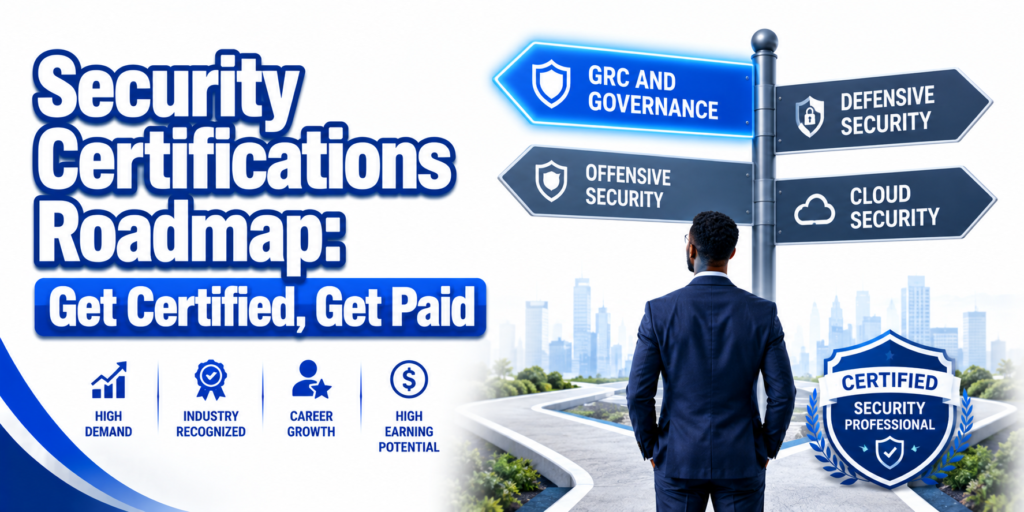
Security Certifications Roadmap: Get Certified, Get Paid
Most people pick cybersecurity certifications the wrong way. They see one on a job posting, study for it, pass it, and then have no idea what to get next. No plan. No sequence. Just hoping it works out.
That approach wastes time and money.
A security certifications roadmap fixes this. It tells you which certifications to get, in what order, at what career stage, and what each one does for your salary and career options. Instead of guessing, you follow a clear sequence that builds on itself.
This guide builds that roadmap specifically for the GRC and information security management path, the most accessible, consistently well-paying track in cybersecurity today.
Table of Contents
Why You Need a Security Certifications Roadmap
The Problem With Choosing Certifications Randomly
There are hundreds of cybersecurity certifications. CompTIA, ISACA, ISC2, OCEG, EC-Council, SANS, all offering credentials at different levels, for different roles, at different prices.
Without a roadmap, most professionals make the same three mistakes.
They chase the most popular certification. CISSP appears on every “top certifications” list. But it requires five years of experience and covers eight broad security domains. Pursuing it without a foundation or the required experience wastes months of preparation.
They collect certifications that do not connect. Security+ followed by CCNP followed by CEH sends three different messages about three different specializations. Employers want to see a clear direction, not a random stack of credentials.
They study for the wrong level. Beginners attempt senior certifications. Experienced professionals spend time on beginner credentials they outgrew years ago. Both miss the mark.
How a Roadmap Saves You Time and Money
A clear cybersecurity certification path does four things well. It matches each certification to your current experience level. It shows you the logical next step. It gives you a realistic cost and timeline. And it connects each credential to the salary and role it opens.
The result is a journey where each certification makes the next one easier and more valuable. You stop adding lines to your resume and start opening actual doors.
Which Path Is Right for You?
Before you build your roadmap, you need to pick your specialization. Cybersecurity has four main career paths. Each has a different day-to-day reality, a different certification sequence, and a different salary trajectory.
The right path is the one that fits what you actually want to do every day, not just what jobs look available right now.
The Four Main Cybersecurity Certification Paths
GRC and Governance Path
GRC stands for Governance, Risk, and Compliance. Professionals on this path design security programs, manage organizational risk, ensure regulatory compliance, and lead security governance at the executive level.
This path is management-focused. The higher you go, the more you work with executives, auditors, regulators, and legal teams. Technical depth here is conceptual, not hands-on.
Who it suits: Professionals from accounting, law, compliance, finance, and IT management. Career changers with strong analytical and communication skills who want security leadership without deep technical work.
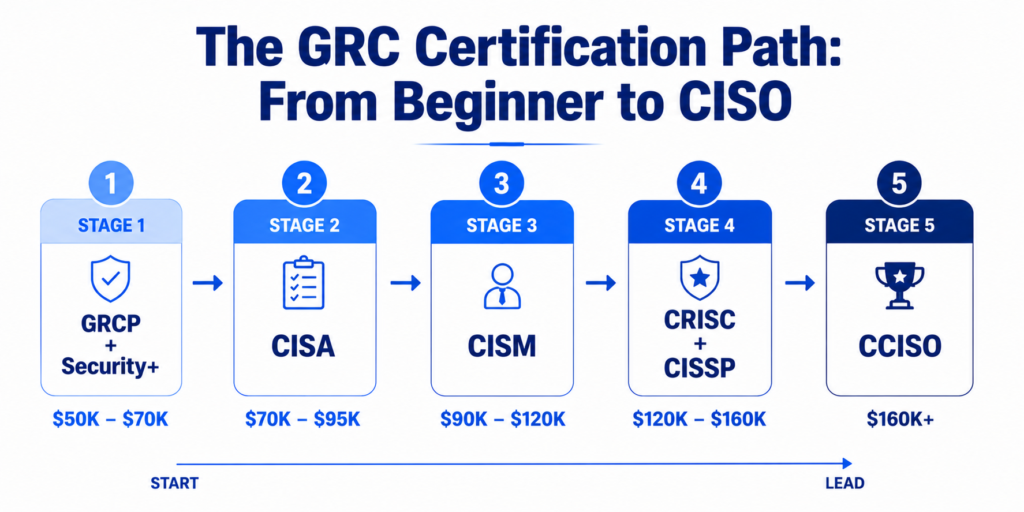
Certification sequence: GRCP → Security+ → CISA → CISM → CRISC → CISO track
Top roles: GRC Analyst, GRC Specialist, Compliance Manager, Information Security Manager, CISO
Defensive Security Path (Blue Team)
Blue team professionals defend organizations from attacks. They monitor networks, analyze threats, investigate incidents, and build detection and response capabilities.
This path is hands-on and tool-heavy. Blue team professionals work with SIEM platforms, endpoint detection tools, and threat intelligence feeds daily.
Who it suits: IT professionals, network administrators, and security analysts who want to specialize in defense and incident response.
Certification sequence: CompTIA A+ → Network+ → Security+ → CySA+ → CASP+ or CISSP
Top roles: SOC Analyst, Security Analyst, Threat Intelligence Analyst, Incident Response Lead, Security Operations Manager
Offensive Security Path (Red Team)
Red team professionals attack systems legally to find vulnerabilities before real attackers do. They run penetration tests, simulate advanced attacks, and help organizations find weaknesses before someone else does.
This is the most technically demanding path. It requires deep knowledge of networking, operating systems, programming, and attack techniques.
Who it suits: IT professionals with strong technical backgrounds who enjoy problem-solving and hands-on technical work.
Certification sequence: Security+ → CEH → OSCP → GPEN → GXPN
Top roles: Penetration Tester, Red Team Analyst, Vulnerability Assessor, Security Researcher
Cloud Security Path
Cloud security professionals protect cloud environments across AWS, Azure, and Google Cloud. As more organizations move to the cloud, this specialization is growing faster than almost any other in cybersecurity.
This path combines cloud architecture knowledge with security principles. Professionals here work closely with DevOps and engineering teams.
Who it suits: IT professionals with cloud infrastructure experience who want to specialize in security. Best for those already working in AWS, Azure, or GCP environments.
Certification sequence: AWS Cloud Practitioner or Azure Fundamentals → Security+ → AWS Security Specialty or AZ-500 → CCSP → CISSP
Top roles: Cloud Security Engineer, Cloud Security Architect, DevSecOps Engineer, Cloud Compliance Manager
Which Path Pays the Most?
Here is an honest comparison of average mid-level earnings across the four paths in the United States:
GRC and Governance: $90,000-$130,000 (mid-level), $149,000+ (senior with CISM) Defensive Security: $85,000-$120,000 (mid-level), $130,000-$170,000 (senior) Offensive Security: $95,000-$140,000 (mid-level), $150,000-$200,000+ (senior specialists) Cloud Security: $110,000-$150,000 (mid-level), $160,000-$220,000+ (senior architect)
Cloud and offensive security command the highest senior-level salaries. But GRC offers the clearest path to executive-level roles because it combines security knowledge with the business strategy and leadership skills organizations value at the C-suite level.
For career changers without deep technical backgrounds, the GRC cybersecurity career roadmap is the most accessible starting point and the most direct route to senior leadership.
The GRC and Information Security Management Roadmap (Detailed)
This is the certification path EMC Institute’s training programs are built around. Here is every stage from zero experience to security leadership, with specific certifications, timelines, and salary ranges at each level.
Stage 1: Foundation (No Experience)
Who this is for: Career changers with no cybersecurity background. Professionals from accounting, law, compliance, finance, IT, or any other field starting fresh.
The goal: Build foundational GRC knowledge and earn your first recognized credential before you have industry experience to show employers.
GRCP (GRC Professional) — OCEG The best starting point for complete beginners on the GRC security certification order. No experience required. Tests foundational knowledge of governance, risk, compliance, ethics, security, and audit. The only widely recognized GRC credential with zero experience requirements.
- Cost: $499/year (OCEG All Access Pass, includes exam and study materials)
- Study time: 6-10 weeks
- Opens doors to: Junior GRC Analyst, Compliance Coordinator, entry-level Risk Analyst
CompTIA Security+ The global baseline for cybersecurity knowledge. Vendor-neutral, widely recognized, and required or preferred in thousands of job postings. It builds your foundational security understanding before you specialize.
- Cost: $392 USD
- Study time: 2-3 months
- Opens doors to: IT Security roles, Security Support Analyst, entry-level GRC positions
Stage 1 total investment: approximately $900 USD Stage 1 timeline: 4-6 months Stage 1 salary range: ₦3-5M Nigeria / $45,000-$65,000 US / £30,000-£45,000 UK
Stage 2: Entry Level (1-3 Years Experience)
Who this is for: Professionals with 1-3 years of experience in GRC, compliance, audit, IT, or information security who want to move into dedicated GRC or security roles.
The goal: Deepen your audit and control knowledge and earn the mid-level credential that most GRC job postings require.
CISA (Certified Information Systems Auditor) — ISACA The most widely recognized GRC-adjacent certification globally. Covers IT systems auditing, control, and assurance. Requires five years of experience for full certification, but you can sit the exam earlier and submit documentation later. The most important mid-level certification on the GRC path.
- Cost: $575 USD (ISACA member) + study materials (~$150-$200)
- Study time: 3-6 months depending on your background
- Opens doors to: GRC Analyst, IT Auditor, Compliance Analyst, Risk Analyst, Security Compliance roles
Stage 2 total investment: approximately $750-$800 USD (plus Stage 1 costs) Stage 2 timeline: 3-6 months of study Stage 2 salary range: ₦5-10M Nigeria / $65,000-$90,000 US / £40,000-£60,000 UK
Stage 3: Mid Level (3-7 Years Experience)
Who this is for: GRC professionals with 3-7 years of experience and CISA who are ready to move into security management with broader program leadership responsibilities.
The goal: Add security management depth and position yourself for senior GRC Specialist and Compliance Manager roles.
CISM (Certified Information Security Manager) — ISACA The senior-level security management credential above CISA on the GRC path. Covers security program design, governance, risk management, and incident leadership. Requires five years of experience including three in security management. Average US salary for CISM holders: $149,000+.
- Cost: $575 USD (ISACA member) + study materials
- Study time: 3-5 months
- Opens doors to: Information Security Manager, Senior GRC Specialist, Security Program Manager, Compliance Director
Stage 3 total investment: approximately $750-$800 USD (plus previous stages) Stage 3 timeline: 3-5 months of study Stage 3 salary range: ₦10-20M Nigeria / $90,000-$130,000 US / £55,000-£85,000 UK
Stage 4: Senior Level (7-10 Years Experience)
Who this is for: Experienced security managers with CISA and CISM who want to specialize in risk management or move toward C-suite security leadership.
The goal: Earn specialist credentials that position you for Director-level and CISO-adjacent roles.
CRISC (Certified in Risk and Information Systems Control) — ISACA The specialist credential for information systems risk management. Covers risk identification, assessment, response, and monitoring. Highly valued in financial services, healthcare, and organizations with complex risk programs.
- Cost: $575 USD (ISACA member) + study materials
- Study time: 3-4 months
- Opens doors to: IT Risk Manager, Senior Risk Analyst, Director of Risk Management, GRC Director
CISSP (Certified Information Systems Security Professional) — ISC2 The broad senior security credential recognized globally. Covers eight security domains. Often listed as required for CISO and Director of Information Security roles. Most valuable for GRC professionals when combined with CISM rather than as a standalone credential.
- Cost: $749 USD + study materials
- Study time: 4-6 months
- Opens doors to: CISO, Director of Information Security, Security Architect, VP of Security
Stage 4 total investment: approximately $1,300-$1,500 USD (plus previous stages) Stage 4 timeline: 6-10 months of study Stage 4 salary range: ₦20-35M Nigeria / $130,000-$180,000 US / £85,000-£120,000 UK
Stage 5: Leadership Level (10+ Years Experience)
Who this is for: Senior security professionals targeting CISO, Chief Risk Officer, or VP of Security roles.
The goal: Combine your certification stack with executive leadership skills that C-suite roles require.
CCISO (Certified Chief Information Security Officer) — EC-Council Built specifically for aspiring and current CISOs. Covers governance, security program management, finance, and strategic planning. Requires five years of management experience across three of the five CCISO domains.
- Cost: approximately $1,000-$1,500 USD including training
- Study time: 3-4 months
- Opens doors to: CISO, VP of Security, Chief Risk Officer
At this stage, certifications alone are not the differentiator. Executive presence, board-level communication, and a track record of leading security programs matter just as much as credentials on paper.
Stage 5 salary range: ₦35-60M+ Nigeria / $180,000-$300,000+ US / £120,000-£200,000+ UK
Security Certifications Roadmap: Cost and Timeline
Total Cost of the GRC Certification Path
Here is the full cost of the GRC security certifications roadmap from Stage 1 to Stage 4:
| Stage | Certifications | Approximate Cost |
| Foundation | GRCP + Security+ | ~$900 USD |
| Entry Level | CISA | ~$750-$800 USD |
| Mid Level | CISM | ~$750-$800 USD |
| Senior Level | CRISC + CISSP | ~$1,300-$1,500 USD |
| Total | Full GRC path | ~$3,700-$4,000 USD |
This covers study materials and exam fees only. Paid training courses add $500-$2,000+ per certification depending on your choices.
Spread over 8-10 years of career development, the full GRC path costs approximately $400-$500 per year on average. Against the salary increases each stage unlocks, that is a strong return.
Realistic Timeline From Beginner to Senior
| Stage | Experience Needed | Study Time | Total Time at Stage |
| Foundation | None | 4-6 months | 1-2 years |
| Entry Level | 1-3 years | 3-6 months | 2-4 years |
| Mid Level | 3-7 years | 3-5 months | 3-4 years |
| Senior Level | 7-10 years | 6-10 months | 2-3 years |
The full journey from beginner to senior security leader typically takes 8-12 years. That is not unusual for a leadership-level career. Lawyers, doctors, and senior accountants follow similar timelines. The roadmap makes sure every year of that journey moves you forward on purpose, not by accident.
How to Budget Your Certification Journey
Do not try to fund the entire roadmap at once. Budget one stage at a time.
Stage 1 costs approximately $900-$1,200 USD including study materials. Each subsequent stage runs $750-$1,500 depending on whether you self-study or use paid training.
Many employers partially or fully reimburse certification costs. Check your employer’s professional development policy before paying out of pocket. If reimbursement is not available, treat certification costs as a career investment that typically pays back through salary increases within months of passing.
Security Certifications Roadmap by Background
Your background affects which certifications to prioritize and how fast you move through each stage.
If You Come From IT or Technology
You already understand IT systems, networks, and basic security concepts. Security+ will feel manageable because you recognize the underlying technology.
Your fastest path: Start with GRCP if you want the GRC track, or go straight to Security+ for the technical track. Move to CISA within 12-18 months. Your IT background gives you an advantage in CISA’s technical domains.
Where to focus: Domains 3 and 4 of CISA (IT development and operations) will feel familiar. Spend more time on Domain 1 (audit methodology) and Domain 2 (governance), where IT professionals typically have gaps.
If You Come From Accounting or Finance
Your analytical skills, control assessment mindset, and regulatory familiarity map directly to GRC work. CISA’s audit methodology content aligns closely with financial audit thinking.
Your fastest path: GRCP first to build security vocabulary, then CISA within 12 months. Your accounting background makes CISA’s governance and control domains more accessible than for most candidates.
Where to focus: Domains 3 and 4 will need more time since IT operations and systems development are less familiar. Build basic IT literacy before sitting CISA.
If You Come From Law or Compliance
Legal and regulatory knowledge transfers well to GRC work. You already understand how compliance frameworks operate, how audits work, and how organizations manage regulatory risk.
Your fastest path: GRCP first to formalize your GRC knowledge, then CISA. Domain 2 (governance) will feel intuitive. Domain 1 (audit methodology) builds on the legal reasoning skills you already have.
Where to focus: Technical domains (Domains 3 and 4) need investment. GRCP’s broad coverage helps bridge the gap before you sit CISA.
If You Have No Technical Background
The path is longer but absolutely achievable. The GRC track is built for professionals who bring analytical, communication, and organizational skills rather than technical depth.
Your fastest path: GRCP first (no experience required), then 3-6 months of basic IT literacy through free resources like Google’s IT Support Professional Certificate on Coursera and ISACA’s free learning materials, then Security+ and CISA.
Where to focus: Do not rush Stage 1. GRCP plus 6 months of IT literacy building creates a much stronger CISA foundation than jumping straight to CISA unprepared.
Global Salary Data by Certification Stage
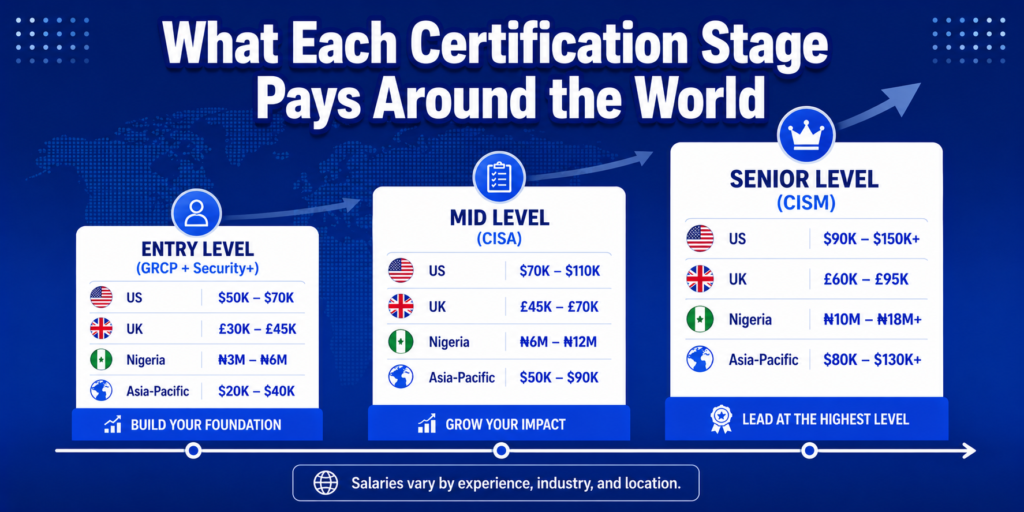
Here is honest salary data across key global markets at each stage of the GRC best cybersecurity certifications path.
Entry Level (GRCP + Security+)
United States: $45,000-$65,000 annually. Major market roles (New York, Washington DC, San Francisco) sit at the higher end.
United Kingdom: £30,000-£45,000 annually. London and financial sector roles pay above this range.
Nigeria: ₦3-5M annually. Banking, fintech, and multinational employers pay above market. Remote roles with international companies reach $1,500-$2,500 monthly.
Asia-Pacific: $35,000-$55,000 USD equivalent annually in Singapore and Australia.
Mid Level (CISA Certified)
United States: $85,000-$110,000 annually. Financial services, healthcare, and government sectors pay at the top of this range.
United Kingdom: £50,000-£75,000 annually. GDPR-focused compliance roles in London reach the higher end.
Nigeria: ₦8-15M annually. Senior GRC Analysts and IT Auditors in financial institutions earn above this range. Remote international roles reach $3,000-$5,000 monthly.
Asia-Pacific: $65,000-$95,000 USD equivalent annually.
Senior Level (CISM Certified)
United States: $149,000+ annually according to ISACA. Senior Information Security Managers and Directors regularly earn $170,000-$220,000 in major markets.
United Kingdom: £75,000-£120,000 annually. CISO-adjacent roles in London reach £130,000+.
Nigeria: ₦15-30M annually for mid-senior roles. Executive-level and multinational employers reach ₦30-50M+. Remote senior roles with international organizations reach $5,000-$10,000+ monthly.
Asia-Pacific: $90,000-$150,000 USD equivalent annually.
Common Mistakes People Make With Security Certifications
Getting certifications in the wrong order. CISSP before Security+. CISM before CISA. Senior certifications before foundational ones. Each certification builds on the last. Skipping stages means studying content you do not have the context to understand.
Choosing based on popularity rather than career fit. CISSP is the most recognized certification in cybersecurity. It is also built for broad senior security professionals, not GRC specialists specifically. Choosing CISSP over CISM because it sounds more impressive is like getting a general business degree when you need an accounting qualification.
Ignoring experience requirements. CISA and CISM both require five years of experience. Many candidates pass the exam and then find their experience documentation does not qualify. Map your work history to the certification requirements before you register, not after you pass.
Studying for the exam instead of the job. The goal is not to pass an exam. The goal is to do the work. Candidates who memorize answers without building real understanding often struggle to apply what they learned once they are in a role. Study for mastery, not for the score.
Not using certifications in career conversations. Passing a certification is half the work. The other half is using it to have a direct conversation with your manager or a target employer about what it means for your responsibilities and your pay. Certifications that sit on a resume without career conversations attached deliver half the value they could.
Your Next Step: Building Your Personal Roadmap
A security certifications roadmap only works if you act on it. Here is how to build yours in the next 48 hours.
Step 1: Identify your current stage. Zero experience (Stage 1), 1-3 years (Stage 2), 3-7 years (Stage 3), or 7+ years (Stage 4)?
Step 2: Check your current certifications. Where are you already on the roadmap? What is the logical next credential?
Step 3: Map your experience to the next certification’s requirements. Targeting CISA? Does your work history qualify? Targeting CISM? Do you have three years of security management experience?
Step 4: Choose your study timeline based on your background. IT professionals targeting CISA: 3-4 months. Compliance professionals: 4-5 months. Career changers: 5-6 months or more.
Step 5: Start. Register at isaca.org. Download the free exam content outline. Block study time in your calendar this week.
The professionals who advance fastest are not the ones who plan the longest. They are the ones who start earliest and stay consistent.
If you want a structured program that builds the foundational GRC and information security knowledge that makes certification study faster, EMC Institute’s cybersecurity training covers the GRCP certification, CISA exam preparation, and CISM certification pathways in a structured sequence. You build real knowledge before you sit each exam, which makes every stage more manageable and every career move more intentional. Watch the free VSL to see how EMC Institute’s training connects to this roadmap and whether it fits your current career stage.
The roadmap is in front of you. The next step is yours to take.
Which Security Certificate Is Best?
The best security certificate depends entirely on your career stage and specialization. For beginners with no experience, the GRCP from OCEG is the most accessible entry point into GRC and governance careers, while CompTIA Security+ is the best foundation for any cybersecurity path. For mid-level professionals in GRC, audit, or compliance, CISA from ISACA is the most widely recognized and valued certification in job postings globally. For senior professionals moving into security management and leadership, CISM from ISACA is the strongest credential, with an average US salary of $149,000+ for holders. For technical security professionals, CISSP from ISC2 is the gold standard for broad senior security roles. There is no single best certificate. The best one is the one that matches your current experience level, your target career path, and the specific roles you are applying for.
What Are the 7 Layers of Security?
The seven layers of security refer to a defense-in-depth model that protects organizations at multiple levels simultaneously. The seven layers are: physical security (controlling who can physically access systems and buildings), network security (firewalls, intrusion detection, and network monitoring), perimeter security (protecting the boundary between internal systems and the outside world), endpoint security (protecting individual devices like laptops and phones), application security (securing software and applications from vulnerabilities), data security (encrypting and protecting sensitive data at rest and in transit), and human security (training employees to recognize threats like phishing and social engineering). No single layer provides complete protection. The power of this model is that if one layer fails, the others continue to protect the organization. GRC professionals are responsible for designing and overseeing programs that address all seven layers through governance frameworks, risk assessments, and compliance monitoring.
What Are the Types of Security Certifications?
Security certifications fall into five main categories. Foundational certifications (CompTIA Security+, ISC2 CC) build the baseline knowledge every cybersecurity professional needs regardless of specialization. GRC and governance certifications (GRCP, CISA, CISM, CRISC) cover governance, risk management, compliance, and security program leadership. Technical security certifications (CEH, OSCP, GPEN) cover offensive security, penetration testing, and ethical hacking. Defensive security certifications (CySA+, CASP+, GCIH) cover threat detection, incident response, and security operations. Cloud security certifications (CCSP, AWS Security Specialty, AZ-500) cover securing cloud environments across major platforms. Within each category, certifications exist at different levels from entry to advanced. The right category depends on your chosen specialization. The right level within that category depends on your current experience.
What Is the Roadmap for Cybersecurity Certification in 2026?
The cybersecurity certification roadmap in 2026 follows the same fundamental stages as previous years but with growing emphasis on AI security, cloud compliance, and privacy regulations. For GRC professionals, the recommended sequence remains GRCP (foundation, no experience required) → CompTIA Security+ (baseline technical knowledge) → CISA (mid-level audit and control) → CISM (senior security management) → CRISC or CISSP (senior specialization). For technical security professionals, the path runs from Security+ → CySA+ (defensive) or CEH and OSCP (offensive). For cloud security professionals, foundational cloud certifications (AWS Cloud Practitioner, Azure Fundamentals) lead to security specializations (AWS Security Specialty, CCSP). In 2026, privacy and AI governance certifications are growing in importance as GDPR enforcement intensifies globally and organizations begin governing AI systems. Professionals who add OneTrust or privacy-specific credentials alongside their core GRC certifications are particularly well positioned in markets with strong data protection regulations.
How Long Does It Take to Complete a Cybersecurity Certification Roadmap?
The full cybersecurity certification roadmap from beginner to senior security leader typically takes 8-12 years, but meaningful career advancement happens much earlier. The foundation stage (GRCP and Security+) takes 4-6 months of study and positions you for entry-level roles within the first year. CISA preparation adds 3-6 months of study and, combined with 1-3 years of experience, opens mid-level GRC and audit roles. CISM adds another 3-5 months of study and, combined with security management experience, opens senior roles. The full timeline is not about waiting. It is about progressing deliberately at each stage, building experience alongside certifications rather than pursuing credentials in isolation. Career changers who start with GRCP and commit to consistent progression typically reach mid-level GRC roles within 2-3 years and senior roles within 5-7 years. The roadmap is long, but each stage delivers career and salary results before you reach the end of it.