
 English
 Arabic
 English
 French
 German
CISM Certification: The Credential Serious Leaders Get
You have been working in information security or GRC for a few years. You have seen CISM certification on senior job postings and LinkedIn profiles of people running security programs. You know it matters. But nobody has given you a straight answer on whether it is right for you, what it costs, or how to actually pass it.
This guide does that.
Table of Contents
What Is the CISM Certification?
What CISM Actually Proves
CISM stands for Certified Information Security Manager. It proves you can govern an enterprise security program, manage information security risk, build and run security programs, and lead incident response.
The key word is manage. CISM is not a technical certification. It does not test whether you can configure firewalls or run penetration tests. It tests whether you can lead the people who do. Whether you can make strategic risk decisions. Whether you can align a security program with business goals.
That leadership focus is what separates CISM from technical credentials and what makes it valuable at the senior level.
Who Issues CISM and Why It Matters
CISM is issued by ISACA, the same organization behind CISA. ISACA has been setting global standards for IT audit, control, and security since 1969.
More than 100,000 professionals worldwide hold the CISM certification. Employers in the US, UK, Europe, Nigeria, and across Asia-Pacific understand what it means without needing an explanation from you.
CISM confirms your ability to assess risks, implement effective governance, and lead incident response. As AI and blockchain reshape the security landscape, it also signals that your skills keep pace with where the industry is going.
Who Should Pursue CISM
CISM is built for professionals who manage or want to manage information security programs. If you work in one of these roles, CISM is probably your next step:
- Information Security Manager or Director
- GRC Manager or Senior GRC Specialist
- IT Risk Manager
- Security Program Manager
- Compliance Manager with security oversight responsibilities
- IT Manager moving into security leadership
- Senior Security Analyst targeting management roles
If your work involves making risk decisions, overseeing security programs, managing security teams, or reporting security posture to leadership, CISM is built for you.
Who Should Wait
CISM is not an entry-level certification. It requires at least five years of work experience in information security, with three of those years in security management specifically.
If you are early in your career with fewer than three years of relevant experience, build your foundation first. The CISA certification and the GRCP from OCEG are more appropriate starting points. CISM makes the most sense once you have real management experience, not just technical security knowledge.
If you work purely in technical cybersecurity (penetration testing, malware analysis, red teaming) with no management responsibilities, CISM is not the right fit yet. Build that management experience first, then revisit.
CISM Exam Structure
Questions, Time, and Format
The CISM exam has 150 multiple-choice questions. You have four hours to complete it.
Questions are scenario-based. ISACA presents real management situations and asks you to choose the best course of action from a security manager’s perspective. The focus is on strategic thinking and risk-based decisions, not technical details.
The exam uses a 200-800 scaled scoring system. The passing score is 450. Scaled scoring means your raw correct answers are converted before being compared to the passing threshold, so it does not translate directly to a percentage.
The exam is available globally at PSI testing centers and via online proctoring. Once registered, you have a six-month window to schedule and sit it.
The Four CISM Domains and Their Weightings
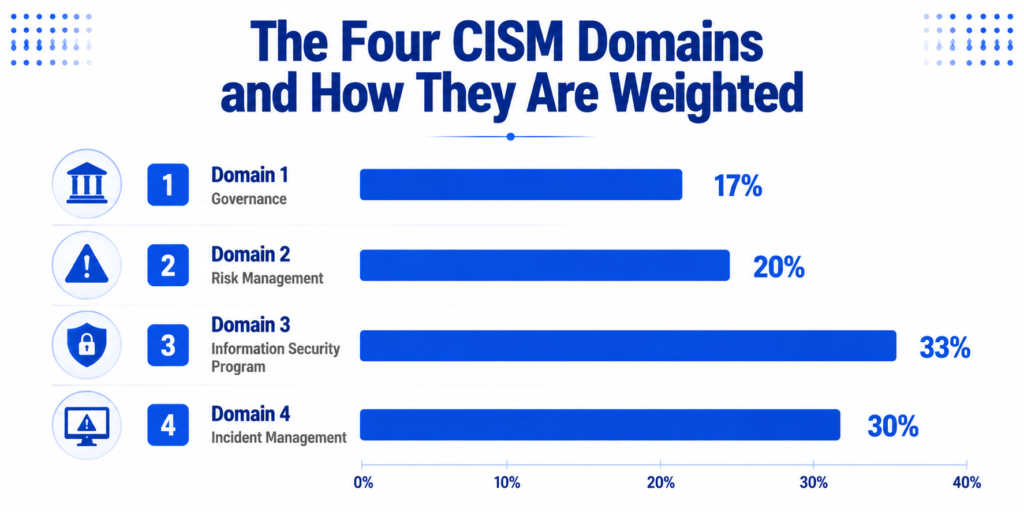
CISM covers four domains. Each carries a specific percentage of total exam questions.
Domain 1: Information Security Governance — 17% Domain 2: Information Security Risk Management — 20% Domain 3: Information Security Program — 33% Domain 4: Incident Management — 30%
Domain 3 is the heaviest at 33%. Domain 4 follows at 30%. Together they make up 63% of the exam. If your study time is limited, start with these two.
CISM Pass Score and What It Means
Scoring consistently above 70-75% on practice questions before exam day is a reliable sign you are ready. The exact conversion from practice scores to scaled scores varies, but candidates who hit that range typically pass.
ISACA does not publish a global first-attempt pass rate for CISM. Industry communities report it is broadly similar to CISA, around 50-60%. The most common reason candidates fail is applying technical security thinking instead of management and governance thinking. CISM rewards the manager’s perspective, not the engineer’s.
CISM vs CISA vs CISSP: Which Comes First?
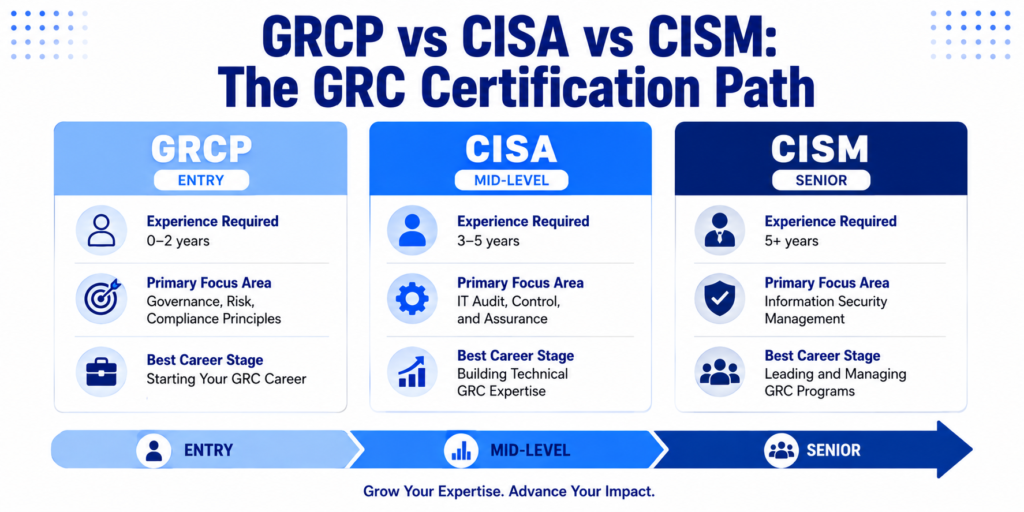
This is the question most professionals searching for CISM certification actually want answered. Here is a clear comparison.
CISA (Certified Information Systems Auditor) Issued by ISACA. Mid-level. Focuses on IT systems auditing, control, and assurance. Requires five years of experience. The most widely recognized GRC-adjacent certification in job postings globally. Best for audit, compliance, and risk professionals moving into GRC leadership.
CISM (Certified Information Security Manager) Issued by ISACA. Senior-level. Focuses on security management, governance, risk, and incident leadership. Requires five years of experience including three in management. Best for security managers and GRC leaders moving toward CISO-level roles.
CISSP (Certified Information Systems Security Professional) Issued by ISC2. Broad security operations across eight domains. CISM emphasizes management and strategy. CISSP emphasizes operations and threat response. Best for technical security professionals moving into security architecture or senior engineering roles.
The sequence most GRC professionals follow:
GRCP → CISA → CISM
CISA builds the audit and control foundation. CISM builds the security management and governance layer on top. Professionals who hold CISA before sitting CISM consistently find the content more intuitive because the frameworks and risk thinking are already familiar.
When CISSP comes before CISM: If your background is deeply technical (security engineering, architecture, operations) and you are moving into management, CISSP then CISM is a reasonable path. CISSP builds technical breadth. CISM adds the management layer.
When CISM comes before CISA: If you already work as a security manager with significant program management experience but limited formal audit background, CISM can come first. Let your experience guide the order, not a rigid sequence.
CISM Certification Requirements
The Five-Year Experience Requirement
CISM requires at least five years of professional work experience across the CISM job practice areas: information security governance, risk management, program development, and incident management. All five years must fall within the 10 years before your certification application date.
Three of those five years must be management experience. That requirement is firm.
General IT experience without a security management component does not qualify. You need to have actually managed security programs, teams, or risk decisions, not just participated in them.
You can sit the exam before completing your experience. After passing, you have five years to submit documentation and receive full CISM certification.
Experience Waivers and Substitutions
ISACA allows up to two years of substitution for CISM, though the waivers are less flexible than for CISA.
- One year for a bachelor’s or master’s degree in information security, information systems, or a related field
- One year for credentials including CISA, CISSP, or other ISACA-recognized certifications
The three-year management requirement cannot be waived or substituted. No degree or credential replaces it. If you do not have it, you need to build it before applying for full certification.
How to Register for the CISM Exam
Step 1: Create or log in to your account at isaca.org.
Step 2: Apply for the CISM exam and pay the registration fee. ISACA member rate is $575 USD. Non-member rate is $760 USD. Membership costs $135/year.
Step 3: Receive your authorization to test (ATT), which gives you a six-month window to schedule and sit the exam.
Step 4: Schedule through PSI at a testing center or via online proctoring.
Step 5: Sit the exam. Results are available immediately after completion.
Global Exam Availability
The CISM exam is available globally through PSI testing centers and online proctoring. For candidates in Nigeria, South Africa, Kenya, and across Africa, online proctoring is the most practical option.
You need a stable internet connection, a quiet private space, and a computer with a working webcam and microphone. Full requirements are in ISACA’s candidate guide on isaca.org.
The Four CISM Domains Explained Simply
Domain 1: Information Security Governance (17%)
This domain covers how security programs are aligned with business objectives and governed at the organizational level.
Topics include building and maintaining a security governance framework, defining security strategy, developing security policies and standards, and ensuring security governance aligns with business goals and regulatory requirements.
If you work in GRC, this domain will feel familiar. The difference is the security-specific lens. You are not governing organizational risk in general. You are governing information security and connecting it directly to business strategy.
Key concepts: Security governance frameworks, information security strategy, security policy development, governance reporting to leadership.
Domain 2: Information Security Risk Management (20%)
This domain covers how security risks are identified, assessed, prioritized, and managed across the organization.
Topics include risk identification and assessment, risk treatment options (accept, mitigate, transfer, avoid), risk monitoring and reporting, and integrating risk management with business decisions.
Professionals with CISA or GRC program experience will find the concepts familiar. The CISM angle emphasizes how risk decisions are communicated to business leadership and used in strategic decision-making, not just documented in registers.
Key concepts: Risk assessment methodologies, risk treatment strategies, risk appetite and tolerance, risk reporting to executives.
Domain 3: Information Security Program (33%)
This is the highest-weighted domain at 33%. It covers the design, development, and management of information security programs.
Topics include security program development, security awareness and training programs, security metrics and performance measurement, managing security resources, and aligning security programs with business needs.
This is where CISM’s management focus is clearest. You are not understanding security concepts in isolation. You are managing programs, allocating resources, measuring effectiveness, and reporting outcomes to people who make business decisions.
Key concepts: Security program development, security awareness design, security metrics and KPIs, resource management, program governance.
Domain 4: Incident Management (30%)
The second highest-weighted domain at 30%. It covers how organizations prepare for, detect, respond to, and recover from security incidents.
Topics include incident management planning, incident detection and classification, response procedures, post-incident review, and business continuity and disaster recovery integration.
The CISM perspective on incident management is a leadership one. You are not the analyst running the alert queue. You are the manager who designed the incident response plan, leads the response team, communicates with executives during active incidents, and runs the post-incident review that prevents the next one.
Key concepts: Incident response planning, incident classification, crisis communication, business continuity, disaster recovery, post-incident improvement.
Which Domain to Study First?
Start with Domain 1. The governance mindset it builds frames everything else in the exam. Understanding how security connects to business strategy makes every other domain make more sense.
After Domain 1, move to Domain 3 (33%) then Domain 4 (30%). These two together cover 63% of the exam. Getting them right matters more than anything else for your score.
Study Domain 2 alongside Domain 3 since risk management and program management connect closely in practice.
Recommended study order: Domain 1 → Domain 3 → Domain 4 → Domain 2 → Review Domain 1.
CISM Certification Cost: What You Will Actually Pay
Exam Fee and Membership
The CISM exam registration fee is $575 USD for ISACA members and $760 USD for non-members. ISACA membership costs $135/year.
Becoming a member before registering saves $50 on the exam fee and gives you access to ISACA’s study resources, community forums, and discounted continuing education materials. If you plan to pursue and maintain CISM certification with ongoing CPE credits, membership pays for itself quickly.
Study Material Costs
CISM Review Manual: ISACA’s official study guide. Approximately $79-$119 depending on format. Non-negotiable.
CISM QAE Database: ISACA’s official practice question bank. Available standalone or bundled with the Review Manual. Approximately $99-$149.
Third-party courses: Mike Chapple publishes courses on Udemy ($15-$30) and LinkedIn Learning ($30/month). Structured programs from Simplilearn and Infosec Institute range from $299-$999+.
Total Budget
Minimum (self-study, ISACA member):
- Membership: $135
- Exam fee: $575
- Review Manual + QAE bundle: ~$150-$200
- Total: approximately $860-$910 USD
With structured training (non-member, paid course):
- Exam fee: $760
- Study materials: ~$200
- Paid course: $300-$1,000+
- Total: approximately $1,260-$1,960 USD
Costs range from under $600 to several thousand dollars depending on your ISACA membership status and which study materials and courses you choose.
How to Prepare for the CISM Exam
Official ISACA Study Materials
Two resources are non-negotiable for CISM exam preparation.
CISM Review Manual: The official study guide covering all four domains. Read it fully at least once, then use it as a reference while working through practice questions.
CISM QAE Database: ISACA’s official practice question bank, written by the same team that writes the actual exam. Work through all of them at least once. Read every explanation, including the ones you got right.
Candidates with strong relevant management experience who use only these two resources consistently pass.
Free Resources Worth Using
ISACA exam content outline: Free on isaca.org. Download it before you open the Review Manual. It shows exactly how the exam is weighted across the four domains and tells you where to focus.
ISACA online community forums: Free for members. Real candidate experiences across many exam sittings. Useful for understanding how questions are framed and which topics come up most.
YouTube: Several CISM instructors publish free domain overviews. Good for building conceptual understanding before working through the denser Review Manual.
Paid Courses: When They Are Worth It
Paid courses add the most value when you are new to security management concepts or when you have already failed one attempt and need a more structured approach.
Mike Chapple (Udemy/LinkedIn Learning): Most consistently recommended CISM instructor. Covers all four domains clearly. Best for professionals who want structured domain coverage without a full training program price tag.
Simplilearn CISM Training: More expensive but includes instructor support and a guided learning experience. Worth it if you prefer live instruction or external accountability.
Your CISM Study Plan
Months 1-2: Foundation Read the CISM Review Manual at 2-3 chapters per week. Understand concepts over memorizing them. Start practice questions by end of Month 1 at 50-100 per week. Target by Month 2: Full Review Manual read. 300+ practice questions done. Scoring above 65% consistently.
Month 3: Deep Domain Work Focus on Domain 3 (33%) and Domain 4 (30%). Complete 400+ practice questions on these two domains. Return to Review Manual chapters where your scores fall below 70%.
Month 4: Integration and Final Preparation Mixed practice questions across all four domains. Target 600+ questions this month. Complete full timed practice exams (150 questions in 4 hours). Target: 75%+ consistently before you schedule the real exam.
Realistic timelines by background:
- Security managers with direct experience: 3-4 months
- GRC professionals moving into security management: 4-5 months
- Professionals with limited management background: 5-6 months
All timelines assume 8-10 hours of study per week.
What CISM Does for Your Career and Salary
CISM Salary Data Across Global Markets
According to ISACA, the average salary of CISM certification holders in the United States is more than $149,000 per year. Senior security managers and directors with CISM regularly earn $170,000-$220,000 in major markets. CISM holders consistently out-earn CISA holders at equivalent seniority levels because the credential targets a higher management tier.
In the United Kingdom, CISM holders earn £75,000-£110,000 annually at mid to senior level. London roles and CISO-adjacent positions reach £120,000+.
In Nigeria, CISM-certified professionals earn well above market average. Senior security managers and GRC leaders with CISM earn ₦15-30M annually. Executive-level roles and multinational employers reach ₦30-50M+. Banks, fintechs, and insurance companies pay at the top of this range.
Remote roles for Nigerian and African CISM holders working with international organizations often reach $5,000-$10,000+ monthly for experienced professionals.
In Asia-Pacific (Singapore, Australia, India), CISM holders earn $90,000-$150,000 USD equivalent annually. Financial services, technology, and government sectors drive the strongest demand.
Job Titles That List CISM
CISM appears most in job postings for:
- Information Security Manager
- Senior GRC Manager
- Security Program Manager
- IT Risk Manager
- Chief Information Security Officer (CISO) and Deputy CISO
- Director of Information Security
- Security Governance Lead
- Cybersecurity Compliance Director
At the senior and executive level, CISM certification is increasingly listed as required rather than preferred. Organizations building security leadership teams treat it as the baseline credential for managers who own the security function.
Where CISM Fits in Your GRC Certification Path
CISM is the senior-level credential in the GRC and security certification sequence.
If you are new to GRC, start with the GRCP certification from OCEG and build toward CISA. These establish the foundational knowledge and mid-level audit depth that makes CISM more accessible and more impactful when you reach it.
Once you hold CISA and have three or more years of security management experience, CISM is the natural next step. It broadens from audit-focused thinking to program leadership and strategic governance.
After CISM, professionals targeting C-suite roles often pursue CRISC (Certified in Risk and Information Systems Control) for deeper risk management specialization, or move directly toward CISO roles using CISM as the primary leadership credential.
Full recommended path: GRCP → CISA exam preparation → CISM → CRISC or CISO track
How Long After Passing Until You See Career Results
Career results from CISM typically appear within three to six months of passing.
Months 1-2: Update your resume and LinkedIn. Apply for senior roles listing CISM as required or preferred. You immediately become competitive for positions that previously required credentials you did not hold.
Months 2-4: Interview volume at senior and director level increases. CISM signals leadership readiness in a way technical certifications do not. Salary negotiations become stronger because CISM is widely recognized as a senior credential.
Months 4-6: For professionals already in security management or GRC leadership roles, CISM supports promotion conversations to Director, VP, or CISO-adjacent positions. It is often the credential that turns a strong candidate into the right hire.
Final Thoughts: Is CISM the Right Next Step for You?
CISM is a senior credential for professionals who lead security programs, not just contribute to them. If you manage security teams, make risk decisions that affect the organization, design security programs, or report security posture to executives, CISM validates exactly what you do.
If you are still building toward management experience, invest in CISA and hands-on program work first. CISM is most powerful when the experience behind it is real.
CISM holders earn above-average salaries globally, hold a recognized credential across more than 180 countries, and are consistently among the strongest candidates for senior security leadership roles.
If you want structured training that builds the security governance, risk management, and program leadership knowledge that makes CISM certification preparation faster and more effective, EMC Institute’s cybersecurity training programs offer a clear pathway. The CISA exam preparation pathway and the broader GRC training sequence build the foundation that CISM sits on, giving you a structured progression from foundational GRC knowledge to senior security leadership credentials. Watch the free VSL to see how EMC Institute’s training connects to the full GRC and security certification path.
The path to CISM is clear. The question is whether your experience is ready to meet it.
How Much Does CISM Cost?
The CISM exam registration fee is $575 USD for ISACA members and $760 USD for non-members. ISACA membership costs $135 per year, so becoming a member before registering saves you $50 on the exam fee and gives you access to study resources and community forums. Beyond the exam fee, you should budget for study materials. The CISM Review Manual costs approximately $79-$119 depending on format, and the official QAE practice question database costs approximately $99-$149. If you choose a paid prep course from providers like Simplilearn or Mike Chapple on Udemy, add another $15-$999 depending on the platform and level of instruction. Total preparation costs typically range from $860-$910 USD for self-study ISACA members to $1,260-$1,960 USD for non-members using structured training courses. Maintaining CISM after passing also requires ongoing continuing education (CPE) credits, which may carry additional costs depending on how you fulfill them.
Is CISM Harder Than CISSP?
Most candidates who have sat both report that CISM and CISSP are comparable in overall difficulty but test very different things. CISM focuses on security management, governance, risk, and incident leadership. It asks what a security manager would decide strategically. CISSP covers eight broad security domains including cryptography, network security, software development security, and identity management. It goes wider and more technically deep. Candidates from GRC and compliance backgrounds typically find CISM more manageable because the management and governance thinking aligns with their daily work. Candidates from technical security backgrounds often find CISSP more natural because the content maps to hands-on security operations. The harder exam is usually whichever one is furthest from your existing experience. For GRC professionals, CISM is generally the more accessible of the two.
Is CISM Difficult to Pass?
CISM is a challenging exam with a first-attempt pass rate of approximately 50-60% based on industry community reports. The difficulty comes less from the content volume and more from the type of thinking the exam requires. ISACA writes scenario-based questions that test management judgment, not technical recall. Candidates who approach the exam thinking like a security engineer rather than a security manager often find themselves choosing technically correct answers that are not the best managerial answer. The most effective preparation combines the CISM Review Manual with 1,000+ practice questions and deliberate focus on understanding why ISACA chooses certain answers, not just memorizing what they are. Candidates with real security management experience who give themselves 3-5 months of consistent preparation typically pass on their first attempt. Rushing the timeline or skipping practice questions are the two most common reasons candidates fail.
Is CISM Higher Than CISA?
Yes, CISM is generally considered a more senior credential than CISA, though they test different skill sets rather than one being strictly above the other. CISA focuses on IT systems auditing, control, and assurance. It is a mid-level credential widely recognized in GRC, compliance, and audit roles. CISM focuses on information security management, governance, program leadership, and incident response. It targets senior security managers and professionals moving toward CISO-level roles. In terms of average salary, CISM holders earn more than CISA holders at equivalent seniority levels. ISACA reports the average US salary for CISM holders is more than $149,000, while CISA holders average around $110,000+. In terms of career stage, CISA is typically pursued first as a foundational GRC credential, with CISM following once you have built security management experience. The recommended path for most GRC professionals is GRCP first, then CISA, then CISM