
 English
 Arabic
 English
 French
 German
GRCP Certification: The Honest Guide to Getting Certified
If you have been researching GRC certifications, you have probably seen GRCP come up. It appears on job postings, LinkedIn profiles, and certification lists. But most articles either sell it to you or bury it in a list of ten certs without explaining anything useful.
This guide gives you the full picture. What the GRCP certification actually is, who it is for, what it costs, how to study for it, and whether it is worth your time and money.
No sales pitch. Just straight answers.
Table of Contents
What Is the GRCP Certification?
The Simple Definition
GRCP stands for GRC Professional. It is a certification that proves you understand governance, risk, and compliance at a foundational level and can apply GRC principles across an organization.
It is not a technical security certification. It is not a legal one either. It sits in the middle, covering governance, strategy, performance, risk, compliance, ethics, security, privacy, and audit.
That breadth is its strength. It is also why some people underestimate it.
Who Issues GRCP and Why That Matters
GRCP is issued by OCEG, the Open Compliance and Ethics Group. OCEG created the GRC Capability Model, the foundational framework that defines how GRC programs are designed and measured globally.
This matters. GRCP is not a vendor badge or a training company certificate. It is issued by the organization that wrote the standard the entire GRC profession is built on. When you pass the GRCP exam, you are being tested against that same standard. The one organizations worldwide use to design and evaluate their GRC programs.
What the Certification Actually Proves
GRCP proves that you understand GRC as a connected system, not just one slice of it.
Most early-career professionals know one area: compliance, or risk, or audit. GRCP tests whether you understand how all of those connect. Governance to risk. Risk to compliance. Compliance to ethics and audit. That integrated view is what organizations need from mid-level GRC professionals and above.
Why the No-Experience Requirement Changes Everything
Here is the detail most articles skip: the GRCP has no minimum experience requirement.
CISA requires five years of relevant experience. CISM also requires five years. GRCP requires none.
That makes it one of the only credible GRC certifications a career changer can earn without prior industry experience. You do not need work history to sit the exam. You need knowledge of the GRC Capability Model, and that knowledge is fully learnable from OCEG’s study materials.
For someone moving into GRC from accounting, IT, law, or any other field, this is a real advantage.
Who Is the GRCP Certification For?
OCEG identifies three types of professionals who get the most value from GRCP. Understanding which one you are helps you decide how and when to pursue it.
The Career Starter (No GRC Background)
If you are new to GRC and want a credential that proves foundational knowledge, GRCP is the most accessible entry point available.
A career changer who has studied GRC concepts, understands the Capability Model, and can demonstrate applied knowledge across governance, risk, and compliance can earn GRCP without prior industry experience. No other widely recognized GRC certification allows this.
Real example: A compliance coordinator at a Nigerian bank with three years in regulatory reporting but no formal GRC certification uses GRCP as their entry credential. It validates their knowledge base and opens doors to GRC Analyst positions they could not previously compete for.
The Career Enhancer (Already Working in GRC or Adjacent Fields)
If you work in audit, security, compliance, risk, or IT and want to broaden your GRC knowledge, GRCP adds real value.
Many professionals in these fields know one area deeply but have limited exposure to how GRC operates as a whole. GRCP fills that gap. It gives audit professionals context for governance and risk. It gives security professionals context for compliance and ethics. It gives compliance professionals context for how their work connects to organizational strategy.
Real example: A cybersecurity analyst at a South African fintech company holds CompTIA Security+ but struggles to connect security work to compliance and risk conversations. After earning GRCP, they speak credibly across all three pillars and move into a GRC Specialist role within eighteen months.
The Career Capstone (Experienced Professional Pulling It All Together)
For senior professionals who already hold CISA, CISM, or CRISC, GRCP works as an integrating credential.
It provides the overarching GRC framework that ties everything together. OCEG describes this as using GRCP to cohesively pull everything into a framework and methodology. Professionals at this level often find GRCP changes how they think about existing work more than it adds new knowledge.
Real example: A GRC Manager in the UK holds CISA and CISM but their team struggles to connect audit findings to risk decisions and governance policies. After earning GRCP, they redesign the team’s reporting structure around the GRC Capability Model, producing clearer risk communication and faster executive decisions.
Who Should NOT Get GRCP First
Most articles do not answer this honestly. Here it is.
If you already hold CISA or CISM and have five or more years of GRC experience, GRCP adds limited value as a standalone credential. At that stage, it works better as a capstone than a primary certification.
If you work purely in technical cybersecurity, penetration testing, red teaming, or incident response with no interest in governance or compliance roles, GRCP is not the right investment. Technical certifications like CEH, OSCP, or CISSP will serve you better.
If your target employers specifically list CISA or CISM and do not mention GRCP, check job postings in your market before committing. GRCP is globally recognized but not as universally listed in job descriptions as CISA.
What Does the GRCP Certification Cover?
The GRC Capability Model (What You Are Actually Studying)
The GRCP exam is based on OCEG’s GRC Capability Model, also called the Red Book. This model defines what a mature GRC program looks like and how its components work together.
The Red Book has four main areas:
LEARN: Understanding the organization’s context, culture, and stakeholders. ALIGN: Setting strategy, objectives, and values. PERFORM: Executing activities that achieve objectives and manage risks. REVIEW: Monitoring, measuring, and improving GRC program performance.
These four areas connect governance, risk, compliance, ethics, internal controls, security, privacy, and audit into one coherent system.
Core Topic Areas on the Exam
OCEG developed the GRCP exam using a job analysis of over 500 GRC professionals. Topics assessed include:
- Governance principles and structures
- Risk identification, assessment, and management
- Compliance program design and monitoring
- Ethics and culture management
- Internal control frameworks
- Security and privacy integration with GRC
- Audit and assurance concepts
- Performance management and measurement
- Stakeholder communication and reporting
How Broad the Syllabus Is
The GRCP syllabus is intentionally wide. That is its design, not a flaw.
Where CISA goes deep on IT auditing and CISM goes deep on security management, GRCP goes wide across all GRC disciplines. That breadth makes it valuable as a foundation or capstone, and less useful as the only credential a narrow specialist needs.
A simple way to think about it: CISA teaches you how to audit deeply. GRCP teaches you how auditing connects to everything else.
GRCP Certification Cost: What You Will Actually Pay
Exam Fee
The GRCP exam costs $575 USD. That covers one attempt.
If you do not pass on the first attempt, retake fees apply. OCEG does not publicly list the retake cost, but it is covered under the All Access Pass, which means pass holders retake for free.
The OCEG All Access Pass
OCEG’s All Access Pass costs $499 per year. It includes:
- Access to all OCEG certifications (GRCP, GRCA, and others)
- All study materials and preparation courses
- Exam attempts including retakes
- Continuing education tracking
- Certification maintenance support
If you plan to sit GRCP and later add the GRCA (GRC Auditor) certification, the All Access Pass is almost certainly worth it. Two certifications, all study materials, and retake coverage for $499 per year is strong value compared to paying $575 per exam separately.
Total Cost With and Without the Pass
Without the All Access Pass:
- GRCP exam: $575
- Study materials: Free if using OCEG’s open-source resources, paid if using third-party prep courses
- Total minimum: $575
With the All Access Pass:
- Annual pass: $499
- Includes exam attempt, retakes, all study materials, and all other OCEG certifications
- Total: $499 for the first year
For most candidates, the All Access Pass is the better value, especially if there is any chance you will not pass on the first try.
Other Costs to Plan For
Third-party training. Some candidates supplement OCEG’s materials with structured courses from providers like PwC Academy. These range from $500-$2,000 depending on provider and format.
Time. Studying for GRCP takes 6-12 weeks at 5-10 hours per week. If you are a working professional, that time has a real cost.
Maintenance. After earning GRCP, you need to complete continuing education requirements to keep it active. Budget for ongoing learning annually.
GRCP vs. CISA vs. CISM: Which Comes First?
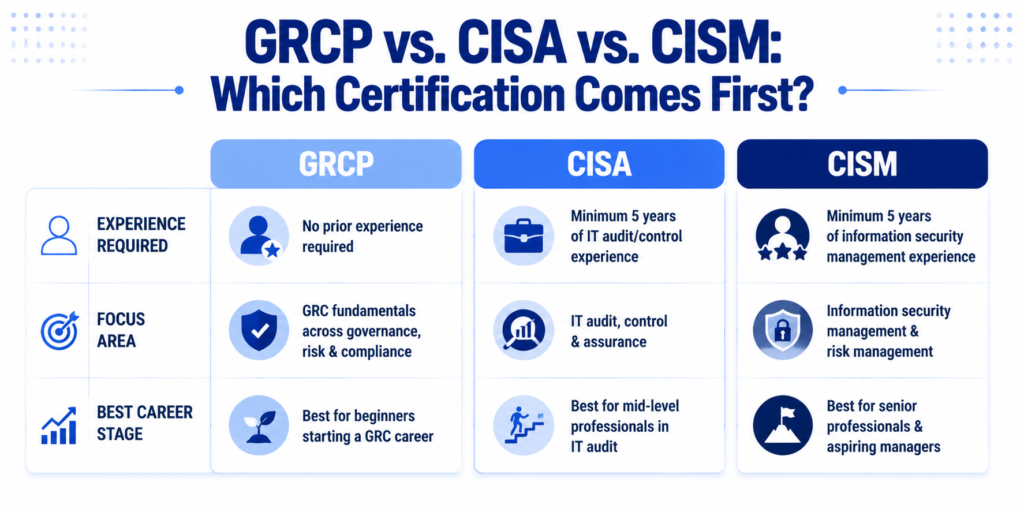
This is the real question behind most GRCP searches. Here is an honest comparison.
What Each Certification Focuses On
GRCP (GRC Professional)
- Issued by: OCEG
- Focus: Integrated GRC across governance, risk, compliance, ethics, audit, security, and privacy
- Depth: Broad foundation across all GRC disciplines
- Best for: Career starters, GRC generalists, experienced professionals using it as a capstone
CISA (Certified Information Systems Auditor)
- Issued by: ISACA
- Focus: Information systems auditing, control, and security
- Depth: Deep expertise in IT audit and control testing
- Best for: IT auditors, professionals moving into GRC from audit backgrounds
CISM (Certified Information Security Manager)
- Issued by: ISACA
- Focus: Information security management and governance
- Depth: Deep expertise in security program management
- Best for: Security managers moving into GRC, professionals targeting CISO-adjacent roles
Comparison Table
| GRCP | CISA | CISM | |
| Issued by | OCEG | ISACA | ISACA |
| Experience Required | None | 5 years | 5 years |
| Exam Cost | $575 | $575 (member) | $575 (member) |
| Focus | Broad GRC integration | IT audit and control | Security management |
| Best career stage | Any | Mid-level | Mid to senior |
| Renewal | Annual CPE | 3-year CPE | 3-year CPE |
| Recognition in job postings | Growing | Very high | High |
The Right Order for Career Starters
If you are new to GRC, start with GRCP. No experience required, foundational across all GRC disciplines, and it gets a credential on your resume while you are still building work experience.
Once you have two to three years of experience, pursue CISA. It adds audit depth and is the most widely recognized GRC-adjacent certification in job postings globally. After CISA, CISM makes sense if your career is heading toward security management rather than compliance or risk.
Recommended order for career starters: GRCP → CISA → CISM
The Right Order for Existing GRC Professionals
If you already work in GRC, compliance, audit, or security with three or more years of experience, CISA is likely the stronger first investment. You already have the experience it requires, and it is more widely recognized in job postings.
GRCP then becomes the integrating credential. It adds the cross-disciplinary framework perspective that CISA does not provide.
Recommended order for existing professionals: CISA → GRCP (capstone or enhancer) → CISM
When GRCP Comes Before Everything Else
GRCP comes first in two situations.
One: you have no experience and need an entry credential.
Two: your target employer specifically values the OCEG framework and GRC Capability Model knowledge over audit-specific credentials. This is more common than it sounds. Organizations that have deliberately built their GRC programs around the OCEG model recognize GRCP immediately.
How to Prepare for the GRCP Exam
Official Study Materials From OCEG
OCEG provides everything you need to pass. The GRC Capability Model (Red Book) is the primary study document. It is available through OCEG’s website as part of the All Access Pass, or in free open-source versions.
OCEG also provides preparation courses, practice questions, and a competency model that maps which knowledge areas are tested and at what depth.
Most candidates who pass on their first attempt spend significant time with the Red Book directly, rather than relying on third-party summaries.
Supplementary Resources Worth Using
The Red Book can be dense reading. Supplementary materials help you move from understanding to applying.
OCEG’s ActiveLearning modules (included in the All Access Pass) are structured and interactive, tied directly to exam topics. They are more effective than passive reading for most people.
Training providers like PwC Academy ME offer structured GRCP preparation courses in workshop or live online formats. Worth it if you learn better with a facilitator than through self-study.
GRC-focused LinkedIn groups, ISACA local chapters, and OCEG forums give you peer discussion, real-world examples, and accountability. Studying alongside others who are preparing or have recently passed makes the material stick faster.
Realistic Study Timeline
Most candidates pass with 6-10 weeks of consistent preparation at 8-10 hours per week.
Candidates already working in GRC or a related field typically need 4-6 weeks. The concepts are familiar in practice, so the model clicks faster. Candidates with no GRC background typically need 10-12 weeks to build enough familiarity with the Capability Model.
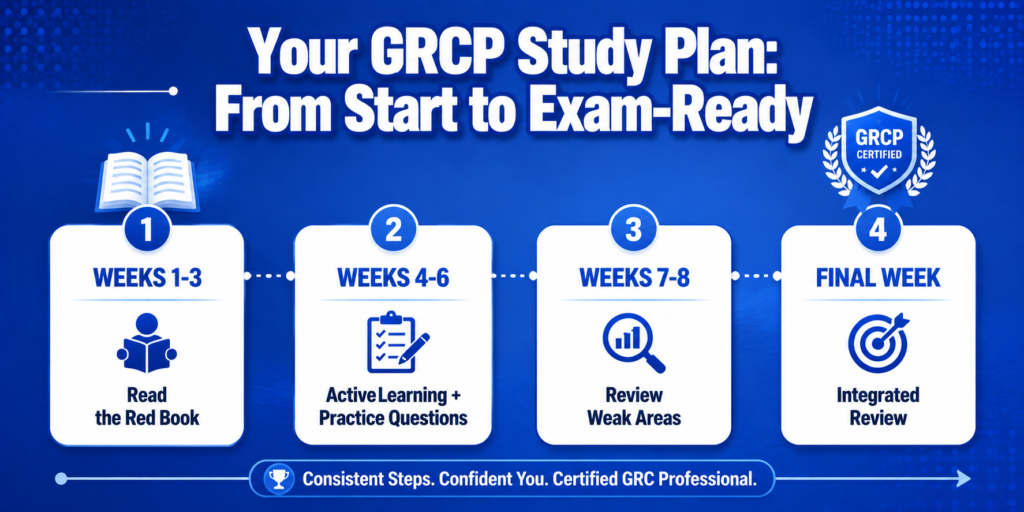
A practical study plan looks like this:
Weeks 1-3: Read the GRC Capability Model. Focus on the four components (LEARN, ALIGN, PERFORM, REVIEW) and how they connect.
Weeks 4-6: Work through OCEG’s preparation materials and ActiveLearning modules. Take practice questions as you go.
Weeks 7-8: Review weak areas from practice questions. Focus on topics where you are scoring below 70%.
Final week: Review integrated application of GRC concepts. Not individual topics. How everything connects.
What the Exam Format Looks Like
The GRCP is multiple-choice. OCEG does not publish the exact number of questions or passing score, but the exam tests both knowledge recall and applied understanding of the GRC Capability Model.
The exam is online and can be taken remotely. All Access Pass holders schedule and sit the exam through the OCEG platform.
Common Mistakes Candidates Make
Memorizing instead of understanding. The exam tests applied knowledge. Memorizing terminology without understanding how the concepts work in practice leads to trouble on scenario-based questions.
Treating GRC disciplines as separate. The exam is built to test integrated thinking. Studying governance, risk, and compliance in isolation misses the entire point of the certification.
Focusing on one area too deeply. GRCP covers many disciplines. Candidates who go deep on risk while neglecting ethics or privacy leave themselves exposed.
Skipping practice questions. The Red Book reads differently from how exam questions are framed. Practice questions close that gap. Candidates who skip them are often caught off guard by how the questions are written.
What GRCP Does for Your Career
How Employers View GRCP on a Resume
GRCP tells an employer that you understand GRC as an integrated system and have been assessed against the same model their GRC program may be built on.
In markets where OCEG’s GRC Capability Model is widely used (US, UK, Australia, and parts of the Middle East), GRCP signals immediate relevance. Hiring managers who know the field understand what it represents without further explanation.
In markets where CISA is the default expected credential, GRCP may need a line of context. The explanation is simple: GRCP is issued by the organization that created the global standard for GRC program design. Most hiring managers find that sufficient.
Job Titles That Recognize or List GRCP
GRCP appears most in job descriptions for:
- GRC Analyst (entry to mid-level)
- GRC Specialist (mid-level)
- Compliance Manager (mid to senior)
- Risk and Compliance Officer
- Governance Manager
- Internal Audit roles with GRC scope
- GRC Program Manager
It is less commonly listed as a hard requirement than CISA but regularly listed as preferred or as an acceptable alternative for GRC-generalist roles.
Salary Impact: Does GRCP Pay Off?
GRCP alone does not command the same salary premium as CISA or CISM. It is a foundational credential, not a specialist one, and it is less recognized in job postings.
But GRCP combined with experience and other credentials consistently improves hiring outcomes and salary negotiations. Professionals who hold GRCP alongside CISA or solid GRC program experience report stronger offers than those with experience alone.
According to Glassdoor 2026 data, GRC Specialists with recognized certifications earn an average of $101,988 per year in the United States, with senior roles reaching $182,045.
In Nigeria, certified GRC professionals earn ₦8-15M annually at mid-level, rising to ₦15-25M+ at senior specialist and manager levels. GRCP as an entry credential positions professionals to reach mid-level faster than those without any formal GRC certification.
Global Demand
United States: GRCP recognition is growing. CISA remains the dominant GRC-adjacent credential in job postings, but GRCP is increasingly listed as an alternative or complement.
United Kingdom and Europe: Recognized particularly in organizations using the OCEG model. In GDPR-focused compliance roles, pairing GRCP with privacy-specific credentials or OneTrust experience adds significant value.
Nigeria and Africa: GRC certification demand is growing fast across Nigeria, South Africa, Kenya, and Ghana. GRCP is a practical entry point because the no-experience requirement makes it accessible in markets where GRC careers are still developing. As NITDA, CBN, and NDPA regulations tighten, certified professionals are increasingly sought after.
Asia-Pacific: Recognized in Australia and Singapore, and growing in India as GRC program maturity increases alongside multinational expansion.
How to Maintain Your GRCP Certification
Continuing Education Requirements
Keeping GRCP active requires ongoing continuing education. OCEG uses this system to ensure certified professionals stay current with GRC developments.
The All Access Pass includes continuing education tracking, so pass holders can log and demonstrate compliance with maintenance requirements in one place.
Renewal Timeline and Process
Certification maintenance is managed through OCEG’s platform. You must meet continuing education requirements within each certification period to maintain active status.
All Access Pass holders get renewal support as part of their subscription, including access to new materials and events that count toward continuing education.
What Happens If You Let It Lapse
If you miss the continuing education requirements, your GRCP lapses. A lapsed certification can typically be reinstated, but it may require additional steps or fees depending on how long it has been inactive.
OCEG sends renewal deadline notifications. Missing those is one of the most common reasons certifications lapse. Set your own calendar reminders independently. Do not rely solely on OCEG’s emails.
Is the GRCP Certification Worth It? (Honest Assessment)
The Case For Getting GRCP
No experience required. The strongest argument for career changers. No other credible GRC certification lets you earn a recognized credential without prior industry experience.
Breadth across all GRC disciplines. GRCP covers more ground in one credential than any other GRC certification. For professionals who need to speak across governance, risk, compliance, ethics, audit, and security, this breadth is genuinely useful.
OCEG credibility. Being certified by the organization that created the global GRC standard carries weight with employers who know the field.
Cost. At $499 for the All Access Pass (which includes all OCEG certifications, study materials, exam attempts, and retakes), GRCP is one of the most cost-effective GRC credentials on the market.
Foundation for further certifications. GRCP builds integrated GRC thinking that makes CISA and CISM easier to understand and apply. Professionals who earn GRCP first consistently say subsequent certifications click faster.
The Case Against Getting GRCP First
Lower job posting recognition than CISA. Scan GRC Specialist job postings and CISA appears far more frequently. For mid-level professionals with existing experience, CISA may be the stronger first investment.
Breadth without depth. GRCP does not make you a specialist. Professionals who need deep credentials in audit, security management, or risk will still need CISA, CISM, or CRISC at some point.
Not universally recognized. In some markets, GRCP is not yet well known. You may need to explain it in interviews, which CISA and CISM holders rarely face.
The Verdict: Who Should Get GRCP and When
Get GRCP first if:
- You are new to GRC with no work experience
- You are transitioning from another field (IT, law, accounting, audit)
- You want one credential that covers all GRC disciplines before specializing
- Your target employers use OCEG’s GRC Capability Model
- You want the most cost-effective entry into GRC certification
Get CISA first if:
- You already have three or more years of GRC, audit, or IT experience
- CISA appears consistently in job postings for your target roles
- You want the most recognized GRC-adjacent credential in the job market
Get GRCP after CISA if:
- You want to broaden beyond audit into integrated GRC thinking
- You are moving into GRC Manager or leadership roles that need cross-disciplinary fluency
- You want to formalize knowledge you have built through experience
Final Thoughts: Your Next Step After Reading This
GRCP is not the most recognized GRC credential in every market. But it is the most accessible, the most integrative, and the most cost-effective entry point for professionals at any career stage.
If you are new to GRC and figuring out where to start, GRCP gives you a credible foundation. If you already work in GRC and want to connect all the parts, GRCP fills the cross-disciplinary gaps that specialist certifications leave open.
No certification is magic. What GRCP does is validate that you understand how governance, risk, compliance, and related disciplines work together. That understanding is exactly what organizations need from the GRC professionals they hire.
If you want a structured program that builds practical GRC skills while preparing you for certifications like GRCP, EMC Institute’s cybersecurity training programs are worth looking into. The IT GRC Certification pathway covers how GRCP, CISA, and CISM connect to real career progression and helps you decide which credential to pursue first, in what order, and why. Watch the free VSL to see how the program is structured and whether it fits where you are going.
The path is clear. The next step is yours.
What Is a GRCP Certification?
GRCP stands for GRC Professional. It is a certification issued by OCEG, the organization that created the GRC Capability Model, the global standard for governance, risk, and compliance program design. GRCP proves that you understand GRC as an integrated discipline covering governance, risk, compliance, ethics, security, privacy, and audit, not just one piece of it. It is one of the few credible GRC certifications with no minimum experience requirement, which makes it accessible to career changers and early-career professionals who cannot yet qualify for CISA or CISM. The exam is based on OCEG’s GRC Capability Model, also called the Red Book, and assesses both knowledge recall and applied understanding of how GRC disciplines connect.
How Hard Is the GRCP Exam?
The GRCP exam is considered moderate in difficulty. It is not a highly technical exam like CISSP or CISA, but it is not easy either. The exam tests applied understanding, not just memorization. Candidates who read the GRC Capability Model and understand how governance, risk, compliance, ethics, and audit connect as a system typically find it manageable. Candidates who try to memorize terminology without understanding how the concepts apply in practice often struggle with scenario-based questions. Most candidates pass with 6-10 weeks of consistent preparation at 8-10 hours per week. Candidates already working in GRC or a related field typically need only 4-6 weeks. The most common mistake is underestimating the breadth of the syllabus and focusing too deeply on one area while neglecting others.
Is GRCP Certification Worth It?
Yes, for the right person at the right career stage. GRCP is worth it if you are new to GRC with no work experience, transitioning from another field like IT, law, or accounting, or want a single credential that covers all GRC disciplines before specializing. At $499 for the OCEG All Access Pass, which includes the exam, all study materials, retakes, and access to all other OCEG certifications, it is one of the most cost-effective GRC credentials available. However, GRCP alone does not command the same salary premium as CISA or CISM, and it appears less frequently in job postings. The strongest value comes from holding GRCP alongside work experience or pairing it with CISA as part of a broader certification strategy. For career changers and entry-level professionals, it is genuinely worth the investment
How Do I Get GRC Certified?
The most accessible path is through the GRCP certification from OCEG. Start by purchasing OCEG’s All Access Pass for $499 per year, which gives you access to the GRC Capability Model (the Red Book), preparation courses, practice questions, and the exam itself. Study the Red Book for 6-10 weeks, work through OCEG’s ActiveLearning modules, practice with exam questions regularly, and schedule your exam through the OCEG platform when you feel ready. After passing, maintain your certification by completing continuing education requirements each year. If you want a broader GRC certification pathway, the recommended order for career starters is GRCP first, then CISA once you have two to three years of experience, then CISM if your career moves toward security management. Each certification builds on the one before it and opens progressively senior roles.
What Is the Difference Between GRCP and GRCA?
GRCP and GRCA are both issued by OCEG and are part of the same certification suite, but they cover different levels of GRC expertise. GRCP (GRC Professional) is the foundational certification. It proves you understand GRC principles and can apply the GRC Capability Model across an organization. GRCA (GRC Auditor) builds directly on GRCP and proves that you can audit GRC programs. Where GRCP tests your ability to design and implement GRC, GRCA tests your ability to independently assess whether a GRC program is working as intended. Most professionals earn GRCP first and then pursue GRCA as a natural next step, particularly if their career involves internal audit, external assurance, or GRC program evaluation. Both certifications are included in OCEG’s All Access Pass at no additional cost beyond the annual subscription fee.