
 English
 Arabic
 English
 French
 German
CISA Exam Preparation: Study Smart and Pass With Confidence
Most CISA exam preparation guides hand you a list of generic tips and send you on your way. Read the ISACA manual. Take practice tests. Good luck.
That is not a study plan. That is a guess.
This guide tells you exactly what the CISA exam tests, how hard it really is for your background, which study materials work, and how to build a study plan you can actually follow.
Table of Contents
What Is the CISA Certification?
What CISA Proves to Employers
CISA stands for Certified Information Systems Auditor. It proves you can audit, control, and secure information systems at a professional level.
When an employer sees CISA on your resume, it signals three things. You understand how to assess IT risks. You know how to evaluate the controls organizations use to manage those risks. And you have been tested against a globally recognized standard in IT audit and information security.
CISA is issued by ISACA, the Information Systems Audit and Control Association, and recognized in over 180 countries. Employers worldwide understand what it represents without needing an explanation.
Who Should Sit the CISA Exam
CISA is built for professionals working in or around IT audit, control, and information security:
- IT Auditor or Internal Auditor with IT responsibilities
- GRC Analyst or GRC Specialist
- Compliance Officer or Compliance Manager
- Information Security Analyst
- Risk Manager or Risk Analyst
- IT Manager moving into governance or audit
Who Should Wait
CISA requires five years of work experience. You can sit the exam before completing that requirement, but you cannot receive full certification until your experience is documented.
If you have fewer than two years of relevant experience, build your foundation first. The GRCP certification from OCEG requires no experience and covers GRC fundamentals. It is a strong entry point that positions you well for CISA once your experience grows.
CISA Exam Structure: Know Before You Study
Format and Time Limit
The CISA exam has 150 multiple-choice questions. You have four hours to complete it.
These are not simple definition recalls. ISACA writes scenario-based questions that test applied understanding. You read a real audit situation and choose the best course of action from an auditor’s perspective.
This distinction matters enormously for CISA exam preparation: ISACA has a specific way of thinking about audit decisions. Understanding that thinking is more important than memorizing facts. Most candidates who fail do so because they studied the right content but applied it with the wrong mindset.
The Five CISA Domains and Their Weightings
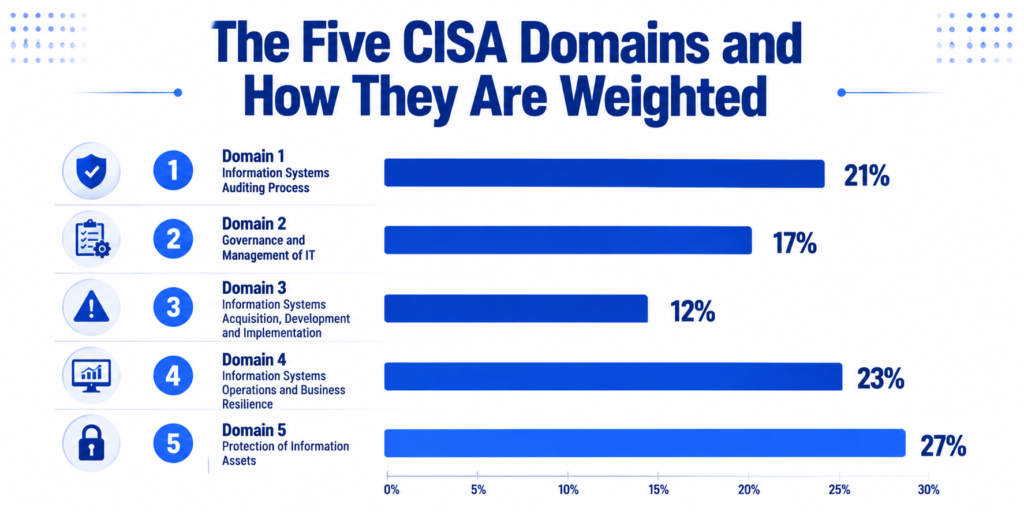
Domain 1: Information System Auditing Process — 21% Domain 2: Governance and Management of IT — 17% Domain 3: Information Systems Acquisition, Development, and Implementation — 12% Domain 4: Information Systems Operations and Business Resilience — 23% Domain 5: Protection of Information Assets — 27%
Domain 5 carries the most weight at 27%. Domain 4 is second at 23%. Together they make up half the exam. If you are short on study time, these two domains give you the highest return per hour.
CISA Pass Rate
ISACA does not publish a global pass rate. Industry sources and candidate communities consistently report a first-attempt pass rate of 50-60%.
Roughly four in ten candidates fail on their first try. The most common reason is not lack of knowledge. It is approaching exam questions like a technician rather than an auditor. The CISA exam tests audit judgment, not technical expertise. That distinction is everything.
Where CISA Fits in Your GRC Certification Path
GRCP (from OCEG) covers broad GRC foundations with no experience requirement. It is the right starting point for career changers and early-career professionals.
CISA goes deep on IT audit. It is mid-level, requires five years of experience, and is the most widely recognized GRC-adjacent certification in job postings globally.
CISM focuses on security management and governance. It is senior-level and the natural next step after CISA for professionals moving toward security leadership.
The sequence most GRC professionals follow: GRCP → CISA → CISM.
How Hard Is the CISA Exam?
What Makes It Difficult
The CISA exam is harder than most candidates expect for one reason: it does not test what you know. It tests how you think.
ISACA writes questions from the perspective of “what would the best auditor do here?” Auditors assess and report. They identify problems and recommend solutions. They do not implement fixes themselves.
Candidates from technical backgrounds often choose the most technically correct answer. ISACA’s correct answer is usually the most auditor-correct answer. Those are not the same thing.
Example: A question describes a system with a known vulnerability. A technical professional picks “implement a patch immediately.” ISACA’s correct answer is more likely “assess the impact and report it to management with a remediation recommendation.” The auditor observes. The business acts.
How Hard Is It For Your Background?
IT Auditors: Content aligns closely with your daily work. Focus your preparation on gaps specific to your audit experience. Timeline: 3-4 months.
GRC and Compliance Professionals: Strong foundation in risk management and control frameworks. Main gap is IT audit methodology — shifting from designing controls to evaluating whether they work. Timeline: 4-5 months.
Career Changers: Steeper learning curve. Domains 3 and 4 assume familiarity with IT environments that you may not have. Give yourself enough time and do not rush. Timeline: 5-6 months.
All timelines assume 8-10 hours of study per week.
CISA Certification Requirements Before You Register
CISA requires five years of professional experience in information systems auditing, control, assurance, or security. ISACA allows up to three years of substitution:
- One year for a bachelor’s or master’s degree in information systems or a related field
- One year for credentials including CGEIT, CRISC, or CISM
- One year for two years of experience in information systems management in a non-IS role
You can sit the exam before your experience is complete. After passing, you have five years to submit documentation and receive full certification.
Registration fees: ISACA member rate is $575 USD. Non-member rate is $760 USD. ISACA membership costs $135/year and pays for itself if you use their study resources.
The exam is available globally through PSI testing centers and via online proctoring, making it accessible for candidates in Nigeria, South Africa, Kenya, and across Africa.
The Five CISA Domains Explained Simply
Domain 1 (21%): Information System Auditing Process The foundation of the exam. Covers how audits are planned, executed, and reported. ISACA’s audit mindset lives here. Master Domain 1 first — the reasoning pattern you build carries through every other domain.
Domain 2 (17%): Governance and Management of IT Covers IT governance frameworks and how organizations align IT with business objectives. GRC professionals find this domain familiar. COBIT and ISO 38500 overlap significantly with GRC program design.
Domain 3 (12%): Information Systems Acquisition, Development, and Implementation Covers how organizations acquire, develop, and implement systems. Lowest weight but hardest for career changers. The exam asks what controls an auditor looks for, not how to build software.
Domain 4 (23%): Information Systems Operations and Business Resilience Second highest weight. Covers IT operations, incident management, and business continuity. Know the difference between RTO (how fast a system must recover) and RPO (how much data loss is acceptable). These appear frequently.
Domain 5 (27%): Protection of Information Assets Highest weight. Covers information security frameworks (ISO 27001, NIST), access controls, encryption basics, and network security. You do not need to be a security engineer. You need to evaluate controls from an auditor’s perspective.
Study order: Domain 1 → Domain 5 → Domain 4 → Domain 2 → Domain 3.
CISA Exam Preparation: Study Materials That Work
Official ISACA Resources (Non-Negotiable)
CISA Review Manual (CRM): The official study guide covering all five domains. Read it at least once, then use it as a reference while working through practice questions. The 2024 edition is current.
CISA QAE Database: ISACA’s official practice question bank written by the same team that writes the exam. Work through all of them at least once. These are the closest questions to what you will face.
Candidates with strong relevant experience who use only these two resources consistently pass. Everything else is supplementary.
Free Resources Worth Using
ISACA’s exam content outline: Free on isaca.org. Shows exactly what percentage of the exam covers each topic. Download this before you open the CRM.
YouTube domain walkthroughs: Several CISA instructors publish free domain overviews. Useful for career changers who need visual explanations before working through the text-heavy manual.
ISACA online community forums: Free for members. Years of real candidate experience and domain-specific discussion.
Paid Courses: When They Are Worth It
Mike Chapple on LinkedIn Learning or Udemy: Most consistently recommended CISA instructor. Covers all five domains clearly, uses simple language, includes practice questions. Best for career changers.
Simplilearn CISA Training: Structured course with video lectures, practice tests, and instructor support. Better for candidates who want guided learning rather than self-study.
Most candidates with strong relevant experience pass using only the CRM and QAE database. Paid courses add the most value for career changers and candidates who have already failed once.
Practice Questions: The Most Important Activity
Practice questions matter more than re-reading the review manual.
Minimum target: 1,500-2,000 questions before exam day.
Read the explanation for every question, including the ones you get right. Understanding why the correct answer is correct builds the ISACA audit thinking pattern the exam actually tests.
Score benchmarks: Above 65% after 200-300 questions. Consistently 70%+ after 500+. If you are not hitting these, return to the CRM for the domains pulling your score down.
Best sources: ISACA’s official QAE database first, then Pocket Prep CISA app, then Mike Chapple’s course banks, then third-party platforms for volume.
Your CISA Exam Preparation Study Plan
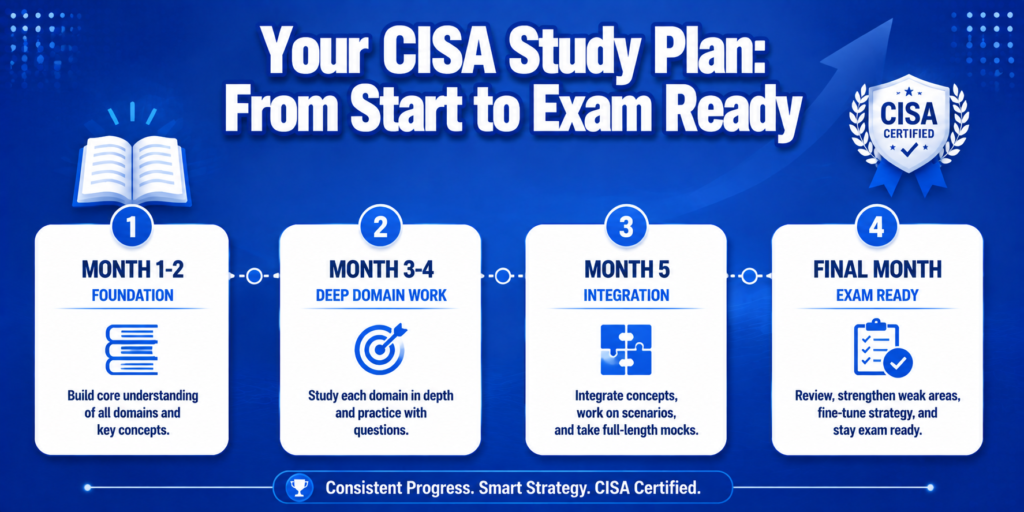
One plan does not fit every background. Here is a flexible structure based on your starting point.
Months 1-2: Foundation Read the CISA Review Manual at 2-3 chapters per week. Start practice questions by end of Month 1 at 50-100 per week. Target by Month 2: full CRM read, 400+ practice questions done, scoring consistently above 65%.
Months 3-4: Deep Domain Work Focus on Domain 5 and Domain 4 first (highest weights, together 50% of the exam). Complete 400+ practice questions on these two domains. Then shift to Domain 1 and Domain 2. Complete 300+ practice questions. Begin mixed domain sessions.
Month 5: Integration Mixed practice questions across all domains. Target 700+ questions. Identify weak areas and return to source material. Complete full timed practice exams. Target: scoring 75%+ consistently on mixed sets.
Final Month: Preparation Timed practice exams (150 questions in 4 hours). Light review of weak areas only. No new content. Confirm exam day logistics.
Career changers: Add two months before this plan to build basic IT and audit familiarity. Use Google’s IT Support Professional Certificate on Coursera and ISACA’s free introductory articles before opening the CRM.
Total timelines: IT Auditors: 3-4 months. GRC professionals: 4-5 months. Career changers: 6-8 months.
Common CISA Exam Mistakes
Memorizing instead of thinking like an auditor. The exam tests judgment, not recall. For every wrong practice question, ask: “What is ISACA’s reasoning here?” Build the thinking pattern, not just the answer list.
Ignoring domain weightings. Domain 5 (27%) and Domain 4 (23%) are half the exam. Domain 3 (12%) is barely one in eight questions. Weight your study time accordingly.
Starting practice questions too late. Start after your first read of each domain chapter, not after you finish the whole manual. Questions reveal gaps that reading alone does not.
Misunderstanding the experience requirement. Map your work history to ISACA’s experience categories before you register. Know which waivers apply to you. Do not discover gaps after you pass.
What CISA Does for Your Career and Salary
According to Pocket Prep’s 2026 certification data, CISA holders earn an average of $110,000+ per year in the United States, with senior roles reaching $130,000-$180,000.
In the United Kingdom, CISA holders earn £65,000-£95,000 at mid to senior level. In Nigeria, mid-level CISA holders earn ₦10-18M annually, with senior roles reaching ₦20-30M+. Financial sector employers pay at the top of this range. Remote roles for Nigerian and African CISA professionals working with international companies often reach $3,000-7,000+ monthly.
CISA appears most in job postings for IT Auditor, GRC Specialist, Compliance Manager, IT Risk Manager, and Information Security Manager roles. At mid-level, it is increasingly listed as required rather than preferred.
Career results typically appear within three to six months of passing. Resume updates lead to new interview opportunities. Salary negotiations become stronger. For professionals already in GRC or audit roles, CISA often supports a promotion conversation that was previously stalled.
Final Thoughts: Start Your CISA Preparation Today
The CISA exam is not easy. Roughly half of first-time candidates do not pass. The ones who do understand ISACA’s audit mindset, use the right materials, and give themselves enough time for their background.
Your first 48 hours:
Go to isaca.org. Download the free CISA Exam Content Outline. Read it fully. Take ISACA’s free 10-question sample test as a baseline. Choose your study timeline. Block study time in your calendar for the next four weeks and treat it like a fixed commitment.
That is the start. Everything else follows from there.
If you want structured training that builds the GRC and information security foundations that make CISA exam preparation faster and more effective, EMC Institute’s cybersecurity programs offer a clear pathway. The IT GRC Certification path within EMC’s training connects CISA to the full GRC career sequence, showing you which certification to pursue, in what order, and why it matters for your career.
Watch the free VSL to see how EMC Institute’s training connects to the CISA path and whether it is the right fit for where you want to go.
What Is the Best Way to Prepare for the CISA Exam?
The best way to prepare for the CISA exam is to combine the official ISACA study materials with consistent practice questions. Start with the CISA Review Manual (CRM) to build domain knowledge, then work through ISACA’s official Question, Answer, and Explanation (QAE) database to build the audit thinking pattern the exam actually tests. Most candidates who fail do so not because they lack knowledge but because they approach questions like a technician rather than an auditor. ISACA wants to know what the best auditor would do, not what the most technically correct action is. Aim for at least 1,500-2,000 practice questions before exam day, read every explanation whether you got the question right or wrong, and prioritize Domains 4 and 5 which together make up 50% of the exam.
How Much Time Does It Take to Prepare for CISA?
It depends on your background. IT auditors with direct experience typically need 3-4 months studying 8-10 hours per week. GRC and compliance professionals need 4-5 months because while they understand risk and control frameworks, they need extra time to shift from designing controls to evaluating whether controls work, which is the auditor’s perspective. Career changers with no IT audit background need 5-6 months minimum, and sometimes 6-8 months if they need to build basic IT familiarity before domain-specific study. Rushing the timeline is one of the most common reasons candidates fail their first attempt. Give yourself enough time based on where you are starting from, not where you want to be.
Is CISA Harder Than CIA?
They are different exams testing different skills, but most candidates who have sat both report that CISA and CIA are comparable in overall difficulty. CISA focuses on IT systems auditing, control, and information security. CIA (Certified Internal Auditor, issued by the IIA) covers broader internal audit principles across all business areas, not just IT. CISA tends to be harder for candidates without IT backgrounds because of the technology-specific content in domains like IT operations, system development, and information asset protection. CIA tends to be harder for pure IT professionals because of its broader business and financial audit scope. If you work in IT audit or GRC, CISA is generally the more natural fit and may feel more manageable because the content aligns closely with your daily work
How Much Does the CISA Exam Cost?
The CISA exam registration fee is $575 USD for ISACA members and $760 USD for non-members. An ISACA membership costs $135 per year, which means becoming a member before registering saves you $50 and also gives you access to ISACA’s study resources, community forums, and continuing education materials. Beyond the exam fee, you should budget for study materials. The CISA Review Manual costs approximately $99-$149 depending on format, and the official QAE database is available as a separate purchase or through ISACA’s bundle packages. If you choose a paid prep course from providers like Simplilearn or Mike Chapple on Udemy, add another $30-$300 depending on the platform. Total preparation cost typically ranges from $700-$1,200 USD depending on which materials and courses you use.
What Happens If You Fail the CISA Exam?
You can retake the CISA exam. ISACA allows candidates to retake the exam up to four times within a rolling 12-month period, with a mandatory waiting period between attempts. Each retake requires a new registration fee at the same rate as the original exam ($575 for members, $760 for non-members). If you fail, ISACA provides a performance report showing how you scored across each domain so you can identify exactly where to focus your preparation before retaking. Most candidates who fail their first attempt do so because of the ISACA audit mindset gap rather than content knowledge gaps. Before retaking, spend focused time on understanding why ISACA chooses certain answers over others, not just on reviewing domain content. Working through more practice questions with detailed explanation reviews is the most effective way to close that gap.