
 English
 Arabic
 English
 French
 German
Cybersecurity Certification Courses That Actually Pay Off
You know which certification you want. Maybe you read a roadmap, talked to someone already in the field, or saw it on a job posting. Now the practical question is: which course actually helps you pass it?
Most articles about cybersecurity certification courses point you to Coursera or SANS and leave you to figure out the rest. This guide is more specific. It tells you which courses work for each certification, what they cost, and how to pick the right one for your background and budget.
No vendor bias. No course marketplace listing. Just straight answers.
Table of Contents
What to Look for in a Cybersecurity Certification Course
Course Quality Indicators That Actually Matter
Not every online cybersecurity certification course is worth your time or money. Here is what separates the useful ones from the ones that waste both.
Updated content. Certification exams change regularly. A CISA course last updated in 2021 may miss content added to the exam in 2024. Always check the last update date before you enroll.
Practice questions that mirror the real exam. The most valuable part of any certification course is not the video lectures. It is the practice questions. The best courses include questions written in the same style as the real exam, with clear explanations of why each answer is right or wrong.
A credible instructor. The best instructors actually hold the certification they teach and have worked in the field. A CISA instructor who has done real IT audits explains ambiguous exam scenarios differently from someone who only read the manual. That difference shows up in your score.
Domain coverage that matches exam weightings. Every certification has specific domains weighted differently. A good course allocates study time to match those weightings. If a course splits time evenly across all domains but the exam weights them differently, you are studying the wrong things for the wrong amount of time.
Pass rate or outcome data. The best courses publish this. It is not always available, but when it is, it is the most honest signal of course quality.
Red Flags to Avoid
No update date. If you cannot tell when the course was last reviewed, assume it is out of date.
No practice questions. A certification course without practice questions is a lecture, not exam prep. Video content alone does not build the pattern recognition you need to pass scenario-based exams.
Generic content. “Learn cybersecurity” is different from “prepare for the CISA exam.” General awareness courses and certification prep courses serve different purposes. Make sure what you buy is actually exam-specific.
Unrealistic promises. “Pass in one week.” “Zero experience needed for CISSP.” These are marketing tactics, not accurate claims. Legitimate courses set honest expectations.
Free vs. Paid: When Each Makes Sense
Free makes sense when you are on a tight budget, the certification body offers official free resources, or you want to try a domain before committing to a paid course.
Paid makes sense when you need structured progression through complex material, you have already failed a self-study attempt, or the certification is significant enough to justify the investment (CISA, CISM, CISSP).
The most effective approach for most candidates: official free resources from the certification body plus one quality paid course or practice question bank. That combination passes most first-time candidates without overspending.
Cybersecurity Certification Courses by Certification Target
Courses for GRCP Preparation
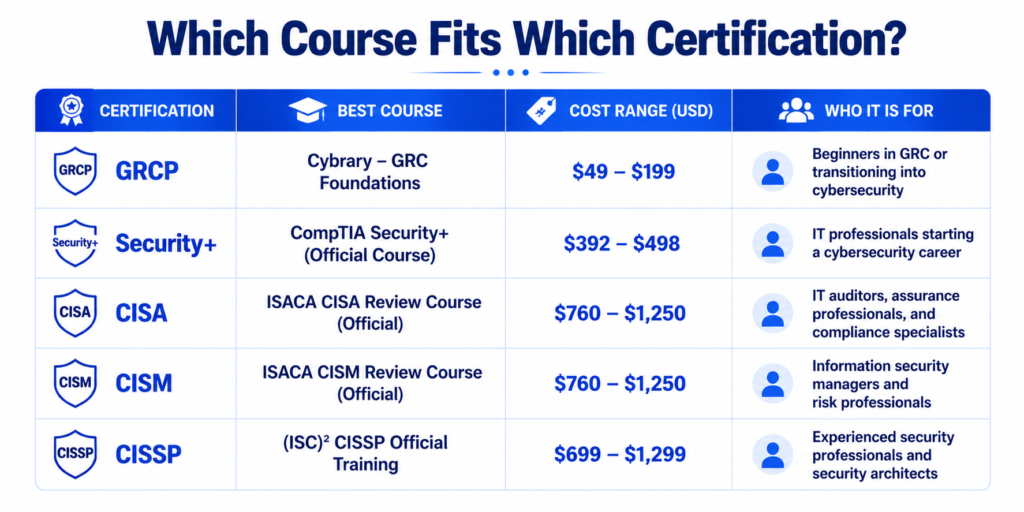
The GRCP certification from OCEG is the most accessible entry point on the GRC path. No experience required. OCEG provides all the study materials you need through its All Access Pass ($499/year), which includes the GRC Capability Model (Red Book), preparation courses, ActiveLearning modules, and exam access.
OCEG All Access Pass The official and most complete resource. Everything you need to study and sit the exam is included. At $499/year for all OCEG certifications combined, it is strong value for anyone starting the GRC path.
PwC Academy ME GRCP Preparation Course A structured workshop-format course for candidates who prefer guided learning. More expensive than self-study but includes facilitation and peer discussion.
YouTube + Quizlet Free supplement. GRC practitioners publish GRCP concept walkthroughs on YouTube. Quizlet has free flashcard sets for GRC Capability Model terminology. Useful alongside official materials, not instead of them.
Recommendation: Start with the OCEG All Access Pass. It is produced by the same organization that writes the exam, so alignment is guaranteed.
Courses for CompTIA Security+ Preparation
Security+ is the global baseline certification for cybersecurity. It is vendor-neutral and tests practical security skills.
Professor Messer’s Security+ Course (Free) One of the most consistently recommended free Security+ resources. Updated for the current exam version. Clear, structured, and free.
Mike Chapple on Udemy or LinkedIn Learning ($15-$30) Covers all exam domains in plain language and includes practice questions. Particularly useful for candidates new to cybersecurity concepts.
CompTIA’s Official CertMaster ($349-$499) CompTIA’s own study platform with adaptive learning and performance tracking. More expensive but guaranteed to be current.
Jason Dion’s Security+ Course on Udemy ($15-$30) Strong on practice questions and exam strategy. Good for candidates who want high-volume practice.
Recommendation: Professor Messer’s free course plus one paid practice question bank (Jason Dion or Mike Chapple). Total cost: $15-$30.
Courses for CISA Preparation
CISA exam preparation is different from most certification studying. The exam tests audit judgment, not technical knowledge. The best courses teach you to think like an auditor.
ISACA’s Official CISA Study Materials The CISA Review Manual ($79-$119) and QAE Database ($99-$149) are non-negotiable. Written by the same team that writes the exam. No other resource matches this alignment.
Mike Chapple’s CISA Course on Udemy or LinkedIn Learning ($15-$30) Covers all five CISA domains clearly, explains the ISACA audit mindset, and includes practice questions. Strong for candidates who find the Review Manual dense.
Simplilearn CISA Certification Training ($299-$999) Structured video lectures, practice tests, and instructor support. More expensive but more guided. Best for career changers who need more structured support through complex material.
ISACA Online Community Forums (Free) Real candidate experience across many exam sittings. Useful for understanding how questions are framed and which topics appear frequently.
Recommendation: ISACA Review Manual plus QAE Database plus Mike Chapple’s Udemy course. Total cost: approximately $300-$350. Career changers with no audit background should add Simplilearn for more structure.
Courses for CISM Preparation
CISM certification is about security management and governance, not just security knowledge. The best CISM courses reinforce the management perspective throughout every domain, not just in one section.
ISACA’s Official CISM Study Materials CISM Review Manual ($79-$119) and QAE Database ($99-$149). The most exam-aligned resources available.
Mike Chapple’s CISM Course on Udemy or LinkedIn Learning ($15-$30) Covers all four domains with consistent management framing. Good for professionals transitioning from technical security into security management roles.
Thor Teaches CISM on Udemy ($15-$30) Particularly strong on Domain 3 (Information Security Program), which carries the highest exam weighting at 33%.
Simplilearn CISM Training ($299-$999) Live instruction and guided learning. Best for candidates who have already failed one CISM attempt and need a different approach.
Recommendation: ISACA Review Manual plus QAE Database plus Mike Chapple or Thor Teaches. Total cost: approximately $300-$350.
Courses for CISSP Preparation
CISSP covers eight broad security domains. It is the most demanding certification in breadth. The best CISSP GRC certification courses cover all eight domains while showing how they connect.
(ISC)2 Official Study Guide and Practice Tests ($60-$100) Essential. Written by the certification body.
Mike Chapple and David Seidl’s CISSP Study Guide ($40-$60) Widely regarded as the best third-party CISSP study book. Covers all eight domains with practice questions.
Thor Teaches CISSP on Udemy ($15-$30) One of the most popular CISSP video courses. Uses visual explanations and memory techniques for complex concepts.
CISSP Official Practice Tests by (ISC)2 ($40-$60) 1,300 practice questions officially endorsed by (ISC)2. The best exam-style practice resource available.
Destination CISSP Community (Free) A dedicated online community for CISSP candidates. Strong peer support and study group organization.
Recommendation: Mike Chapple and David Seidl study guide plus Thor Teaches video course plus (ISC)2 practice tests. Total cost: approximately $120-$190.
Cybersecurity Certification Courses by Career Stage
Best Courses for Complete Beginners
If you are starting from zero, the right cybersecurity courses for beginners build vocabulary and foundational knowledge before you tackle certification-specific content.
Google Cybersecurity Professional Certificate on Coursera ($49/month or Coursera Plus) One of the best beginner entry points. Covers fundamental security concepts in accessible language. Prepares you for Security+ and introduces GRC basics. Includes hands-on labs and a portfolio project.
CompTIA IT Fundamentals (ITF+) If Security+ feels too advanced, ITF+ builds the foundational IT knowledge you need before moving into cybersecurity specialization.
Professor Messer’s Free Security+ Course A free, well-structured introduction to cybersecurity. The best no-cost starting point for beginners who cannot yet invest in paid training.
OCEG All Access Pass For beginners who know they want the GRC path, the OCEG All Access Pass provides structured GRCP preparation without assuming any prior cybersecurity knowledge.
Best Courses for Mid-Level Professionals
Mid-level professionals (3-7 years of experience) are typically targeting CISA or CISM. Courses at this stage should assume foundational knowledge and focus on domain depth and exam strategy.
ISACA Official Study Materials Non-negotiable for CISA and CISM. Professionals with relevant experience often pass using only the Review Manual and QAE Database.
Mike Chapple’s CISA or CISM Courses The best third-party option for structured video content alongside official materials.
ISACA Online Community Free peer discussion and real candidate experience from thousands of CISA and CISM holders globally.
Simplilearn Certification Training Worth the investment for mid-level professionals who have already failed a previous attempt.
Best Courses for Senior Professionals
Senior professionals (7+ years) targeting CRISC, CISSP, or CCISO need cybersecurity certification training that matches the strategic depth these exams test.
ISACA Official CRISC Materials Review Manual plus QAE Database is the foundation, same as CISA and CISM.
Mike Chapple or Thor Teaches CISSP The most effective video courses for CISSP at this level.
Destination CISSP Community Free peer community specifically for senior candidates preparing for CISSP.
EC-Council CCISO Program For professionals on the CISO track. Structured CCISO preparation from within the EC-Council ecosystem.
Cybersecurity Certification Course Providers: Honest Comparison
Coursera and Online Platforms
Strengths: Broad course selection, recognizable brand partnerships (Google, IBM, Microsoft), affordable subscription pricing, self-paced flexibility.
Weaknesses: Many courses are general cybersecurity awareness rather than exam-specific preparation. Quality varies. No GRC-specific certification path. Limited instructor access.
Best for: Complete beginners building foundational knowledge. The Google Cybersecurity Certificate is genuinely useful here.
Cost: $49-$99/month or $399/year for Coursera Plus.
SANS Institute
Strengths: Deep technical content, expert instructors with real-world experience, globally recognized GIAC certifications, hands-on labs.
Weaknesses: Extremely expensive ($4,000-$8,000+ per course). Almost entirely technical security focused. No GRC-specific CISA or CISM preparation. Not accessible without employer funding.
Best for: Technical security professionals (blue team, red team, incident response) whose employers cover training costs.
Cost: $4,000-$8,000+ per course.
EC-Council
Strengths: Structured certification roadmap, practical content, globally recognized certifications (CEH, CPENT, CCISO), accessible online format.
Weaknesses: Entirely vendor-biased. No ISACA or OCEG coverage. Limited GRC-specific content. CEH faces criticism for being less practical than alternatives like OSCP.
Best for: Professionals targeting ethical hacking, penetration testing, or CISO-track certifications within the EC-Council ecosystem.
Cost: $500-$1,500+ per certification course.
Udemy and Affordable Options
Strengths: Extremely affordable ($15-$30 on sale), wide selection of certification-specific courses, self-paced, frequently updated.
Weaknesses: Quality varies significantly. Some courses (Mike Chapple, Jason Dion, Thor Teaches) are excellent. Others are not. No live instruction or community. No official endorsement.
Best for: Self-motivated candidates who have identified quality instructors and want affordable exam-specific content alongside official materials.
Cost: $15-$30 per course on sale.
Structured Professional Programs
Strengths: Combine foundational GRC knowledge with certification preparation in sequence. Include career guidance alongside exam prep. Provide community and mentorship that self-study lacks.
Weaknesses: More expensive than self-study. Require consistent time commitment. Not the right fit for candidates who already have strong foundations and only need exam prep.
Best for: Career changers and early-to-mid-level professionals who want a guided path from foundational GRC knowledge through certification and into specific roles.
Cost: Typically $2,000-$15,000 depending on depth and duration.
Cybersecurity Certification Course Costs: Full Breakdown
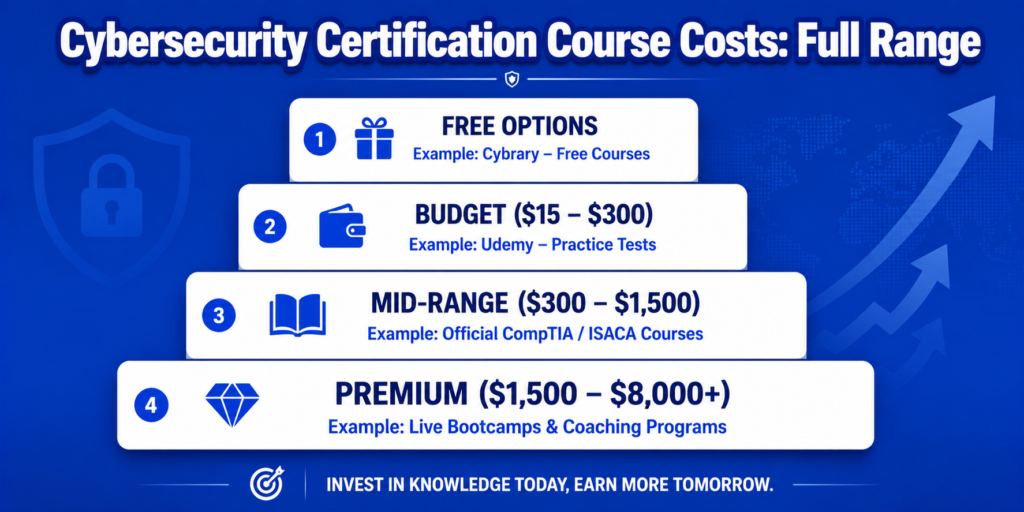
Free Options Worth Using
- ISACA free resources: Exam content outlines, sample questions, and introductory articles at isaca.org
- OCEG free GRC Capability Model resources: Available at oceg.org for members
- Professor Messer’s Security+ Course: Free video content at professormesser.com
- ISACA and (ISC)2 community forums: Free peer discussion and study support
- YouTube certification overviews: Free domain walkthroughs from multiple instructors
- Google Cybersecurity Certificate via financial aid: Coursera offers financial aid for eligible candidates
Budget Options ($15-$300)
- Udemy courses (Mike Chapple, Jason Dion, Thor Teaches): $15-$30 per course on sale
- ISACA Review Manual: $79-$119
- ISACA QAE Database: $99-$149
- CompTIA Study Materials: $50-$100
- Pocket Prep app subscriptions: $20-$40/month for mobile practice questions
Mid-Range Options ($300-$1,500)
- CompTIA CertMaster: $349-$499
- Simplilearn Certification Training: $299-$999
- Coursera Plus Annual Subscription: $399/year
- OCEG All Access Pass: $499/year
- EC-Council Self-Paced Courses: $500-$1,000
Premium Options ($1,500-$8,000+)
- SANS Institute Courses: $4,000-$8,000+ per course
- EC-Council Live Instructor-Led Training: $1,500-$3,000
- University Certificate Programs (SNHU, Johns Hopkins): $3,000-$7,000
- Structured Professional Programs: $2,000-$15,000 depending on depth and support
How to Get Your Employer to Pay
Before spending personal funds on cybersecurity certification courses, check these three things first.
Company training budget: Many organizations allocate annual professional development funds. Certification courses frequently qualify. Ask your manager or HR directly.
Tuition reimbursement: Some organizations reimburse course costs after completion. Check your employee handbook.
Exam vouchers: Some employers buy exam vouchers in bulk at discounted rates. If your organization has a security team, ask whether these exist.
If your employer does not fund training, make a business case. Show the role you are targeting, the certification it requires, and the salary increase it unlocks. That framing works better than a personal development request with most managers.
Cybersecurity Certification Courses in Nigeria and Africa
The global cybersecurity certification course market is built mainly for US and European learners. Here is what works for African professionals.
Accessibility and Online Options
Every course in this guide is available online. Udemy, Coursera, SANS OnDemand, EC-Council online programs, and ISACA’s digital materials all work from any location with a stable internet connection.
Online proctoring for exams is available in Nigeria, South Africa, Kenya, Ghana, and across Africa through PSI and Pearson VUE. You need a stable internet connection, a quiet private space, and a computer with a working webcam and microphone.
Cost Considerations for African Professionals
Exchange rates make US-priced courses more expensive in local currency. Here is the most cost-effective path for African professionals.
Most affordable path: OCEG All Access Pass ($499/year) for GRCP, Professor Messer’s free course for Security+, ISACA Official Materials (~$200-$250) plus Mike Chapple’s Udemy course ($15-$30) for CISA. Total for the first two certifications: approximately $750-$800 USD.
Employer funding: Nigerian banks, fintechs, and multinationals increasingly fund cybersecurity certifications for compliance and security staff. As NITDA, CBN, and NDPA regulations tighten, organizations need certified professionals. Ask directly before funding it yourself.
Coursera financial aid: Coursera offers financial aid for candidates who cannot afford subscription costs. The Google Cybersecurity Certificate is available through this program.
Remote Learning and International Recognition
ISACA certifications (CISA, CISM, CRISC) are recognized in more than 180 countries. GRCP and CompTIA Security+ are globally recognized. Nigerian and African professionals with these credentials are immediately competitive for mid-level and senior GRC roles in local financial services and fintech, remote security management roles with international companies, and compliance and governance positions in multinationals operating across Africa.
How to Choose the Right Course for Your Certification
Three Questions That Narrow the Field
Question 1: What is your budget? Under $100: Free resources plus one Udemy course. Sufficient for most experienced candidates. $100-$500: Official study materials plus a Udemy course plus ISACA or OCEG membership. The strongest combination for most GRC candidates. $500+: Simplilearn, a structured professional program, or premium resources if you have failed self-study before.
Question 2: What is your learning style? Self-directed: Official materials plus practice questions. That is all you need. Structured: A paid course with video content and a weekly schedule. Simplilearn or Mike Chapple works here. Community-based: Programs with peer cohorts or study groups. Structured professional programs and ISACA forums provide this.
Question 3: How much experience do you have in this domain? Strong experience: Official materials plus practice questions. No supplement needed. Some experience: Official materials plus one quality video course plus practice questions. Little or no experience: Structured program plus official materials plus video course plus community access. The less experience you have, the more structure you need.
Your First 48 Hours After Choosing
Do not sit on the decision. Act within 48 hours.
Day 1: Purchase or access your course. Download the official exam content outline from the certification body’s website. Read it fully. Know exactly what domains are covered and how they are weighted.
Day 2: Block study time in your calendar for the next eight weeks. Treat it like a work meeting that cannot be moved. Start the first domain. Complete the first set of practice questions.
Two days of action creates more momentum than two weeks of planning.
Final Thoughts: The Course Is the Starting Line, Not the Finish
A cybersecurity certification course prepares you for an exam. Passing the exam is just the beginning of what the certification does for your career.
The professionals who get the most from certification training connect their study to their work. They apply concepts to real projects. They use the credential to start a career conversation before they even have the certificate in hand. They treat each certification as one step in a longer journey.
Choose the right course for your certification and your budget. Study consistently. Pass the exam. Then use the credential to open the doors it was built to open.
If you want structured training that connects certification preparation to real GRC career progression, EMC Institute’s cybersecurity programs are built for this. The program covers the GRCP certification, CISA exam preparation, and CISM certification pathways in sequence, combining foundational knowledge, hands-on application, and career guidance alongside exam prep. Watch the free VSL to see how the program is structured and whether it fits your certification goals.
The right course is the one you actually finish. Choose well and start today.
Which Certificate Is Best for Cyber Security?
The best cybersecurity certificate depends on your career stage and specialization. For complete beginners with no experience, the GRCP from OCEG and CompTIA Security+ are the two strongest starting points. GRCP requires no experience, covers governance, risk, and compliance fundamentals, and costs $499 through the OCEG All Access Pass. Security+ is the global baseline for all cybersecurity paths and costs $392 for the exam. For mid-level professionals in GRC, audit, or compliance, CISA from ISACA is the most widely recognized and valued certification in job postings globally, with an average US salary of $110,000+ for holders. For senior professionals moving into security management and leadership, CISM from ISACA is the strongest credential, with an average US salary of $149,000+. There is no single best certificate. The right one is the one that matches your current experience level, your target career path, and the roles you want to apply for next.
How Much Does Cybersecurity Training Cost in Nigeria?
Cybersecurity training costs in Nigeria vary widely depending on the type and depth of training. Free resources from ISACA, OCEG, Professor Messer, and government agencies cost nothing and cover foundational content well. Individual online courses on Udemy typically cost $15-$30 per course, making them accessible at most exchange rates. Mid-range options like the OCEG All Access Pass ($499/year) and ISACA study materials ($200-$250 combined) are the most commonly used by Nigerian GRC professionals preparing for GRCP and CISA. Premium structured programs from providers like Simplilearn run $299-$999 per certification. For Nigerian professionals, the most cost-effective path for the first two certifications (GRCP and CISA) typically costs approximately $750-$800 USD total. Many Nigerian banks, fintechs, and multinational companies now fund cybersecurity certifications for compliance and security staff, so checking your employer’s training policy before paying out of pocket is worth doing first.
Can I Learn Cyber Security in 3 Months?
Yes, you can build a solid cybersecurity foundation in 3 months, but what you can realistically achieve depends on your starting point and how many hours per week you commit. In 3 months studying 8-10 hours per week, a complete beginner can finish the Google Cybersecurity Professional Certificate on Coursera and build foundational security knowledge. Someone with IT or compliance experience can prepare for and sit the GRCP exam within 6-10 weeks, or prepare for CompTIA Security+ within 2-3 months. What 3 months will not achieve is full certification-level mastery across multiple domains or the work experience that senior certifications like CISA and CISM require. Think of 3 months as the time needed to get your first credential on the GRC path and start building experience alongside it. The professionals who advance fastest in cybersecurity combine consistent short-term study windows with deliberate on-the-job application of what they are learning.
Where Can I Work in Nigeria If I Study Cyber Security?
Cybersecurity professionals in Nigeria have strong and growing employment opportunities across several sectors. The financial sector is the largest employer, with commercial banks (Access Bank, GTBank, Zenith Bank, First Bank), fintechs (Flutterwave, Paystack, Kuda, PiggyVest), and insurance companies all actively hiring GRC analysts, compliance officers, IT auditors, and information security managers. Telecommunications companies including MTN Nigeria, Airtel Nigeria, and Glo also maintain large security and compliance teams. Government agencies such as the National Information Technology Development Agency (NITDA), the Central Bank of Nigeria (CBN), and defense and intelligence organizations hire cybersecurity professionals for regulatory compliance and national security roles. Consulting firms including the Big Four (Deloitte, KPMG, PwC, EY) in Nigeria hire GRC specialists to serve financial sector clients. Beyond local employment, Nigerian cybersecurity professionals increasingly work remotely for international organizations, with mid-level remote roles paying $3,000-$7,000+ monthly and senior roles paying significantly more.
Do I Need a Degree to Get a Cybersecurity Certification in Nigeria?
No, you do not need a degree to earn most cybersecurity certifications. GRCP from OCEG, CompTIA Security+, and most entry-level certifications have no degree requirement at all. CISA and CISM from ISACA require work experience rather than academic qualifications, and while a relevant degree can substitute for up to one year of the five-year experience requirement, it is not mandatory. What matters most to certification bodies is demonstrable knowledge (passing the exam) and relevant work experience (meeting the experience requirement for full certification). In the Nigerian job market, certifications like CISA and CISM often carry as much weight as degrees for GRC and security management roles, particularly in financial sector organizations where regulatory compliance competence is valued over academic credentials. If you have a degree in any related field (accounting, IT, law, business), that background will help you study more effectively, but it is not a prerequisite for getting certified or building a successful cybersecurity career.