
 English
 Arabic
 English
 French
 German
CISA vs CISM: 6 Differences That Decide Your Career
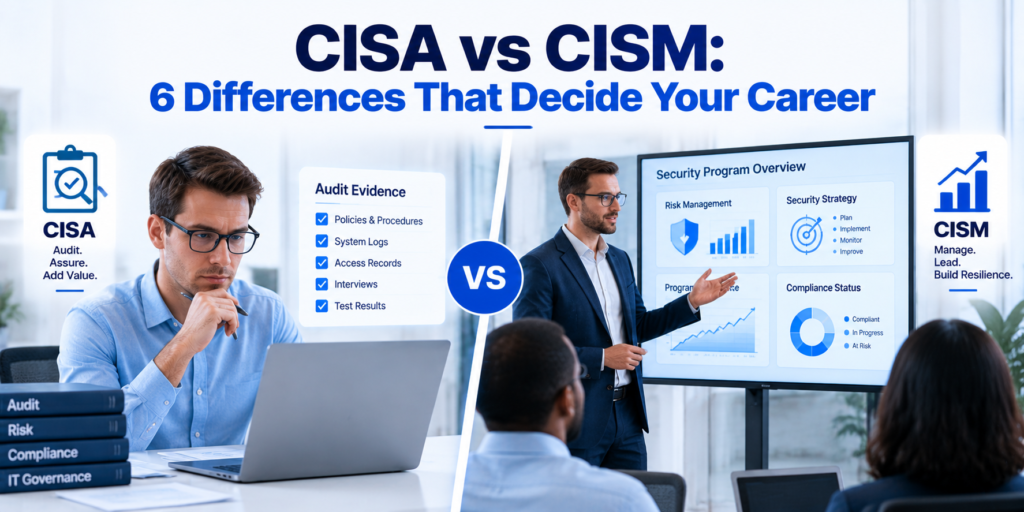
If you are building a GRC or information security career, this question comes up eventually. CISA vs CISM: which one do you need, which is harder, and which should you go after first?
Both come from ISACA. Both require five years of experience. Both are globally recognized. But they test completely different things, open different career doors, and feel harder to completely different people.
This guide gives you the full picture. Not a generic “both are valuable” response. A clear, honest breakdown that helps you decide and move forward.
Table of Contents
What CISA and CISM Actually Test
What CISA Is Really About
CISA stands for Certified Information Systems Auditor. The key word is auditor.
CISA tests your ability to assess, evaluate, and report on IT systems and the controls organizations use to manage risk. You examine evidence. You judge whether controls are designed properly. You determine whether audit conclusions can be defended. You report findings to management in a structured, clear way.
CISA professionals are the people organizations bring in to ask one question: “Is what you say you are doing actually what you are doing?” They verify. They test. They assess.
The exam covers five domains: IS Auditing Process (21%), Governance and Management of IT (17%), IS Acquisition, Development and Implementation (12%), IS Operations and Business Resilience (23%), and Protection of Information Assets (27%).
What CISM Is Really About
CISM stands for Certified Information Security Manager. The key word is manager.
CISM tests your ability to govern, design, and lead information security programs. You make strategic decisions. You allocate resources. You build the security program that CISA auditors later come in to assess. You explain risk posture to executives and boards. You lead incident response.
CISM professionals are the people organizations rely on to answer: “What security program should we build, and is it working?” They design. They lead. They decide.
The exam covers four domains: Information Security Governance (17%), Information Security Risk Management (20%), Information Security Program (33%), and Incident Management (30%).
The Single Biggest Difference Between CISA and CISM
CISA asks: “Is this control working?” CISM asks: “What controls should we build and how do we manage them?”
CISA is an evaluator’s certification. CISM is a leader’s certification.
That distinction explains almost everything else about how they compare.
CISA vs CISM: Side-by-Side Exam Comparison
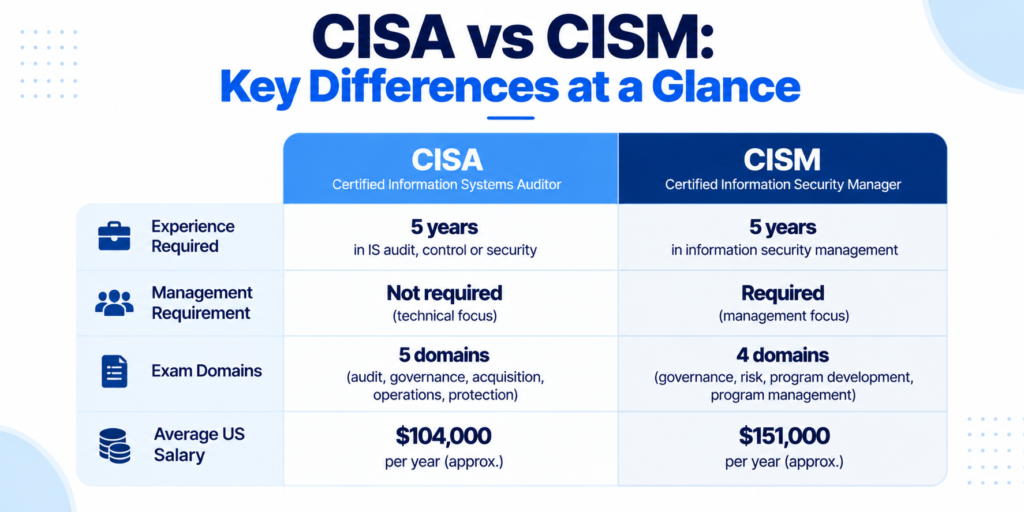
Number of Questions, Time, and Format
| CISA | CISM | |
| Questions | 150 | 150 |
| Time | 4 hours | 4 hours |
| Format | Multiple choice, scenario-based | Multiple choice, scenario-based |
| Delivery | PSI testing centers or online proctoring | PSI testing centers or online proctoring |
| Window after registration | 6 months | 6 months |
Both exams look identical on paper. The difference is entirely in the thinking style each one tests. CISA tests auditor judgment. CISM tests management judgment. Those are two different mindsets, and the exam questions make that clear from the very first section.
CISA Domains and Weightings
Domain 1: IS Auditing Process (21%) Covers audit planning, evidence gathering, testing procedures, and reporting. This is the “how auditors think” domain. Master this first and every other CISA domain becomes more manageable.
Domain 2: Governance and Management of IT (17%) Covers IT governance frameworks, strategy, policies, and performance management. Familiar territory for GRC professionals.
Domain 3: IS Acquisition, Development and Implementation (12%) Covers system development lifecycles, project management controls, and implementation auditing. Lowest weighting. Study this last.
Domain 4: IS Operations and Business Resilience (23%) Covers IT operations management, business continuity, and disaster recovery. Second highest weighting. Give this significant study time.
Domain 5: Protection of Information Assets (27%) Covers information security frameworks, access controls, encryption, and incident management. Highest weighting. Study this first after Domain 1.
CISA study order: Domain 1 → Domain 5 → Domain 4 → Domain 2 → Domain 3
CISM Domains and Weightings
Domain 1: Information Security Governance (17%) Covers how security programs align with business strategy. Connects security decisions to organizational objectives.
Domain 2: Information Security Risk Management (20%) Covers risk identification, assessment, treatment, and monitoring. Strong overlap with GRC program management work.
Domain 3: Information Security Program (33%) Covers security program development, resource management, and performance measurement. Highest weighting by far. This domain carries the most exam questions.
Domain 4: Incident Management (30%) Covers incident planning, response leadership, and post-incident improvement. Second highest weighting.
CISM study order: Domain 1 → Domain 3 → Domain 4 → Domain 2 → Review Domain 1
CISA vs CISM Experience Requirements Compared
| CISA | CISM | |
| Total experience required | 5 years | 5 years |
| Management experience required | None specified | 3 years in security management |
| Domain-specific requirement | IS auditing, control, or security | Information security governance, risk, program, or incident management |
| Exam before experience? | Yes (5 years to submit after passing) | Yes (5 years to submit after passing) |
| Experience substitutions | Up to 3 years via degree or credentials | Up to 2 years via degree or credentials |
The management experience requirement is the most important distinction here. CISM requires three years in security management specifically. CISA does not. This is why CISA is typically the first stop it is accessible earlier in a career.
CISA vs CISM Cost Compared
| CISA | CISM | |
| ISACA member exam fee | $575 USD | $575 USD |
| Non-member exam fee | $760 USD | $760 USD |
| ISACA membership | $135/year | $135/year |
| Review Manual | $79-$119 | $79-$119 |
| QAE Database | $99-$149 | $99-$149 |
| Estimated total (self-study, member) | $860-$910 USD | $860-$910 USD |
The cost is identical. If budget is the only factor in your CISA vs CISM decision, it does not help you choose. Both require the same financial investment.
Which Is Harder: CISA or CISM?
This is the question most people actually want answered. The honest answer is: it depends entirely on your background.
Why CISA Feels Harder for Most People
CISA is harder for most candidates because of one thing: the auditor mindset.
ISACA writes CISA questions from the perspective of a trained auditor. Auditors observe and report. They do not implement or fix problems. They assess whether controls exist and whether they work. When an exam question describes a security gap, the correct CISA answer is almost always “assess the impact and report to management” rather than “fix it immediately.”
This trips up technical candidates constantly. A security engineer wants to fix the problem. CISA rewards the person who documents the finding first.
CISA also covers five domains compared to CISM’s four, including Domain 3 on IT acquisition and development, which is the most unfamiliar domain for non-technical candidates. Many compliance professionals underestimate how much time this domain takes.
Why CISM Feels Harder for Others
CISM is harder for candidates who are technically strong but thin on management experience.
CISM questions come from the perspective of a security manager making strategic calls. They ask things like: “What is the BEST first step when developing a new security awareness program?” or “What should a security manager do FIRST when a new regulation affects the organization?”
These questions have multiple plausible answers. The correct one is always the most strategically sound management decision, not the most technically correct action.
Technical professionals who know security tools and systems inside out often find CISM frustrating because technical knowledge is rarely the deciding factor. Management judgment is.
CISA vs CISM: Which Is Harder If You Come From IT Audit?
If you already work as an IT auditor, CISA is genuinely manageable. The content maps directly to your daily work. Audit planning, evidence gathering, control testing, and reporting are already familiar. You spend study time reviewing and practicing, not learning new concepts.
For this background, CISM feels harder. Moving from evaluating security controls to designing and managing security programs is a real mindset shift. The strategic management thinking CISM tests is less familiar for people who have spent their careers in audit.
For IT auditors: CISA is easier. CISM is the bigger challenge.
CISA vs CISM: Which Is Harder If You Come From GRC or Compliance?
GRC and compliance professionals have a strong advantage in both exams. Risk frameworks, control assessment, policy management, and governance structures are already part of daily work.
For this background, CISA is typically the harder exam. Domain 3 (IT acquisition and development) and parts of Domain 4 (IT operations) cover IT-specific concepts that compliance professionals may not encounter regularly. The CISA audit mindset is learnable, but it requires deliberate focus for professionals who have spent their careers in policy and compliance rather than audit fieldwork.
CISM, by contrast, maps well to GRC work. Security program design, risk management, and governance alignment feel familiar.
For GRC professionals: CISM is easier. CISA takes more deliberate preparation.
CISA vs CISM: Which Is Harder If You Are a Career Changer?
For career changers with no background in IT audit, security management, or GRC, both exams are genuinely challenging. But they present different challenges.
CISA requires you to learn IT audit methodology from scratch. You need to understand how organizations build and operate IT systems before you can meaningfully evaluate the controls around them. Domain 3 and Domain 4 assume significant IT literacy that career changers from accounting, law, or HR may not have.
CISM requires you to learn security management principles and governance frameworks. The concepts are complex but less technically dense than CISA’s IT operations content. Career changers who have managed programs or teams in other fields often find the management thinking in CISM more accessible.
For career changers: CISM may feel slightly more accessible, but CISA is the more important first credential for job market access.
The Verdict: Which Is Actually Harder?
Neither is universally harder. The harder exam is whichever one is furthest from your existing experience.
The industry consensus leans toward CISA being the more technically demanding exam overall because audit methodology and judgment require very specific thinking that CISM does not test as deeply. But for any individual, background determines difficulty more than exam content.
CISA vs CISM: Career and Salary Comparison
Job Titles CISA Opens
CISA appears most in job postings for:
- IT Auditor and Senior IT Auditor
- Information Systems Auditor
- GRC Analyst and Senior GRC Analyst
- Compliance Analyst and Compliance Manager
- IT Risk Analyst
- Security Compliance Specialist
- Internal Auditor with IT scope
At mid-level GRC and audit roles, CISA is increasingly listed as required rather than preferred. Without it, many candidates are filtered out before a hiring manager sees their application.
Job Titles CISM Opens
CISM appears most in job postings for:
- Information Security Manager
- Senior GRC Manager
- Security Program Manager
- IT Risk Manager
- Chief Information Security Officer (CISO) and Deputy CISO
- Director of Information Security
- Security Governance Lead
- Cybersecurity Compliance Director
At the senior and executive level, CISM signals leadership readiness in a way CISA does not. Organizations building security leadership teams treat CISM as the minimum credential for managers who own the security function.
CISA vs CISM Salary (US, UK, Nigeria, Global)
United States: CISA average salary: $110,000+ per year. Senior CISA roles (IT Audit Manager, Senior GRC Specialist): $120,000-$160,000. CISM average salary: $149,000+ per year (ISACA data). Senior CISM roles (Security Manager, Director): $170,000-$220,000.
United Kingdom: CISA holders: £55,000-£85,000 at mid to senior level, £90,000+ in London. CISM holders: £75,000-£110,000 at mid to senior level, £120,000+ for CISO-adjacent roles.
Nigeria: CISA holders: ₦8-18M annually at mid-level. Senior IT Auditors and GRC Specialists in financial institutions earn above this range. Remote international roles: $3,000-$5,000+ monthly. CISM holders: ₦15-30M annually at mid-senior level. Executive roles and multinational employers reach ₦30-50M+. Remote senior roles: $5,000-$10,000+ monthly.
Asia-Pacific: CISA holders: $65,000-$95,000 USD equivalent annually. CISM holders: $90,000-$150,000 USD equivalent annually.
Which Pays More?
CISM pays more at every level and in every market. But comparing CISA vs CISM salaries is somewhat misleading. They are not competing for the same roles. CISA opens mid-level doors. CISM opens senior doors. The salary gap reflects seniority and experience as much as it reflects the credential itself.
Which Should You Get First?
Most articles give a vague “it depends” answer here. Here is a direct one.
The Recommended Order for Most GRC Professionals
Get CISA first.
CISA does not require management experience. That makes it accessible earlier in your career, typically after 2-3 years of relevant work experience.
CISA also appears far more frequently in mid-level job postings. GRC Analyst, Compliance Manager, IT Auditor, and Risk Analyst roles all list CISA far more than CISM. Getting CISA first puts you in front of more opportunities faster.
CISA builds the audit and control thinking that makes CISM more intuitive when you reach it. Professionals who sit CISM without CISA often find the program management content harder to grasp because they lack the control assessment foundation CISA builds.
The sequence that works for most GRC professionals:
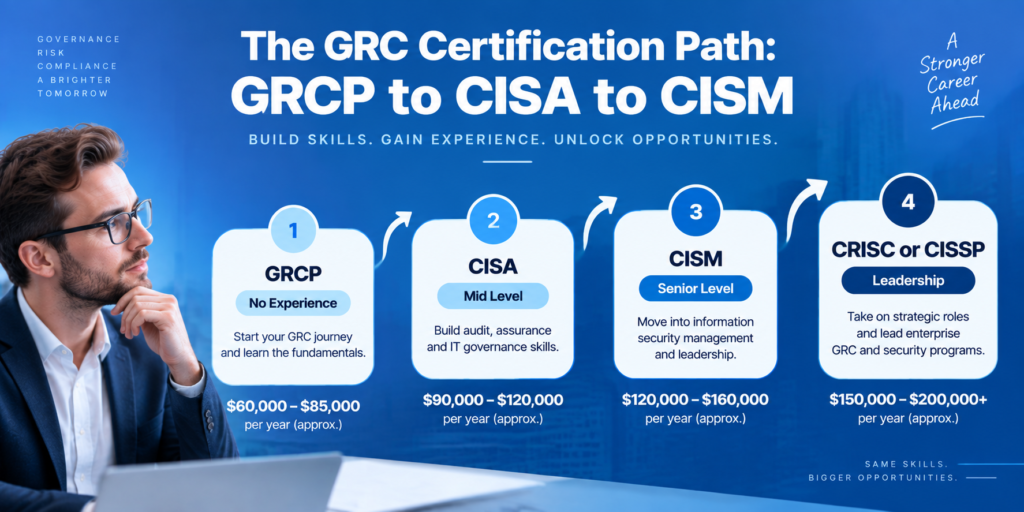
GRCP → CISA → CISM → CRISC or CISSP
Start with GRCP if you are early in your career. Move to CISA at the 2-3 year mark. Pursue CISM once you have 5 years of experience and at least 3 in security management.
When CISM Makes Sense Before CISA
If you already work as a security manager with 5+ years of experience including 3+ in management, you may already qualify for CISM and not need CISA first. Your experience gives you the management foundation CISM builds on.
If your target roles consistently list CISM and rarely mention CISA, follow the market. Check ten job postings for your target role. If CISM appears in seven out of ten and CISA in only two, pursue CISM first.
If your employer funds only one certification and your current role is security management rather than audit, CISM is the more directly applicable investment.
Can You Do Both at the Same Time?
Technically yes. Practically, no.
Both exams require 3-5 months of consistent study at 8-10 hours per week. Studying both simultaneously means splitting time between two different thinking styles (auditor and manager) across nine combined domains. Most candidates who try this end up underprepared for both.
A better approach: pass CISA, spend 6-12 months applying what you learned in your role, then begin CISM preparation. That work experience between exams makes CISM preparation faster and the exam performance stronger.
Where CISA and CISM Fit in the Full GRC Certification Path
Stage 1 (No experience): GRCP from OCEG. No experience required. Builds GRC foundational vocabulary.
Stage 2 (1-3 years experience): CISA exam preparation begins. Mid-level credential. Builds audit and control depth. Opens GRC Analyst, IT Auditor, and Compliance roles.
Stage 3 (3-7 years experience): CISM certification preparation. Senior credential. Builds security management and governance depth. Opens Information Security Manager, GRC Manager, and Security Director roles.
Stage 4 (7+ years experience): CRISC (risk specialization) or CISSP (broad senior security). Opens Director and CISO-track roles.
Both CISA and CISM are essential steps on this path. They serve sequential stages of the same career journey. Neither is optional if you want to reach the top of the GRC ladder.
How to Prepare for Whichever You Choose
Study Timelines for CISA vs CISM by Background
CISA study timelines:
| Background | Estimated Study Time |
| IT Auditor with direct experience | 3-4 months at 8-10 hrs/week |
| GRC or Compliance Professional | 4-5 months at 8-10 hrs/week |
| Career Changer with no audit background | 5-6 months at 8-10 hrs/week |
CISM study timelines:
| Background | Estimated Study Time |
| Security Manager with direct experience | 3-4 months at 8-10 hrs/week |
| GRC Professional moving into security management | 4-5 months at 8-10 hrs/week |
| Professionals with limited management background | 5-6 months at 8-10 hrs/week |
Best Study Materials for CISA
Non-negotiable:
- ISACA CISA Review Manual ($79-$119)
- ISACA CISA QAE Database ($99-$149)
Recommended supplement:
- Mike Chapple’s CISA course on Udemy or LinkedIn Learning ($15-$30)
- ISACA online community forums (free)
For career changers:
- Simplilearn CISA Training ($299-$999) for structured guidance
- Professor Messer’s free Security+ course for IT fundamentals background
Practice question minimum: 1,500-2,000 questions before exam day. Score 75%+ consistently on mixed sets before scheduling.
Best Study Materials for CISM
Non-negotiable:
- ISACA CISM Review Manual ($79-$119)
- ISACA CISM QAE Database ($99-$149)
Recommended supplement:
- Mike Chapple’s CISM course on Udemy or LinkedIn Learning ($15-$30)
- Thor Teaches CISM on Udemy ($15-$30) particularly strong on Domain 3
For candidates who have failed one attempt:
- Simplilearn CISM Training ($299-$999) for live instruction and structured guidance
Practice question minimum: 1,000-1,500 questions before exam day. Score 75%+ consistently on mixed sets before scheduling.
Final Thoughts: Stop Comparing and Start Deciding
The CISA vs CISM debate is worth understanding. But the longer you spend comparing, the longer you delay the certification that actually moves your career forward.
Here is the decision made simple:
Get CISA first if:
- You have fewer than 5 years of experience
- You have fewer than 3 years in security management specifically
- CISA appears more in job postings for your target roles
- You want the most widely recognized mid-level GRC credential
Get CISM first if:
- You already have 5+ years of experience including 3+ in security management
- CISM appears consistently in your target job postings
- Your employer funds only one certification and your role is management-focused
The real answer is not CISA vs CISM as a competition. It is CISA then CISM.
If you want a structured training program that builds the foundations for both certifications in a clear sequence, EMC Institute’s cybersecurity training programs cover the full GRC career path. You build the governance, risk, and compliance knowledge that makes both the CISA exam preparation and the CISM certification journey faster and more effective. You learn in context, not just for an exam. Watch the free VSL to see how EMC Institute’s training connects to the full CISA and CISM certification path.
Stop comparing. Pick one. Start studying.
Is CISA or CISM better?
Neither is universally better. The right one depends entirely on your career stage and what you do day to day. CISA is better if your work involves IT auditing, control evaluation, or compliance assessment. It is the most recognized mid-level GRC credential in job postings globally and the right first step for most professionals entering the GRC field. CISM is better if your work involves leading security programs, managing security teams, or making strategic risk decisions. It targets senior management roles and carries a higher average salary ($149,000+ in the US) compared to CISA ($110,000+). For most GRC professionals, the honest answer is that CISA is better first and CISM is better second. They are sequential steps in the same career path, not competing options.
Can I do CISM without CISA?
Yes, you can. ISACA does not require you to hold CISA before sitting the CISM exam. The only formal requirements are five years of information security work experience, with three of those years in security management specifically. However, most GRC professionals find CISA first more practical because CISA has no management experience requirement and is accessible earlier in a career. Professionals who attempt CISM without CISA and without significant management experience often find the governance and program management content harder to absorb because they lack the control assessment foundation that CISA builds. If you already have 5+ years of experience including 3+ years in security management, going directly to CISM is a perfectly valid path.
Which pays more, CISA or CISM?
CISM pays more at every level and in every market. In the United States, CISM holders earn an average of $149,000+ annually according to ISACA, while CISA holders earn $110,000+ on average. In Nigeria, CISM holders earn ₦15-30M annually at mid-senior level, while CISA holders earn ₦8-18M at mid-level. However, the salary gap reflects seniority as much as it reflects the credential. CISM targets senior management roles that carry broader organizational responsibility. CISA targets mid-level audit and compliance roles. Comparing their salaries is like comparing a mid-level salary to a director salary. The stage behind the credential drives the compensation as much as the credential itself. Both certifications offer strong earning potential for the career stage they serve.
Is CISA harder than CISM?
For most candidates, CISA feels harder because of the auditor mindset it requires. ISACA writes CISA questions from the perspective of a trained auditor who observes, evaluates, and reports rather than fixes problems. Candidates from technical backgrounds who instinctively want to solve problems rather than document findings often find this mindset adjustment difficult. CISM can feel harder for candidates who are technically strong but thin on management experience, because it tests strategic management judgment rather than technical knowledge. The honest answer is that neither is universally harder. Whichever exam is furthest from your current experience will feel harder. IT auditors find CISM harder. GRC and compliance professionals find CISA slightly harder. Career changers find both challenging but for different reasons
How long does it take to get both CISA and CISM?
The total time from starting CISA preparation to holding both certifications typically ranges from 2 to 5 years, depending on your background and how quickly you accumulate the required work experience. CISA preparation takes 3-6 months of study depending on your background. After passing, you have up to 5 years to submit the required work experience documentation for full certification. Most professionals earn full CISA certification within 1-3 years of passing the exam. CISM preparation adds another 3-5 months of study. It also requires 5 years of total information security experience, including 3 years in security management. Professionals who pursue CISA first typically reach CISM readiness 2-4 years after earning CISA. The fastest realistic path for a career changer starting from scratch is approximately 5-7 years from beginning GRC studies to holding both certifications.