
 English
 Arabic
 English
 French
 German
How AI Is Changing Cybersecurity Jobs in 2026
AI can now review alerts, study logs, find weak settings, and draft reports in seconds. If you want to start or grow a cyber career, that speed may worry you. You may be asking, will AI replace cybersecurity jobs?
AI will replace some tasks, but it will not replace the need for skilled people. A tool cannot fully understand a company, lead a team through an attack, or take responsibility for a poor decision. People must still check the facts and choose what happens next.
This guide explains how AI is changing cybersecurity jobs and what those changes mean for you. You will see which roles are changing, which AI cybersecurity jobs are growing, and what skills to learn. You will also get five useful project ideas and a clear 90-day plan.
Table of Contents
How AI Is Changing Cybersecurity Jobs: The Short Answer
The biggest change is happening inside each role. AI is taking over parts of the work, not most full jobs.
A cybersecurity job has many parts. An analyst may review alerts, write reports, investigate attacks, and help the company recover. AI may speed up the first review. It cannot manage every part of the role.
Entry-level work may become more demanding. Employers may expect new workers to use AI, check its answers, and spot errors. That does not mean beginners have no place. It means strong security basics matter more than ever.
Learn the work first. Then learn to use AI as a helper. People who can guide a tool, test its output, and make sound choices will have an advantage.
What Is AI Already Doing in Cybersecurity?
Finding Unusual Activity
AI can review a large amount of user and network activity. It looks for actions that do not match the usual pattern.
For example, a worker may sign in from Lagos every weekday. A new login from another country at 2 a.m. may look risky. An analyst must check whether the worker is travelling or someone stole the account.
The tool spots the change. The analyst uses the full story to decide what it means.
Sorting and Grouping Security Alerts
Security tools can create thousands of alerts. AI can group alerts that may be linked and move urgent ones to the top.
This helps a Security Operations Centre, or SOC, work faster. A SOC is a team that watches for and responds to cyber threats. Even with AI, an analyst must still check the facts and the risk to the business.
Finding Software Weaknesses
AI can scan software, devices, and cloud settings. It may find an open storage folder or an account with too much access. A person must confirm that the weakness is real. The person must also choose a fix that will not stop an important service.
The 2026 Verizon Data Breach Investigations Report says 31% of breaches now start with software weaknesses. It also says generative AI helps attackers work faster across different methods.
Writing Reports and Incident Summaries
AI can turn long technical notes into a short incident report. This can save time, but the first draft is not the final report. A person must check every date, action, and claim. Private company data must also stay out of public AI tools.
Will AI Replace Cybersecurity Jobs?
This is where the fear often starts. Yet the answer becomes clearer when we separate a job from the tasks within it.
Cybersecurity Tasks AI Is Most Likely to Automate
AI works well when a task follows a clear pattern. This includes:
- Sorting basic alerts
- Summarising logs
- Running routine scans
- Collecting basic threat data
- Checking repeated evidence
- Drafting reports and emails
These tasks may not disappear. People may simply spend less time doing them by hand and more time checking the result.
Cybersecurity Tasks That Still Need Human Judgment
People still need to:
- Decide whether an alert is a real attack
- Understand the company and its risks
- Lead an incident response
- Speak with managers, clients, legal teams, and regulators
- Make ethical choices
- Test systems safely and with permission
- Take responsibility for final decisions
AI can suggest an answer. It cannot understand every human need or take responsibility when a poor answer harms a customer or stops a business.
Why Task Automation Is Not the Same as Job Replacement
Imagine that AI groups 500 alerts and writes a short summary. The analyst checks the evidence, finds the cause, blocks the threat, and tells the right people.
The role still exists. The worker spends less time sorting and more time thinking. This is one of the clearest examples of how AI is changing cybersecurity jobs.
Which Cybersecurity Jobs Will AI Change the Most?
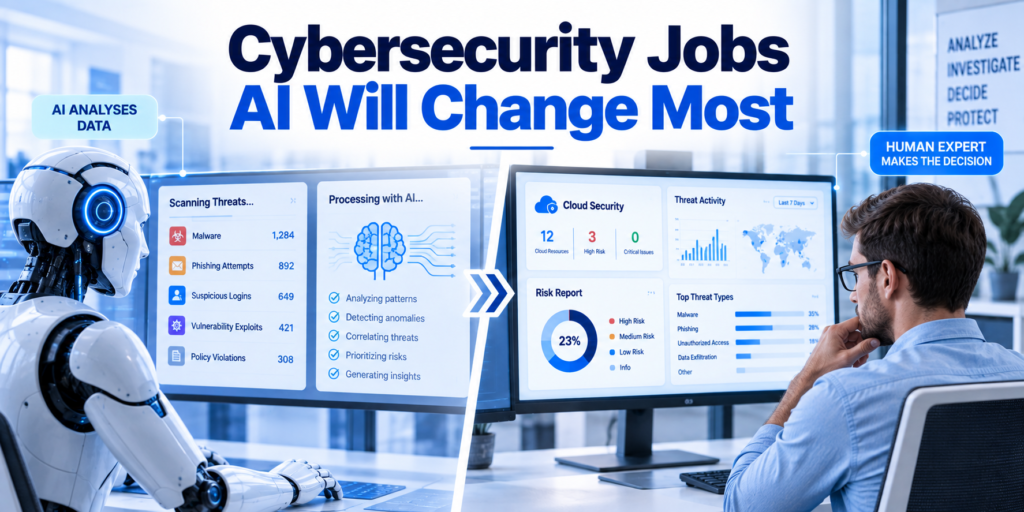
To understand how AI is changing cybersecurity jobs, it helps to look at real roles and the tasks inside them.
| Cybersecurity role | Tasks AI may speed up | Tasks people still lead | Useful AI skills |
| SOC or security analyst | Alert sorting, log summaries, first drafts | Investigation, response, and escalation | AI-assisted detection and output checks |
| Penetration tester | Research, test plans, and code review | Safe testing, creative attack paths, and reporting | Scripting and AI tool checks |
| Threat intelligence analyst | Data collection and summaries | Source checks, context, and prediction | AI research and false-information checks |
| Cloud security professional | Setting reviews and risk alerts | Design, access decisions, and fixes | Cloud automation and AI monitoring |
| GRC professional | Evidence sorting and policy drafts | Risk decisions, interviews, and control design | AI governance, privacy, and compliance checks |
SOC and Security Analysts
AI can group alerts, study logs, and draft notes. Analysts will spend more time on complex events and response decisions. These security analyst interview questions can help you see what employers may test.
Penetration Testers and Ethical Hackers
AI can help testers research systems, review code, and plan tests. Testers must confirm every result, work within written permission, and avoid harm. Human creativity still matters because real systems do not always act as expected.
Threat Intelligence Analysts
AI can collect threat data and create a quick summary. It may repeat an old or false claim, so an analyst must check the source, date, and meaning.
Cloud Security Professionals
AI can watch cloud activity and flag an open database or strange account access. People still design the security plan, control access, and choose fixes.
GRC and Cybersecurity Risk Professionals
Governance, risk, and compliance professionals may use AI to sort evidence and draft policies. They still study rules and decide whether controls work. Common GRC tools help teams manage evidence, risks, and reports.
What New AI Cybersecurity Jobs Are Emerging?
AI is not only changing old roles. It is also creating new AI cybersecurity jobs. The exact title may differ from one company to another, but these five areas are becoming more important.
AI Security Analyst
An AI security analyst checks AI systems for unsafe access, data leaks, strange activity, and misuse. Basic scripting helps, but careful thinking and strong security basics matter most.
Security Automation Engineer
A security automation engineer builds workflows for repeated work. One may collect an alert, gather details, and send it to an analyst. This role often needs scripting, APIs, testing, and SOC knowledge.
AI Red Team Specialist
An AI red team specialist tests AI systems for prompt injection, harmful output, data leaks, and weak access controls. Coding often helps. Written permission and strong ethics are vital.
AI Governance and Risk Specialist
This person checks AI tools before staff use them. The role needs knowledge of policy, privacy, risk, and controls. It suits people who prefer GRC work over coding.
Machine-Learning Security Engineer
This engineer protects AI models, training data, and related systems. It is a technical path that often needs coding, data, cloud, machine-learning, and security skills.
What AI Skills Do Cybersecurity Professionals Need?
The right AI skills for cybersecurity professionals start with security basics. If you do not understand the task, you may not know when a tool is wrong.
Strong Cybersecurity Fundamentals
Learn networking, identity, access control, cloud basics, risk, incident response, and common types of cyber attacks. These skills help you check AI output.
Basic AI Knowledge
Learn what prompts, models, and training data mean. AI can give a clear answer that is still wrong. Learn about bias, private data, unsafe output, and human review.
Automation and Data Skills
Basic Python, PowerShell, APIs, spreadsheets, and log reading can help you work faster. Start with one skill that fits your target role. You do not need to master every tool.
AI Risk and Governance Skills
Companies need rules for AI use and ways to reduce risk. The NIST AI Risk Management Framework is a useful guide to trusted and responsible AI.
Human Skills AI Cannot Easily Replace
Clear writing, careful thinking, teamwork, curiosity, and ethical judgment remain valuable. Workers must explain risk, stay calm during attacks, and ask questions a tool may miss.
Do You Need Coding for AI Cybersecurity Jobs?
You may think every AI role needs strong coding skills. That is not true. It depends on the work you choose.
Roles Where Coding Is Helpful
Coding helps in automation, AI red teaming, detection engineering, machine-learning security, and advanced cloud security. Python is a common starting point. Understand what your code does and test it safely.
Roles Where Coding Is Not the Main Requirement
GRC, AI governance, compliance, and security awareness focus more on people, rules, and decisions. Some SOC work also begins with little coding. Explore these paths in our guide to cybersecurity without coding.
Practical AI Cybersecurity Projects to Build Experience
Knowing the ideas is useful. Showing that you can apply them is better. Pick one project and create work you can explain in an interview.
Project 1: Compare Manual and AI-Assisted Alert Triage
Review safe sample alerts by hand and with an approved AI tool. Compare time, correct findings, missed details, and false alarms. Explain when a human must step in.
Project 2: Build an AI Risk Register
Create a sample company with an AI chatbot. List each risk, affected data, impact, control, and owner. Turn it into a risk register and treatment plan.
Project 3: Review AI-Generated Phishing Messages
Mark warning signs in safe, made-up emails, such as urgent requests and strange links. Create a one-page guide to spotting AI-written scams.
Project 4: Write a Safe AI Use Policy
Write rules for what staff can place in public AI tools. Cover private data, fact checks, approval, and reporting mistakes. Add a short checklist.
Project 5: Correct an AI-Generated Incident Report
Create a fictional security event and an AI-written first draft. Find missing facts, weak claims, unclear words, and private details. Correct it and explain each key change.
How to Prepare for the Future of Cybersecurity Jobs in 90 Days
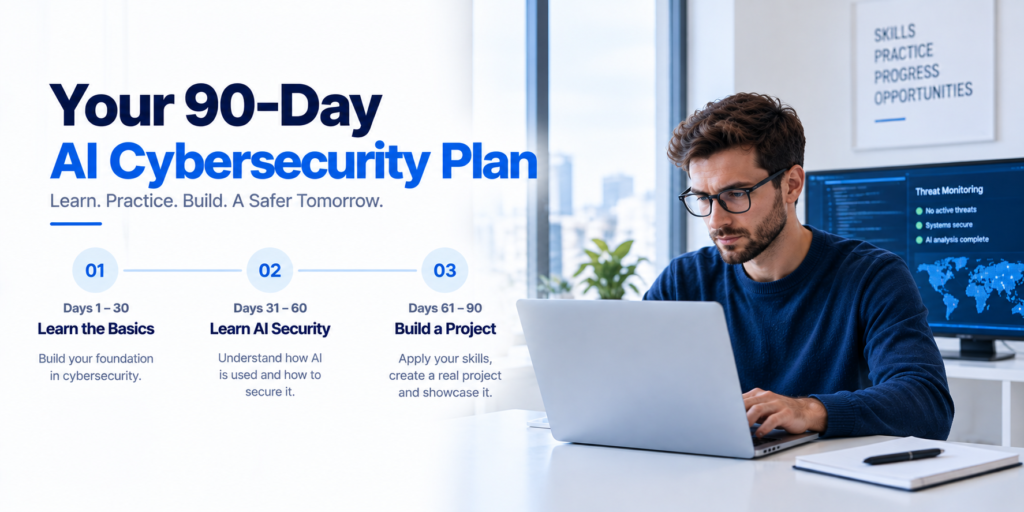
The future of cybersecurity jobs may feel hard to plan for. You do not need to learn everything at once. Use this plan to build your skills in the right order.
Days 1 to 30: Build the Foundation
Study networks, identity, attacks, risk, and incident response. Complete small labs. Record what happened, what you found, and how you fixed it.
Days 31 to 60: Learn How AI Supports Security Work
Learn AI terms, limits, privacy risks, automation, and governance. Use AI only for safe, approved tasks. Check every answer with a trusted source.
Days 61 to 90: Complete and Present One Project
Choose one project. Record the problem, tools, steps, findings, limits, and result. Add it to your portfolio and write two or three resume points. Practise explaining it without AI.
Common Mistakes to Avoid When Using AI in Cybersecurity
AI can help you work faster, but speed can lead to careless choices. Avoid these common mistakes:
- Uploading company, client, or private data to a public AI tool
- Trusting every AI answer
- Copying a report without checking the facts
- Testing a system without written permission
- Listing skills on your resume that you cannot explain
- Letting AI make an important security decision alone
- Ignoring company rules, privacy duties, or legal limits
Before using AI, ask: Is the data safe to share? Can I check the answer? Who makes the final decision?
Is Cybersecurity Still a Good Career in the Age of AI?
Yes. Cybersecurity is still a good career, but the work and the skills are changing.
The U.S. Bureau of Labor Statistics projects that information security analyst jobs will grow 21% from 2025 to 2035. It also projects about 14,100 openings each year on average during that period. The median yearly pay was $129,180 in May 2025.
These are U.S. figures. Pay and demand differ by country, role, and experience. BLS also lists more use of AI as one reason stronger security will be needed.
This job outlook does not mean every person will get a role. It does show that security work is still needed. As you prepare for the future of cybersecurity jobs, do not chase every new AI tool. Learn security well, build proof of your skills, and use AI safely in your chosen role.
Build Practical Cybersecurity and AI Skills With ExcelMindCyber
It can be hard to know what to learn first or how to turn lessons into real work. ExcelMindCyber helps career changers, graduates, and working professionals follow a clear path through structured training, hands-on work, career guidance, and support.
If you want a clearer path into cybersecurity, learn more about EMC Institute’s cybersecurity training programs. Review the program information and choose the next step that fits your goals.
Final Thoughts on How AI Is Changing Cybersecurity Jobs
AI is changing cybersecurity work, but skilled people still matter. A tool can sort data and draft an answer. A person must check the facts, understand the risk, and act with care.
You do not need to compete with AI. You need to know how to work with it. Build strong security basics. Learn safe AI use. Then complete a project that proves your skill.
Now that you understand how AI is changing cybersecurity jobs, choose one role and begin the first 30 days of the plan.
Will AI replace cybersecurity jobs?
AI will replace some basic and repeated tasks, but it is unlikely to replace most cybersecurity jobs. People are still needed to investigate threats, check AI results, make decisions, and manage security incidents.
How is AI changing cybersecurity jobs?
AI is helping professionals sort alerts, study logs, find system weaknesses, and draft reports. This allows workers to spend more time investigating threats, solving problems, and making important security decisions.
Which cybersecurity jobs will AI affect the most?
AI will strongly affect SOC analysts, threat intelligence analysts, penetration testers, cloud security experts, and GRC professionals. These roles will remain important, but some daily tasks will become faster or automated.
What AI skills do cybersecurity professionals need?
Cybersecurity professionals should understand basic AI tools, automation, data safety, and AI risks. They should also know how to check AI answers instead of trusting every result.
Do I need coding for AI cybersecurity jobs?
Not every AI cybersecurity job requires coding. Coding is useful for security automation, AI red teaming, and machine-learning security. Roles in GRC, compliance, risk, and AI governance may require little or no coding.