
 English
 Arabic
 English
 French
 German
19 Types of Cyber Attacks: Know Your Enemy, Stay Safe
You hear about cyber attacks constantly. Ransomware shut down a hospital. A phishing email leaked millions of records. A supply chain attack hit hundreds of companies at once. But if someone asked you to explain exactly how each of these works, could you?
If the answer is not a confident yes, this guide fixes that.
Understanding types of cyber attacks is not just a technical skill. It is a career skill. GRC professionals, compliance managers, and security leaders all need this knowledge to assess risk accurately, design effective controls, and respond when something goes wrong.
This guide explains the main attack categories in plain English, connects each one to real organizational risk, and shows how this knowledge builds your cybersecurity career.
Table of Contents
Why Understanding Cyber Attack Types Matters for Your Career
How Attack Knowledge Connects to GRC Work
GRC professionals do not build firewalls or write detection rules. But they do design risk assessments, build security policies, oversee compliance programs, and manage incident response plans. All of that work requires understanding what you are protecting against.
If you cannot explain the difference between phishing and ransomware, you cannot accurately assess the risk they represent. If you do not understand how a DDoS attack works, you cannot evaluate whether your organization’s business continuity plan covers it. If you have never heard of credential stuffing, you cannot write a meaningful access control policy.
Attack knowledge is the foundation of GRC work. The better you understand how attackers operate, the better your risk assessments, policies, and controls become.
Which Certifications Test Attack Knowledge
Every major cybersecurity certification covers attack types.
CompTIA Security+ tests attack types across multiple domains. Understanding how malware, social engineering, and network attacks work is essential for passing.
CISA tests how organizations control and detect security threats. Auditors need to understand what attacks look like to evaluate whether controls are effective against them.
CISM tests how security managers respond to and recover from incidents. You cannot lead an incident response without knowing what type of attack you are dealing with.
GRCP tests governance and risk management principles. Understanding what attacks exist and the risks they create is part of the foundational knowledge the exam covers.
Types of Cyber Attacks
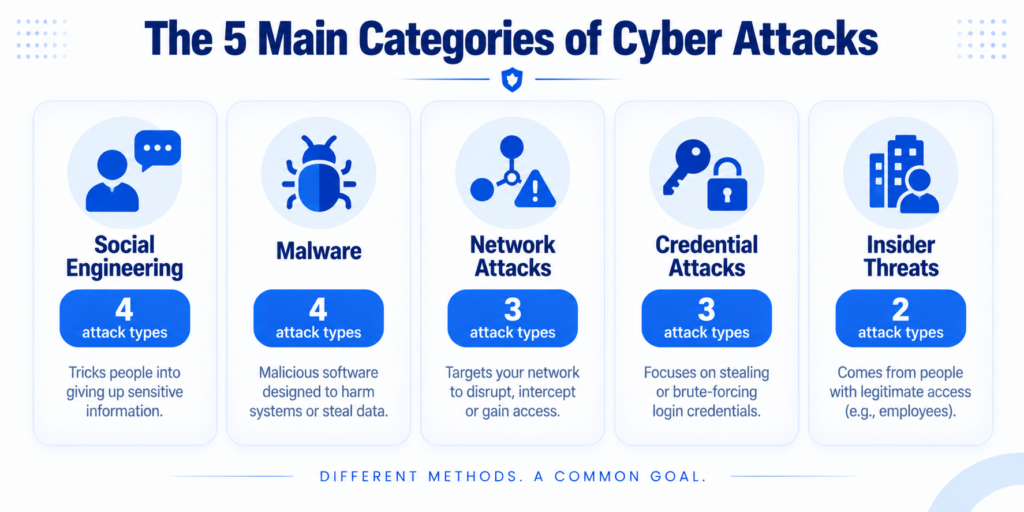
Cyber attacks fall into five broad categories. Each targets a different weakness and requires different defenses.
Social engineering attacks target human psychology. They trick people into doing something they should not.
Malware attacks use malicious software to damage, steal from, or take control of systems.
Network and infrastructure attacks target the systems and connections that keep organizations running.
Credential and identity attacks target login information and user privileges to gain unauthorized access.
Insider threats come from within the organization, from malicious employees or careless ones.
Most real attacks combine more than one category. A ransomware attack (malware) often starts with a phishing email (social engineering). A credential stuffing attack may follow a data breach. Understanding each category separately helps you recognize and defend against the combinations.
Social Engineering Attacks
Social engineering attacks are the most common type of cyber attack globally. Phishing, ransomware, malware, denial-of-service, and credential-based attacks all rank among the most frequent threats organizations face. Phishing sits at the top because it works regardless of how strong your technical defenses are. If an employee hands over their password voluntarily, no firewall stops that.
Phishing
Phishing is when an attacker sends a fake message that looks like it comes from a trusted source. A bank. A colleague. A government agency. The goal is to trick the recipient into clicking a bad link, downloading a malicious file, or entering login credentials into a fake website.
A common example: an attacker sends a fake Microsoft 365 login page link to employees. The employee sees what looks like a routine login prompt, types their credentials, and the attacker captures them instantly.
GRC implication: Phishing is the entry point for many of the most costly breaches. GRC professionals design phishing awareness training programs, set email handling policies, and include phishing scenarios in risk assessments. Mature GRC programs measure phishing simulation results and track employee reporting rates over time.
Spear Phishing
Spear phishing is targeted phishing. Instead of sending generic emails to thousands of people, the attacker researches one specific target. They use the target’s name, job title, recent activity, and colleague names to craft a message that feels completely real.
A finance manager receives an email appearing to come from the CEO, asking them to approve an urgent wire transfer to a new vendor. The sender address looks right. The tone sounds right. The request seems plausible. The money goes to an attacker’s account.
GRC implication: Spear phishing bypasses general awareness training because it is too specific. GRC programs address this through targeted training for high-risk roles (finance, HR, executive assistants), strict wire transfer approval processes, and email authentication controls.
Vishing and Smishing
Vishing uses voice calls. Smishing uses text messages. Both use the same psychological tactics as email phishing but through different channels.
A vishing attacker calls an employee pretending to be from IT support, asking them to verify login credentials to fix a system issue. A smishing attacker sends a text saying a package could not be delivered, with a link to reschedule.
These attacks are growing because most people apply less skepticism to calls and texts than to emails. AI-generated voices cloning real colleagues or executives are making vishing attacks significantly harder to detect.
GRC implication: GRC professionals address vishing and smishing through multi-channel security awareness programs, verification procedures for sensitive requests by phone, and mobile device management policies.
Business Email Compromise (BEC)
BEC attacks target organizations for financial loss. The attacker either compromises a real email account or creates a convincing fake one. They then use it to request fraudulent payments, redirect payroll, or change vendor bank details.
In 2019, Toyota lost $37 million when an attacker impersonating a European subsidiary executive convinced a finance employee to change wire transfer details. The money went directly to the attacker.
GRC implication: BEC is one of the highest-cost cyber attack examples for organizations. GRC professionals address it through dual-approval processes for large financial transactions, strict verification procedures for payment detail changes, and regular financial controls audits.
Malware Attacks
Malware is any software designed to damage, steal from, or take control of a system. It enters systems through phishing emails, malicious downloads, infected USB drives, and software vulnerabilities. Once inside, what it does depends on the type.
Ransomware
Ransomware encrypts a victim’s files or locks their system. The attacker then demands a ransom payment to restore access. It usually spreads through phishing emails or malicious downloads.
WannaCry ransomware is the most well-known example. It encrypted system files and demanded Bitcoin payment for decryption. It infected over 200,000 computers in 150 countries in a single day in 2017. The UK’s National Health Service was among the victims, forcing hospitals to cancel appointments and divert ambulances.
GRC implication: Ransomware carries direct compliance implications. Healthcare organizations hit by ransomware face HIPAA breach notification requirements. Financial organizations face regulatory reporting obligations. GRC professionals ensure business continuity plans, backup strategies, and incident response procedures address ransomware specifically.
Spyware
Spyware secretly monitors and collects information from a victim’s system. It runs silently in the background, recording keystrokes, capturing screenshots, and transmitting sensitive data to attackers.
Organizations infected with spyware may have confidential data, customer records, or employee credentials stolen with no visible signs of intrusion. The attacker collects information quietly for weeks or months before acting.
GRC implication: Spyware directly threatens data privacy compliance. GDPR, HIPAA, NDPA (Nigeria Data Protection Act), and other privacy regulations require organizations to protect personal data from unauthorized access. GRC professionals include endpoint monitoring, data loss prevention, and access logging controls to detect spyware activity.
Trojans
A Trojan is malware disguised as legitimate software. It looks harmless from the outside but delivers something harmful once it is inside.
An employee downloads what appears to be a legitimate software update. The update installs normally, but in the background it also installs a Trojan that gives the attacker remote access to the system.
GRC implication: Trojans highlight the importance of software procurement controls. GRC programs address Trojans through approved software lists, download restrictions, vendor security assessments, and application whitelisting policies.
Viruses and Worms
A virus attaches to a legitimate file and spreads when that file is shared. A worm spreads automatically across networks without needing human action. Both can cause significant damage at scale once they enter an organization’s systems.
GRC implication: Viruses and worms spread through poor patch management, weak network segmentation, and lack of endpoint controls. GRC professionals include patch management requirements, network segmentation standards, and antivirus deployment controls in security program frameworks.
Network and Infrastructure Attacks
Network attacks target the systems and connections that keep organizations running. Their goal is often disruption rather than data theft, though some combine both.
Denial of Service (DoS) and DDoS Attacks
A DDoS attack floods a website or online service with traffic from thousands of infected devices, making it unavailable to legitimate users. Attackers use a network of infected devices called a botnet to send millions of requests simultaneously, causing the server to crash or slow to a halt.
For organizations that depend on their websites (e-commerce, banking, fintech), a DDoS attack causes direct financial loss for every minute of downtime. For hospitals or emergency services, it can affect patient safety.
GRC implication: DDoS attacks directly impact business continuity and availability, which are core compliance requirements across HIPAA, SOC 2, and ISO 27001. GRC professionals include DDoS response procedures in business continuity plans and ensure service level agreements with cloud and hosting providers include DDoS protection commitments.
Man-in-the-Middle (MitM) Attacks
A MitM attack happens when an attacker secretly positions themselves between two communicating parties. Both parties think they are communicating directly. The attacker reads, intercepts, or alters the communication without either knowing.
A common example is an attacker setting up a fake Wi-Fi hotspot in a coffee shop. Employees who connect and check work email or access internal systems send that data directly through the attacker’s device.
GRC implication: MitM attacks highlight the importance of encryption, VPN policies, and public Wi-Fi usage restrictions. GRC professionals address MitM through remote access policies, mandatory VPN use, certificate management requirements, and employee education about public network risks.
SQL Injection
SQL injection is a web application attack where an attacker enters malicious database commands into an input field instead of the expected text. If the application is not properly protected, it executes the command and returns sensitive database contents, including customer records, payment data, or login credentials.
A simple example: a website has a search box. A user types a product name. An attacker types a database command. The vulnerable application returns everything in the database.
GRC implication: SQL injection is a known, preventable vulnerability. Organizations that suffer SQL injection breaches face compliance consequences because the attack exploits a failure in secure development practices. GRC professionals include secure coding standards, application security testing requirements, and web application vulnerability scanning in development and deployment policies.
Credential and Identity Attacks
Credential attacks focus on stealing or guessing login information. Once an attacker has valid credentials, they can access systems while appearing to be a legitimate user.
Brute Force Attacks
A brute force attack systematically tries every possible password combination until it finds the right one. A dictionary attack uses a list of common passwords and known leaked passwords to try likely combinations faster.
A brute-force tool might repeatedly test password combinations to gain unauthorized access to a server. This is why short, simple passwords are so dangerous.
GRC implication: Brute force attacks are addressed through password policies (minimum length, complexity requirements, no reuse), account lockout controls, and multi-factor authentication. GRC professionals establish these as baseline security standards across the organization.
Credential Stuffing
Credential stuffing uses username and password combinations leaked in one breach to try to access accounts on other services. Because many people reuse passwords, this attack is highly effective.
An attacker obtains 50 million username and password combinations from a leaked retail database. They run those combinations against banking apps, email services, and corporate login portals. For every person who reused a password, the attack succeeds automatically.
GRC implication: Credential stuffing is addressed through mandatory unique password policies, password manager adoption, multi-factor authentication requirements, and monitoring for unusual login patterns. These are standard elements of a GRC security controls framework.
Privilege Escalation
Privilege escalation happens when an attacker gains access to a low-privilege account and then exploits vulnerabilities to increase their access level. Starting as a regular user, they work their way up to administrator access.
An attacker compromises an entry-level employee’s account through phishing. That account has limited access. The attacker then exploits an unpatched software vulnerability to gain administrator privileges. Now they have access to everything.
GRC implication: Privilege escalation highlights the importance of least-privilege principles in access control. GRC professionals establish policies requiring users receive only the minimum access needed for their role, and that privileged accounts are monitored, regularly reviewed, and protected with stronger authentication.
Insider Threats
Insider threats come from within the organization. They are particularly dangerous because insiders already have legitimate access, making their activity harder to detect than external attacks.
Malicious Insiders
A malicious insider deliberately misuses their access for personal gain or to harm the organization. A disgruntled employee stealing customer data before leaving. A contractor exfiltrating intellectual property. A systems administrator abusing privileged access for financial fraud.
In 2020, a Tesla employee was approached by Russian cybercriminals and offered $1 million to install malware on Tesla’s network from the inside. The employee reported the attempt to the FBI. Not all employees do.
GRC implication: Malicious insider risk is addressed through background checks, separation of duties, least-privilege access controls, activity monitoring for privileged users, and offboarding procedures that immediately revoke access when employees leave.
Negligent Insiders
Not all insider threats are deliberate. Negligent insiders cause incidents through carelessness or lack of awareness. An employee who clicks a phishing link, connects to public Wi-Fi without a VPN, sends sensitive data to the wrong email address, or leaves a laptop unsecured in a public space creates real security risk without any malicious intent.
GRC implication: Negligent insider risk is addressed through security awareness training, acceptable use policies, data handling procedures, and technical controls that reduce the damage a careless action can cause (data loss prevention tools, email filtering, device encryption).
How GRC Programs Address Insider Threats
Insider threat programs in mature GRC frameworks include three components. Prevention through policies, training, and access controls. Detection through monitoring of user behavior, privileged account activity, and data movement. Response through defined procedures for investigating and escalating suspected insider incidents.
The GRC Roadmap from entry-level analyst to senior specialist includes increasing ownership of these program components at each career stage.
Emerging Attack Types in 2026
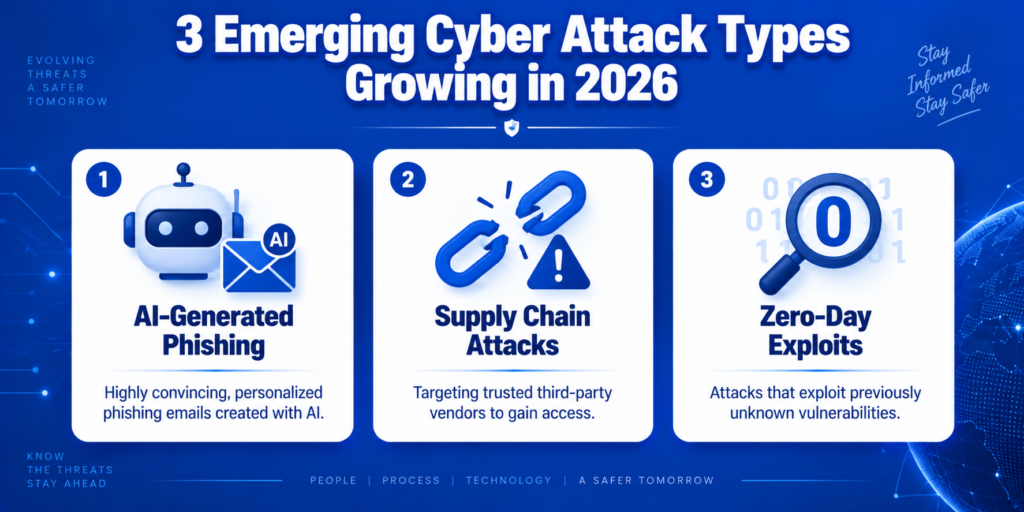
The threat landscape changes every year. These three attack categories are growing in frequency and impact this year.
AI-Generated Phishing
AI tools have made phishing emails significantly harder to detect. Where attackers once produced messages with obvious grammar mistakes and generic greetings, AI now generates highly personalized, grammatically perfect messages at scale.
AI voice cloning is also enabling more sophisticated vishing attacks. An attacker clones a CEO’s voice from a publicly available video and calls the finance team requesting an urgent transfer. The voice sounds identical to the real person.
GRC implication: AI-generated phishing is outpacing awareness training that teaches people to spot poor grammar and generic content. GRC professionals are shifting programs to focus on process-level verification rather than message-level detection. When a request triggers a financial action, verify through a second channel regardless of how legitimate the message appears.
Supply Chain Attacks
A supply chain attack targets a vendor or software provider to reach their customers indirectly. Instead of attacking an organization directly, the attacker compromises a trusted tool or service and uses it as the entry point.
The SolarWinds attack in 2020 is the clearest example. Attackers compromised a software update for SolarWinds’ Orion platform. When 18,000 organizations installed the update, they unknowingly installed malware too. Victims included US government agencies and major corporations.
GRC implication: Supply chain attacks have driven significant growth in vendor risk management as a GRC discipline. GRC professionals now design and manage vendor risk assessment programs that include security questionnaires, contractual security requirements, and ongoing monitoring of critical suppliers.
Zero-Day Exploits
A zero-day exploit targets a vulnerability the software vendor does not yet know about. Because no patch exists, organizations remain vulnerable until the vendor discovers the issue and releases a fix.
Zero-day vulnerabilities are valuable in criminal markets. Sophisticated attackers, including state-sponsored groups, acquire and hold zero-days to use against specific high-value targets.
GRC implication: Zero-day risk highlights the importance of defense-in-depth in GRC frameworks. Since perfect prevention is impossible, GRC professionals ensure controls exist to detect and limit damage from attacks that succeed despite best efforts. Network segmentation, privileged access management, behavioral monitoring, and incident response planning all reduce zero-day impact.
How Cyber Attacks Connect to GRC and Compliance
Risk Assessment and Attack Types
Every risk assessment starts with threat identification. What could go wrong? What are the realistic cybersecurity threats for this organization, in this industry, with this data?
Understanding attack types makes this analysis meaningful. A healthcare organization faces different primary threats than a retail company. A fintech startup faces different risks than a government agency. GRC professionals who understand attack categories build threat models that reflect the actual risk landscape rather than generic lists.
Compliance Frameworks and Attack Prevention
Major compliance frameworks organize their controls around defending against specific attack types even when they do not name them directly.
NIST Cybersecurity Framework categories (Identify, Protect, Detect, Respond, Recover) map directly to the lifecycle of any cyber attack. ISO 27001 A.13 covers network security controls addressing DDoS, MitM, and SQL injection. A.7 covers human resource security controls addressing insider threats and social engineering. A.12 covers operations security controls addressing malware.
GRC professionals who understand attacks use these frameworks to evaluate whether existing controls address the threats an organization actually faces.
Incident Response Planning
When an attack happens, the response depends entirely on the attack type. A ransomware incident requires isolating infected systems, identifying the malware variant, and activating backup recovery. A data exfiltration incident requires identifying what was taken, notifying affected parties, and meeting breach reporting deadlines. A DDoS incident requires activating alternative service arrangements and working with providers on traffic mitigation.
GRC professionals who understand attack types build incident response plans that address each category specifically. Generic plans that do not differentiate by attack type often fail in practice because the right response depends entirely on what you are facing.
Cyber Attacks in Nigeria and Africa: What You Need to Know
The African cybersecurity threat landscape has specific characteristics that GRC professionals in the region need to understand.
Phishing and BEC attacks are the most prevalent threats in Nigeria. Financial institutions, fintechs, and telecommunications companies are the most frequently targeted sectors. Rapid digital adoption combined with relatively immature security infrastructure creates significant vulnerability across many organizations.
Nigeria ranks among the most targeted countries in Africa for cybercrime. The Nigerian Communications Commission (NCC) and Central Bank of Nigeria (CBN) have both issued cybersecurity guidelines requiring regulated organizations to have specific controls in place. The National Information Technology Development Agency (NITDA) enforces the Nigeria Data Protection Act (NDPA), which requires organizations to protect personal data from the common cyber attacks described in this guide.
Ransomware targeting Nigerian businesses has increased as more organizations move critical operations online. Healthcare, education, and government agencies are particularly vulnerable because security investment has historically lagged digital adoption in these sectors.
For GRC professionals working in Nigeria and across Africa, understanding the regional threat landscape means knowing which attack types are most likely, which industries are most targeted, and which regulatory frameworks require specific protective responses. That knowledge directly improves risk assessments, security program design, and compliance reporting in the regional context.
Final Thoughts: Knowledge Is Your First Defense
You cannot defend against what you do not understand. That applies to technical security professionals. It applies equally to GRC professionals, compliance managers, and anyone building a cybersecurity career.
Understanding types of cyber attacks gives you the foundation to assess risk accurately, design controls that address real threats, build incident response plans that work, and communicate security risk in language executives and auditors can act on.
The threat landscape keeps changing. AI-generated attacks are getting more convincing. Supply chain risks are growing. Zero-day exploits remain impossible to fully prevent. But the fundamental categories in this guide are stable. Understand them and you will recognize any new attack type that emerges as a variation on one of these foundations.
If you want structured training that connects attack knowledge to GRC program design, risk assessment, and cybersecurity career development, EMC Institute’s cybersecurity programs build this understanding as part of a broader GRC professional curriculum. You learn not just what attacks are, but how they connect to governance frameworks, compliance requirements, and the security decisions GRC professionals make every day. Watch the free VSL to see how the program covers the security knowledge GRC professionals need to advance.
Attack knowledge is not optional for GRC professionals. It is foundational.
What Are the 7 Types of Cybersecurity Threats?
The seven main types of cybersecurity threats are malware, social engineering, ransomware, man-in-the-middle attacks, denial of service attacks, credential attacks, and insider threats. Malware covers any malicious software designed to damage or steal from systems, including viruses, worms, trojans, and spyware. Social engineering attacks like phishing and BEC exploit human psychology rather than technical vulnerabilities. Ransomware encrypts files and demands payment for restoration. Man-in-the-middle attacks intercept communications between two parties without their knowledge. Denial of service attacks flood systems with traffic to make them unavailable. Credential attacks including brute force and credential stuffing target login information to gain unauthorized access. Insider threats come from employees or contractors who misuse legitimate access, whether deliberately or through negligence. Understanding these seven categories gives you a framework for identifying risk and designing defenses across any organization.
What Are the 12 Most Common Types of Cybercrime?
The 12 most common types of cybercrime globally are phishing, ransomware, business email compromise (BEC), identity theft, data breaches, malware attacks, online fraud, credential theft, DDoS attacks, insider theft, supply chain attacks, and cryptojacking. Phishing is the most frequently reported cybercrime in most countries, used both as a standalone attack and as the entry point for larger incidents. Business email compromise is the most financially damaging, costing organizations billions annually. Ransomware is the fastest-growing, with attacks on healthcare, education, and government organizations increasing sharply since 2020. Identity theft and data breaches often result from the same credential attack and drive significant regulatory and compliance consequences for organizations. Supply chain attacks, though less frequent, tend to have the widest organizational impact because one compromised vendor can reach thousands of downstream victims. For GRC professionals, understanding which cybercrimes are most common in their industry and region directly shapes risk assessment priorities and compliance program design.
Which Is the Most Common Cyber Attack?
Phishing is the most common cyber attack globally. It accounts for the majority of reported cybersecurity incidents across industries and regions and serves as the entry point for many of the most damaging breaches, including ransomware deployments and business email compromise. Phishing works because it targets human behavior rather than technical vulnerabilities. No firewall stops an employee who voluntarily hands over their credentials. According to multiple industry reports, phishing is involved in more than 80% of reported security incidents. The variants of phishing, including spear phishing (targeted attacks), vishing (voice calls), smishing (text messages), and AI-generated phishing, are all growing in frequency and sophistication. For organizations in Nigeria and across Africa, phishing and BEC attacks are the most commonly reported cybercrime categories, particularly targeting financial institutions, fintechs, and telecommunications companies. GRC professionals address phishing through security awareness training programs, phishing simulations, email authentication controls, and verification procedures for high-risk financial actions.
How Do Cyber Attacks Affect GRC and Compliance?
Cyber attacks create direct compliance obligations for organizations. A ransomware attack on a healthcare organization triggers HIPAA breach notification requirements within 60 days. A data breach exposing customer records in Nigeria triggers NDPA reporting obligations. A financial fraud incident at a bank triggers CBN and SEC regulatory reporting. Beyond mandatory reporting, attacks that succeed reveal gaps in existing security controls, which creates audit findings, remediation requirements, and potential regulatory fines. GRC professionals are responsible for ensuring compliance frameworks like ISO 27001, NIST CSF, SOC 2, and GDPR are implemented in ways that actually reduce the likelihood and impact of these attacks. This means understanding which attack types each control framework addresses, which threats are most relevant to the organization’s industry, and what the regulatory consequences look like when an attack succeeds despite existing controls.
How Can GRC Professionals Use Knowledge of Cyber Attacks in Their Career?
Understanding cyber attacks is a direct career asset for GRC professionals at every level. At the entry level, attack knowledge improves the quality of risk assessments, makes policy writing more practical, and helps analysts communicate security risk more convincingly to technical colleagues. At the mid level, it enables GRC specialists to design security programs that address real threats rather than generic checklists, evaluate vendor security posture more accurately, and lead incident response planning with clear thinking about what different attacks require. At the senior level, it supports executive communication by allowing security leaders to translate technical attack scenarios into business risk language that boards and regulators understand. Attack knowledge is also tested in every major GRC certification including Security+, CISA, CISM, and GRCP, which means building this knowledge now accelerates certification preparation alongside career development.