
 English
 Arabic
 English
 French
 German
Cybersecurity Without Coding: Your Complete Guide
“I want to learn cybersecurity, but I don’t know how to code. Does that mean I’ve already missed my chance?”
If you’ve ever asked yourself that question, you’re not alone. Every day, people give up on the idea of cybersecurity without coding because they believe programming is the only way in. They watch ethical hackers write commands on a black screen, read job descriptions filled with technical terms, and quietly convince themselves that cybersecurity without coding is impossible.
The truth is, many people never miss the opportunity. They simply walk away because of a misunderstanding.
Yes, some cybersecurity careers require coding. But many others do not. Organizations also need professionals who can manage security risks, prepare for audits, protect sensitive information, train employees, and help businesses meet security standards. These roles rely on problem solving, communication, and critical thinking, not software development.
That does not mean you can avoid learning technology. You still need to understand how systems, networks, and cybersecurity work. The difference is that your job may focus on protecting the business instead of writing code.
Whether you are a teacher, banker, accountant, nurse, customer service representative, project manager, recent graduate, or someone looking for a career change, you may already have skills that employers value in non coding cybersecurity roles.
In this article, you’ll learn what cybersecurity without coding really means, why so many people think programming is required, the cybersecurity careers you can pursue without becoming a programmer, and the practical steps you can take to get started with confidence.
Can You Really Work in Cybersecurity Without Coding?
Yes, you can.
Many cybersecurity roles do not require programming because they focus on managing risks, protecting information, improving security processes, and helping organizations meet industry standards. In these roles, your ability to analyze problems, communicate clearly, and make informed decisions is often more valuable than writing code.
Some of the most common non coding cybersecurity careers include:
- Governance, Risk, and Compliance (GRC)
- IT Audit
- Security Awareness
- Third Party Risk Management
- Cybersecurity Project Management
These professionals work in banks, hospitals, schools, government agencies, technology companies, insurance firms, and many other organizations. As cyber threats continue to grow, the need for people who can protect data and manage security risks also continues to increase.
The important thing is to choose the right career path. Once you understand where your interests and strengths fit, you can focus on learning the skills employers are looking for instead of worrying about becoming a programmer.
What Does Cybersecurity Without Coding Really Mean?
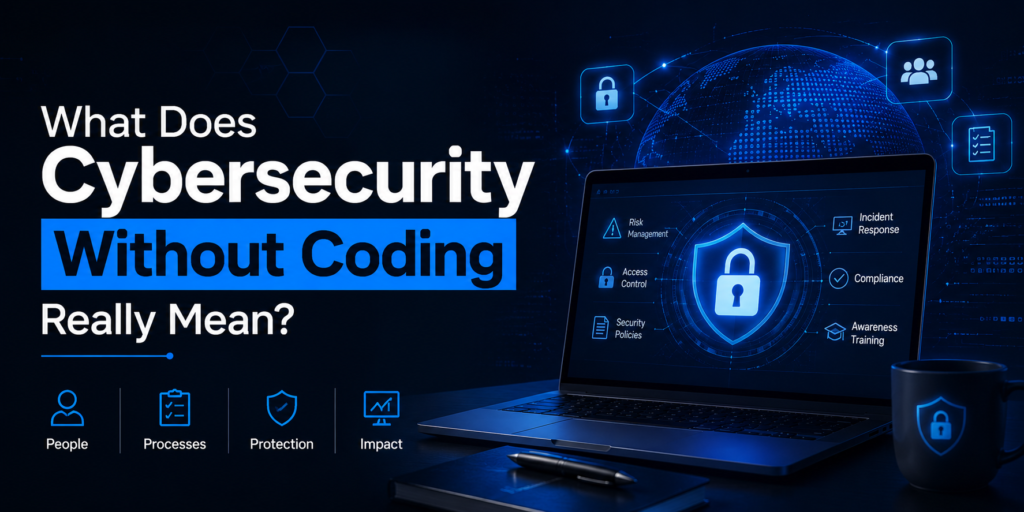
Cybersecurity without coding means you can build a cybersecurity career without becoming a programmer. Instead of writing software, your work may involve identifying security risks, reviewing policies, carrying out audits, responding to incidents, or helping an organization meet security standards.
That does not mean you can avoid learning technology. You still need to understand basic cybersecurity concepts such as phishing, malware, ransomware, access control, and data protection. These are cybersecurity skills, not programming skills.
Many non coding cybersecurity professionals also use security tools to monitor risks, review reports, document findings, and support security decisions. Their job is to protect the organization, even though they are not writing code.
The most important thing is to choose a cybersecurity role that matches your skills and interests, then learn what that role requires.
Why Do People Think Coding Is Required?
One reason is that the cybersecurity roles people see most often involve hacking, penetration testing, and software security. These careers often require coding or scripting, so it is easy to assume every cybersecurity job is the same.
The reality is different. Cybersecurity is a broad field with many career paths. Some roles involve writing code, while others focus on managing risks, reviewing security controls, training employees, and helping organizations follow security standards.
For example, a penetration tester may write scripts to test a system for weaknesses. A GRC professional, on the other hand, may spend the day reviewing security policies, assessing risks, or preparing for an audit. Both work in cybersecurity, but their responsibilities are very different.
That is why you should choose a cybersecurity career based on your interests and strengths, not on the assumption that every role requires programming.
Cybersecurity Jobs That Do Not Require Coding

If you want to build a cybersecurity career without becoming a programmer, you have several options. Each role contributes to keeping organizations secure, but the day to day responsibilities are different.
Governance, Risk, and Compliance (GRC)
GRC professionals help organizations identify security risks, follow industry standards, and prepare for audits. They also develop policies, assess compliance, and recommend ways to reduce risk.
IT Auditor
IT auditors review systems and processes to confirm they meet security and regulatory requirements. They identify weaknesses and recommend improvements before they become bigger problems.
Security Awareness Specialist
Many cyber attacks begin with human error. Security awareness specialists educate employees on topics like phishing, password security, and safe online behavior to reduce that risk.
Third Party Risk Analyst
Organizations often work with vendors who have access to sensitive data. Third Party Risk Analysts assess these vendors to determine whether they meet the organization’s security requirements.
Cybersecurity Project Manager
Cybersecurity projects involve different teams working toward the same goal. Project managers coordinate these projects, manage timelines, and help keep security initiatives on track.
These careers may not require programming, but they do require curiosity, problem solving, communication, and a willingness to keep learning. The best role for you depends on your interests, strengths, and long term career goals.
Can You Earn a Good Salary Without Coding?
Yes. Many non coding cybersecurity roles offer competitive salaries because organizations need professionals who can manage risk, protect sensitive data, and meet regulatory requirements.
For example, Governance, Risk, and Compliance professionals, IT Auditors, and Cyber Risk Analysts are in demand across industries such as finance, healthcare, government, consulting, and technology. As you gain experience, you can also move into leadership positions with greater responsibilities and higher pay.
Your salary will depend on factors such as your role, experience, location, industry, and certifications. Someone working in the United States or Canada may earn more than someone in the same role elsewhere, but the demand for skilled cybersecurity professionals continues to grow globally.
According to the U.S. Bureau of Labor Statistics, employment for Information Security Analysts is projected to grow 33 percent between 2023 and 2033, much faster than the average for all occupations. This reflects the increasing need for cybersecurity professionals as organizations continue to face new security challenges.
The important question is not, “Which role pays the most?” It is, “Which role fits my skills and gives me room to grow?” Building expertise in the right career path often leads to better long term opportunities than chasing the highest starting salary.
How to Start a Cybersecurity Career Without Coding
Once you’ve decided that cybersecurity is the right career for you, the next step is knowing where to begin. You do not need to learn everything at once. Focus on building a strong foundation.
Start by following these steps:
- Learn the basics of cybersecurity, networking, and operating systems.
- Choose a career path that matches your interests, such as GRC or IT Audit.
- Earn a beginner friendly cybersecurity certification that supports your chosen path.
- Practice what you learn through hands on labs, case studies, or real world scenarios.
- Connect with cybersecurity communities, attend webinars, and keep learning from industry professionals.
If you’re wondering whether you can learn cybersecurity on your own before joining a training program, it helps to understand the benefits and limitations of self learning so you can choose the approach that works best for you.
Most importantly, avoid comparing your progress with others. Everyone starts somewhere. Consistent learning and practical experience will take you much further than trying to learn every area of cybersecurity at the same time.
URL: [ on the third point here on cybersecurity certification ]
How ExcelMindCyber Can Help

Starting a cybersecurity career is easier when you have a clear learning path and the right support.
At ExcelMindCyber we help aspiring cybersecurity professionals build practical skills for careers that do not require programming, especially in Governance, Risk, and Compliance (GRC). Our training focuses on the knowledge and hands on experience employers are looking for, helping you understand how cybersecurity works in real business environments.
As an ExcelMindCyber student, you also gain access to career support designed to help you prepare for the job market. This includes career coaching, CV review, interview preparation, and internship support to help you apply your skills with confidence.
If you are looking for a structured way to start a cybersecurity career without coding, learning from experienced professionals can help you avoid common mistakes and focus on the skills that matter most.
Final Thoughts
A career in cybersecurity is not reserved for programmers. If you’ve been holding back because you thought coding was a requirement, it may be time to rethink that belief.
The cybersecurity industry needs professionals with different skills and backgrounds. Whether your strength is communication, problem solving, risk management, or working with people, there is likely a role that fits you.
The most important step is to choose a career path, learn the skills that role requires, and keep building your knowledge through practice and continuous learning.
You do not have to know everything before you begin. You simply have to start.
If you’re ready to build a career in cybersecurity without coding, explore ExcelMindCyber’s training programs and take the first step toward a career that matches your skills and goals.
Can I get into cybersecurity without coding?
Yes. Many cybersecurity careers do not require programming. Roles such as Governance, Risk, and Compliance (GRC), IT Audit, and Security Awareness focus on managing risks, improving security processes, and helping organizations protect their data.
Which cybersecurity jobs do not require coding?
Some of the most common non coding cybersecurity careers include Governance, Risk, and Compliance (GRC), IT Auditor, Security Awareness Specialist, Third Party Risk Analyst, and Cybersecurity Project Manager.
What are the seven types of cybersecurity?
Cybersecurity includes several areas, including network security, cloud security, application security, information security, endpoint security, identity and access management, and Governance, Risk, and Compliance (GRC). Each area helps protect organizations from different types of cyber threats.
Which IT job does not require coding?
Many IT careers do not require programming. Examples include GRC Analyst, IT Auditor, Cybersecurity Project Manager, Business Analyst, IT Support, Technical Writer, and Security Awareness Specialist. The skills required depend on the role and the employer.
Do I need a computer science degree to start cybersecurity?
No. Many employers hire candidates based on their skills, certifications, and practical experience. While a degree can be an advantage, it is not the only path into a cybersecurity career.