
 English
 Arabic
 English
 French
 German
GRC Specialist: Master the Role That Pays to Lead
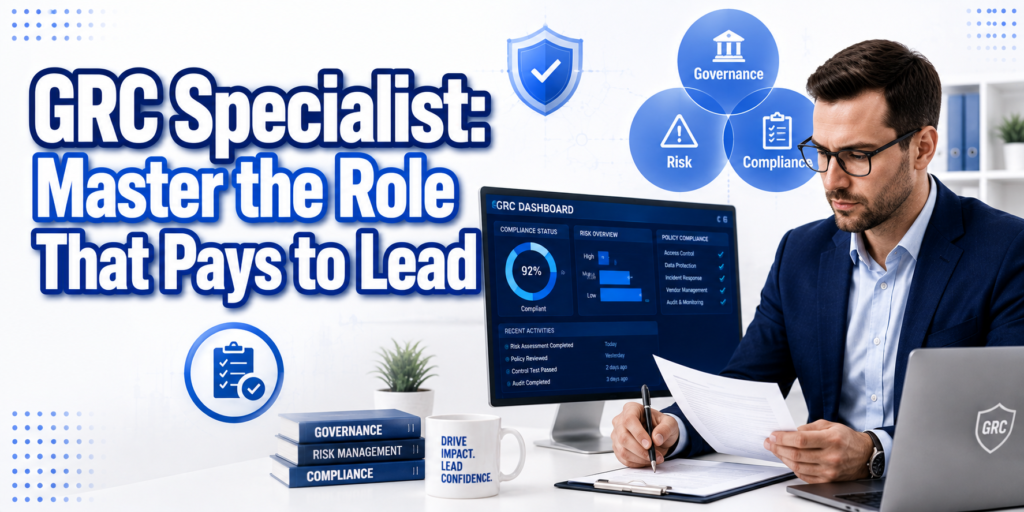
Most people in cybersecurity have heard of GRC. But very few can explain what a GRC Specialist actually does every day, how the role differs from a GRC Analyst, and what it takes to get there.
This guide starts from the beginning. Whether you are new to GRC or already working as an analyst and ready to move up, you will find a clear picture of the role, the skills you need, the right certifications, the salary ranges, and the exact steps to advance.
Table of Contents
What is a GRC Specialist?
A GRC Specialist is a professional who makes sure an organization runs securely, responsibly, and within the law. GRC stands for Governance, Risk, and Compliance. Each word carries a different meaning, and together they describe one of the most important roles in cybersecurity today.
Governance
Governance is how an organization sets its rules and makes decisions. Think of it as the company’s internal rulebook. Who is responsible for what? What must every employee follow? What happens when someone breaks a rule?
A GRC Specialist helps create these rules, keeps them updated, and makes sure everyone, from developers to executives, follows them. Without governance, organizations drift. Security becomes inconsistent. Nobody knows who owns what.
Risk
Risk is anything that could go wrong and hurt the organization. A hacker breaking into the network is a risk. An employee clicking a suspicious email is a risk. A third-party vendor storing your customer data carelessly is also a risk.
A GRC Specialist finds these problems before they become disasters. They measure how likely each risk is and how bad the impact would be. Then they work with security teams to reduce or remove those risks entirely.
Compliance
Compliance means following rules that come from outside the organization. Governments, regulators, and international standards bodies create these rules. Some examples:
- GDPR : data privacy law in Europe
- HIPAA : healthcare data rules in the US
- PCI DSS : security standards for payment card processing
- ISO 27001 : a global security management standard
- NIST frameworks : security guidelines widely used by US government and beyond
A GRC Specialist makes sure the organization follows whichever rules apply to it. They collect evidence for auditors, track gaps, and fix problems before they become fines or violations.
How the Three Work Together
Governance sets the rules. Risk management identifies what threatens those rules. Compliance proves to regulators that the rules are being followed.
A GRC Specialist is the person who holds all three together. They sit between technical security teams, legal and compliance teams, and business leadership. They translate technical language into business decisions and turn regulatory requirements into actual security controls.
That combination is rare. And it is exactly why strong GRC Specialists are always in demand.
GRC Specialist vs. GRC Analyst: What is the Difference?
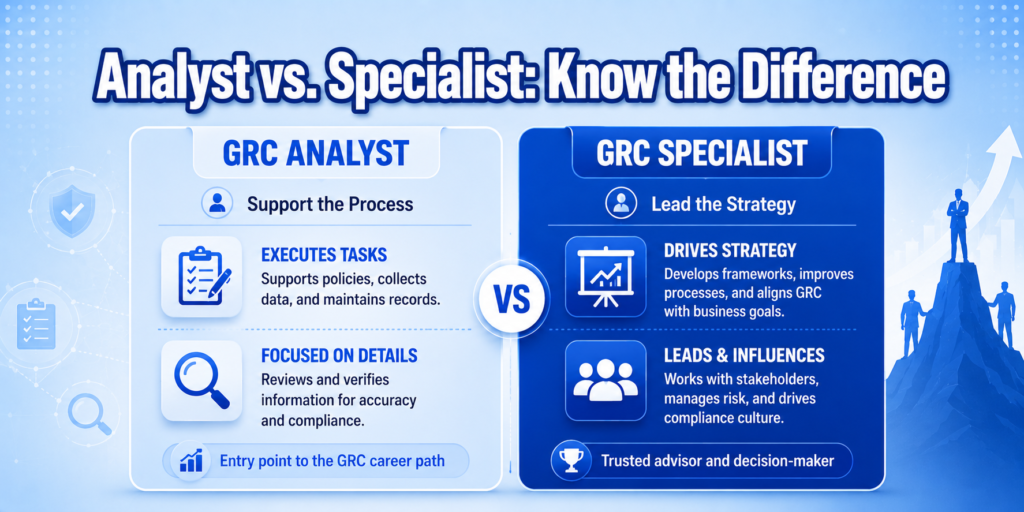
People use these titles as if they mean the same thing. They do not. Understanding the difference tells you exactly where you are in your career and what you need to do next.
GRC Analyst: Entry to Early Mid-Level (0-4 Years)
A GRC Analyst is earlier in their career. They support GRC programs rather than lead them. The work is more task-based and operational.
Day to day, a GRC Analyst typically:
- Assists with risk assessments and documentation
- Gathers compliance evidence for audits
- Monitors compliance dashboards and flags issues
- Researches regulatory changes and summarizes them for senior staff
- Helps maintain policy documents and internal standards
- Supports employee training programs
Analysts are still learning. They are building their understanding of frameworks, tools, and how GRC programs actually work in practice.
GRC Specialist: Mid to Senior Level (4-10 Years)
A GRC Specialist has moved past support work. They design, lead, and own GRC programs. They make decisions, not just collect information.
Day to day, a GRC Specialist typically:
- Designs and implements GRC frameworks from scratch
- Leads risk assessments without supervision
- Owns compliance programs end to end (SOC 2, ISO 27001, PCI DSS)
- Manages relationships with external auditors and regulators
- Translates compliance requirements into technical controls for IT and security teams
- Trains and guides junior analysts
- Reports directly to security leadership and executives
The key difference is ownership. Analysts assist. Specialists lead.
How to Move From Analyst to Specialist
Time alone does not make you a specialist. Here is what actually does:
Technical depth. Specialists understand frameworks at a level where they can map a compliance requirement to a specific technical control and explain why that control works. Reading about frameworks is not enough. You need to work inside them.
Communication skills. You will present findings to executives. You will answer auditor questions. You will explain complex regulations to non-technical colleagues. If you cannot communicate clearly, frameworks knowledge alone will not advance you.
Ownership experience. You need to have led at least one compliance program or certification process from start to finish. ISO 27001 preparation, a SOC 2 audit, a risk assessment end to end. Analysts who wait to be handed ownership rarely get it. Ask for it directly.
Certifications. Certain credentials signal readiness for specialist roles. The right order matters. We will cover that shortly.
Core Responsibilities of a GRC Specialist
Here is what the job actually looks like in practice.
Governance and Policy Management
GRC Specialists write, maintain, and enforce security policies. These documents define how the organization handles data, who can access what, and what happens if something goes wrong.
A policy is only useful if people follow it. Part of this job is making sure policies are practical enough to actually be used, not just filed away. A policy nobody reads protects nobody.
Policies also need to change. When GDPR guidance is updated, when a new type of attack becomes common, when the organization adopts new technology, those policies need to reflect the new reality.
Example: A GRC Specialist at a financial company notices the data retention policy was last updated in 2021. New GDPR guidance from 2024 requires shorter retention periods for certain customer records. The specialist reviews the guidance, rewrites the policy, and works with the IT team to automate deletion of records that exceed the new limits.
Risk Assessment and Mitigation
Risk assessment is at the core of what GRC Specialists do. It means systematically asking: what could go wrong, how likely is it, how bad would it be, and what do we do about it?
The process works in steps:
Identify assets. What data, systems, or processes matter most to the organization?
Identify threats. What could attack or damage those assets? External hackers? Insider mistakes? System failures? Natural disasters?
Find vulnerabilities. Where are the weaknesses? Outdated software? Weak passwords? Untrained employees?
Calculate risk. Combine likelihood and impact. A highly likely attack with low damage may be less urgent than a rare but catastrophic breach.
Plan mitigations. Design controls to reduce each risk. This might be technical (encrypting a database), process-based (requiring two people to approve data access), or physical (requiring access badges to enter a server room).
GRC Specialists document this in a risk register, a live document tracking known risks, their current status, and what actions are underway.
Compliance Monitoring and Audit Management
Compliance is not a one-time project. It is ongoing. Organizations must continuously show they meet the standards that apply to them.
GRC Specialists track compliance across multiple frameworks at the same time. A healthcare company might manage HIPAA, SOC 2, and ISO 27001 simultaneously. A payments company might handle PCI DSS, GDPR, and SOC 2 together.
The skill here is mapping overlaps. Many frameworks require similar controls. A good GRC Specialist maps them together so the organization does not duplicate effort.
Example: A cloud security tool flags an unencrypted database containing customer data. The GRC Specialist maps this single finding across four frameworks at once:
- SOC 2: CC6.1 : logical access controls
- ISO 27001: A.10.1.1 : cryptographic controls
- NIST SP 800-53: SC-28 : protection of information at rest
- PCI DSS: Requirement 3.4 : cardholder data encryption
One fix satisfies four requirements. That is multi-framework thinking in action.
Security Awareness and Training
GRC Specialists design and run security awareness programs. They create training for different audiences: technical teams need different content than HR or finance teams. Executives need different framing than entry-level employees.
They also measure whether training actually changes behavior. Completion rates mean very little. What matters is whether people act differently after training. Do they report suspicious emails? Do they follow data handling policies correctly?
Working Across Teams
A GRC Specialist is not locked in one team. They move between:
- Security teams : turning business requirements into technical controls
- IT and engineering : making sure systems are built to meet compliance standards
- Legal : tracking regulatory requirements and new laws
- Executives and boards : reporting on risk and compliance in plain business terms
- External auditors : answering questions, providing evidence, managing the audit relationship
This is not a solo role. It is a connector role. And the professionals who are best at it are the ones who can speak every team’s language.
Essential Skills and Certifications for GRC Specialists
Technical Knowledge
Security frameworks. You need working knowledge, not just awareness, of NIST CSF, ISO 27001, CIS Controls, COBIT, and SOC 2. Working knowledge means you can implement and audit controls within them.
Regulatory requirements. Know the regulations relevant to your industry: GDPR in Europe, HIPAA in US healthcare, PCI DSS for payments, CMMC 2.0 for US defense contractors, NDPA in Nigeria, POPIA in South Africa.
Cloud security basics. Most organizations now run in cloud environments like AWS, Azure, or Google Cloud. GRC Specialists need to understand cloud risks: misconfigurations, identity and access management (IAM), data exposure, and what “shared responsibility” actually means in cloud compliance.
GRC platforms. Get familiar with at least one GRC tool: ServiceNow GRC, RSA Archer, Workiva, Vanta, or Drata. Employers increasingly expect platform experience, not just spreadsheet-based compliance tracking.
Risk methodology. Know both quantitative and qualitative risk assessment approaches. Understand threat modeling. Know how to build and maintain a risk register.
Soft Skills
Written communication. You write policies, audit reports, risk summaries, and executive briefings. Poor writing creates poor policies. Poor policies create compliance gaps.
Verbal communication. You explain technical findings to non-technical executives. You answer auditor questions confidently. You train employees. If you cannot explain clearly, the technical knowledge is wasted.
Critical thinking. Regulations are not always clear. Two frameworks may seem to conflict. A risk assessment may produce ambiguous results. GRC Specialists make defensible decisions under uncertainty.
Project management. A SOC 2 or ISO 27001 certification project involves dozens of stakeholders, hundreds of tasks, and tight deadlines. You need to organize and drive these projects without losing momentum.
Attention to detail. One missed compliance requirement, one inaccurate audit response, or one outdated policy can expose the organization to regulatory fines or a security breach.
Certification Roadmap: In the Right Order
Most guides give you a list of certifications without telling you which to pursue first. Here is the right sequence:
Step 1: CompTIA Security+ If you do not have this yet, start here. It builds foundational cybersecurity knowledge, is vendor-neutral, and is required or preferred in many GRC job postings. Cost: approximately $392 USD. Study time: 2-3 months.
Step 2: CISA (Certified Information Systems Auditor) This is the most recognized GRC-specific certification globally. Issued by ISACA, it covers information system auditing, control design, and security. It shows employers you can assess and test security controls, which is exactly what GRC Specialist roles require. Cost: approximately $575 USD (ISACA member). Requires 5 years of relevant experience for full certification. Study time: 3-6 months.
Step 3: CISM (Certified Information Security Manager) CISM shifts focus from auditing to managing and governing security programs. It signals readiness for senior specialist and GRC Manager roles. Also issued by ISACA. Cost: approximately $575 USD (ISACA member). Study time: 3-6 months.
Step 4 (Specialization): CRISC or CISSP CRISC (Certified in Risk and Information Systems Control) is best if risk management is your specialization. CISSP is the gold standard for senior security professionals broadly, and increasingly appears in senior GRC Specialist job postings. Choose based on where you want to specialize.
Framework-specific credentials: Once you have the core certifications, consider ISO 27001 Lead Implementer or Lead Auditor. For specific industries, targeted training in SOC 2, GDPR, or HIPAA adds significant value.
GRC Specialist Salary and Career Progression
United States
According to Glassdoor 2026 data, the average GRC Specialist salary in the United States is $101,988 per year. The range runs from $76,491 (25th percentile) to $138,873 (75th percentile), with top earners reaching $182,045 annually.
Entry-level specialists (4-5 years) earn $76K-$90K. Mid-level specialists (5-7 years) earn $90K-$130K. Senior specialists and those moving into management earn $130K-$182K and beyond.
Location matters significantly. Roles in San Francisco, New York, Washington DC, and Seattle pay well above the national average. Remote roles are increasingly common and often pay at or near major market rates.
United Kingdom and Europe
In the United Kingdom, GRC Specialist salaries average £55,000-£85,000 annually. Senior roles in London reach £90,000-£120,000. Germany, the Netherlands, and France show similar ranges in local currencies.
GDPR expertise commands a premium across Europe. GRC Specialists with deep data protection knowledge and hands-on GDPR implementation experience are particularly sought after across EU member states.
Nigeria and Africa
The GRC market across Africa is growing fast. Banking, fintech, telecommunications, and government sectors in Nigeria, South Africa, Kenya, and Ghana are all actively hiring GRC professionals.
In Nigeria, GRC Specialist salaries range from ₦8-15M annually at mid-level, reaching ₦15-25M+ for senior specialists and GRC Managers. Financial sector employers and multinationals tend to pay at the higher end.
Remote opportunities are a strong growth area. Nigerian and other African GRC professionals are increasingly being hired by international companies at near-international rates, with remote roles often paying $3,000-7,000+ monthly at mid-level.
Regulatory pressure is also increasing. Nigeria’s NDPA, South Africa’s POPIA, and Kenya’s Data Protection Act are all driving demand for professionals who understand local requirements alongside global frameworks.
Asia-Pacific
In Singapore, Australia, and Japan, GRC Specialists earn the equivalent of $70,000-$120,000 USD annually. India’s GRC market is growing strongly, with salaries ranging from ₹15-40 lakh annually at mid-level, with significant opportunities in multinational companies and technology firms.
Career Path: Specialist to Leadership
GRC Specialist (4-8 years): You own GRC programs, lead risk assessments, manage compliance frameworks, and report to GRC leadership.
Senior GRC Specialist (6-10 years): You lead more complex programs, manage junior professionals, and carry deep expertise in specific frameworks or industries. You influence strategy.
GRC Manager (8-12 years): You build and manage GRC teams. You are accountable for the organization’s entire compliance posture. You brief C-suite executives regularly. Your decisions shape the company’s risk profile.
Compliance Director / Chief Risk Officer / CISO (12+ years): Executive-level GRC leadership. You own risk and compliance at the organizational level. You sit on steering committees, advise boards, and shape company strategy from a risk perspective.
The GRC professionals who reach CISO level tend to have two things in common: they built deep framework expertise early, and they developed the communication skills to translate technical risk into business decisions that leaders could act on. If you are looking for a structured GRC Roadmap to follow from entry level to leadership, that progression is laid out step by step across the learning paths available to cybersecurity professionals today.
What Employers Actually Want: Real Job Market Requirements
Core Requirements from Job Postings
Experience: Most GRC Specialist roles require a minimum of 4 years in GRC, compliance, IT audit, or information security. Some require 5+. Analysts with 2 years of experience are usually not yet competitive for specialist titles.
Framework knowledge: Every posting mentions at least two of these: SOC 2, ISO 27001, NIST CSF, PCI DSS, GDPR, HIPAA, CMMC 2.0. Employers want people who have worked inside these frameworks, not just read about them.
Audit experience: Most postings require direct audit involvement: preparing evidence, managing auditor relationships, tracking remediation. This is one of the most commonly mentioned requirements.
Risk assessment: The ability to run a risk assessment independently, conduct a gap analysis, and maintain a risk register. Employers want this to be a skill you own, not one you assist with.
Cross-functional collaboration: Almost every posting mentions working with IT, legal, security, and business teams. GRC is a team sport. Communication matters as much as technical knowledge.
GRC tools: ServiceNow, RSA Archer, Workiva, Vanta, or Drata appear regularly. Experience with at least one platform is increasingly expected.
What Separates Good Candidates from Great Ones
Ownership, not just participation. “I assisted with SOC 2 preparation” is far weaker than “I led our SOC 2 Type II certification from gap assessment through audit completion.” Ownership is what gets you hired.
Multi-framework experience. Specialists who have worked across more than one framework are more valuable. They identify overlaps faster, reduce duplicate work, and adapt more easily when requirements change.
Cloud compliance experience. GRC Specialists who understand cloud-specific compliance (AWS and Azure configurations, IAM, container security) are in higher demand than those with only traditional IT compliance backgrounds. Cloud is where most compliance gaps now live.
Quantified results. The best candidates support their experience with numbers. “Reduced audit preparation time by 40%.” “Completed ISO 27001 certification in 8 months.” “Identified and remediated 23 high-risk gaps.” Numbers show impact. Job descriptions do not.
Skills That Move GRC Specialists Into Leadership
Some GRC Specialists execute programs competently and stay there. Others become the people executives rely on to make risk decisions. Here is what separates the two groups.
Translating Risk Into Business Language
This single skill advances GRC careers faster than any certification. Most security professionals can find risks. Very few can explain them in a way that makes a CFO act on them.
Here is the difference:
Technical version: “We have unencrypted databases containing PII that are not compliant with ISO 27001 A.10.1.1.”
Business version: “Customer data is stored without encryption. If we experience a breach before fixing this, we face up to €20M in GDPR fines, potential class-action litigation, and reputational damage that directly affects customer retention.”
Same problem. Very different response from leadership. GRC Specialists who master this translation become indispensable.
Continuous Controls Monitoring
The best GRC Specialists stop doing quarterly compliance checks and build systems that monitor compliance continuously. Automated tools track configurations, flag drift, and alert teams in real time when something falls out of compliance.
This shift from periodic to continuous is happening across the profession. Specialists who understand automation, API-based compliance tools, and continuous monitoring frameworks are leading the change.
Proactive Risk Identification
Junior professionals respond to problems. Senior specialists and leaders anticipate them. They read regulatory updates before those updates take effect. They watch emerging threats. They identify risks before those risks become incidents.
This mindset is what builds trust with executives. It is also what justifies moving into GRC Manager and Director roles.
Mentoring and Team Building
Leadership in GRC is not just about personal technical skill. It is about making a team better. GRC Specialists who coach junior analysts, share knowledge, and build team capability are showing organizations that they are ready for management.
The professionals who get promoted are not always the most technically skilled. They are often the ones who make everyone around them more effective.
Your 90-Day Plan: From GRC Analyst to Specialist
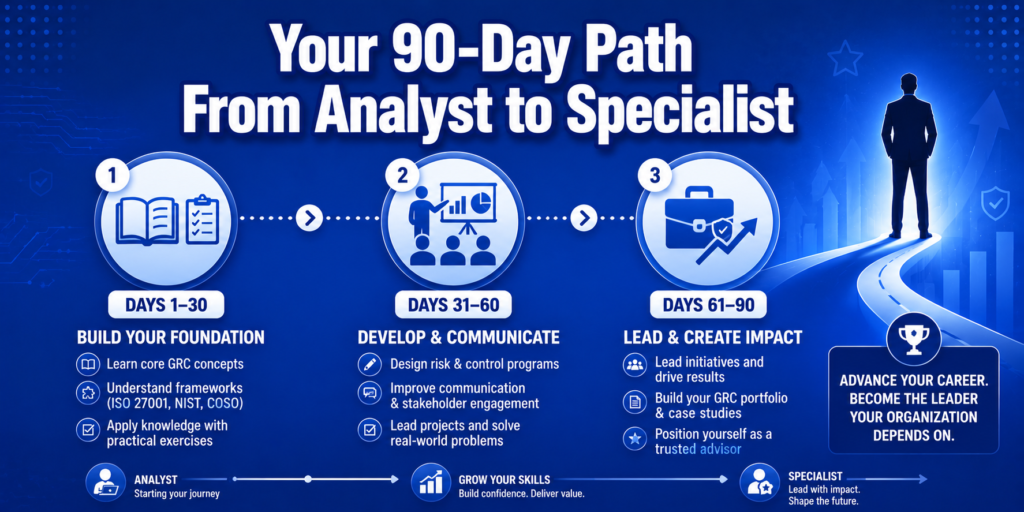
Already working as a GRC Analyst and want to move up? Here is a 90-day plan built around what actually gets people promoted.
Month 1: Go Deeper on Technical Knowledge
Week 1-2: Find the framework your organization uses most but where you know the least. If it is ISO 27001, buy the standard and read it carefully. If it is SOC 2, study the Trust Services Criteria in full detail. Go deeper than your daily work demands.
Week 3: Volunteer to lead one specific section of your next risk assessment or compliance project. Not assist. Lead. Document your work and your thinking independently.
Week 4: Pick one GRC tool your organization uses (ServiceNow, RSA Archer, or similar) and go beyond surface-level use. Learn to configure workflows, set up dashboards, and automate evidence collection. Become the person your team calls when they have a platform question.
Month 2: Build Leadership and Communication
Week 5-6: Take a real risk finding from your work and write a one-page summary as if presenting to a non-technical executive. Cover: what the risk is, why it matters in business terms, what it will cost if ignored, and what the recommended fix is. Keep it clear enough that someone with no security background can act on it.
Week 7: Ask your manager for the chance to present at the next team meeting or stakeholder update. Present one finding. Practice turning technical language into plain business terms in a real setting with real stakes.
Week 8: Find a junior analyst or new team member who needs support. Help them with something they find hard. Teaching strengthens your own knowledge and shows management you are ready to lead others.
Month 3: Build Your Portfolio and Advance
Week 9-10: Write up one significant GRC project as a case study. Cover the problem, your approach, the frameworks you used, the outcome, and what you learned. This becomes your strongest evidence in your next interview or promotion conversation.
Week 11: Update your resume and LinkedIn to reflect specialist-level work. Be specific: “Led compliance evidence collection for SOC 2 Type II audit across 47 controls” is far stronger than “assisted with compliance activities.”
Week 12: Have a direct conversation with your manager. Show what you have built over 90 days. Ask specifically about a GRC Specialist title or taking on specialist-level responsibilities where you are now.
By day 90, you will have stronger technical depth, real leadership experience, a portfolio case study, and a clear conversation in progress with your manager.
Final Thoughts: Why GRC Specialists Are Rare and Valuable
The GRC software market is projected to reach $37.71 billion by 2030. Regulatory requirements are expanding globally. Cloud adoption keeps growing, bringing new compliance complexity. AI is creating governance and risk challenges that organizations are only beginning to understand.
Demand for skilled GRC Specialists is growing faster than the supply of qualified professionals.
The ones who succeed are not simply those who know the frameworks. They are the ones who own programs, communicate in business language, anticipate emerging risks, and build teams that protect organizations at scale.
If you are building toward this role, the path is clear. Start with foundational certifications. Build real ownership experience on compliance programs. Learn to speak business language, not just technical language. Develop multi-framework expertise that travels with you across industries and organizations.
If you want a structured program that builds GRC foundations, frameworks knowledge, and hands-on skills, EMC Institute’s cybersecurity training programs offer a clear pathway. You learn GRC fundamentals, compliance frameworks, and risk management from professionals who have done the work, not just studied it. Explore what the program covers and see if it fits where you want to go.
The GRC Specialist role is demanding. It is also one of the most rewarding paths in cybersecurity. It combines business strategy, technical knowledge, regulatory expertise, and real leadership in ways that few roles do. That is exactly why it pays well and why the best people in this field are never without options..
What is a GRC Specialist?
A GRC Specialist is a cybersecurity professional who manages an organization’s Governance, Risk, and Compliance programs. They write and enforce security policies, identify and reduce business risks, and make sure the organization follows relevant regulations like GDPR, ISO 27001, SOC 2, and PCI DSS. They work between technical security teams, legal departments, and business leadership, translating complex security requirements into actions the whole organization can follow. Most GRC Specialist roles require at least 4 years of experience in compliance, IT audit, or information security.
Is GRC an IT Job?
GRC sits between IT, security, and business, so it is not purely an IT job. GRC Specialists need technical knowledge of security frameworks, cloud environments, and compliance tools. But they also need legal and regulatory knowledge, strong writing skills, and the ability to present to executives. Many GRC professionals come from IT or cybersecurity backgrounds. Others come from audit, accounting, or legal backgrounds. What matters most is the ability to combine technical understanding with clear business communication.
Is GRC a Good Career?
Yes. GRC is one of the most stable and well-paying career paths in cybersecurity. The GRC software market is projected to reach $37.71 billion by 2030, and demand for qualified professionals is growing faster than supply. In the US, GRC Specialists earn an average of $101,988 per year, with senior roles reaching $182,045. Globally, the role pays competitively across the UK, Europe, Asia-Pacific, and Africa. Beyond salary, GRC offers clear career progression from analyst to specialist to manager to director or CISO, making it a strong long-term investment.
What Does GRC Stand For?
GRC stands for Governance, Risk, and Compliance. Governance is how an organization sets and enforces its internal rules and policies. Risk is the process of identifying, measuring, and reducing threats that could harm the organization. Compliance is making sure the organization follows external laws and industry standards set by regulators and standards bodies. Together, these three functions protect organizations from legal violations, security breaches, and operational failures. A GRC Specialist is the professional responsible for managing all three areas in a coordinated way.
How Long Does It Take to Become a GRC Specialist?
Most professionals reach GRC Specialist level after 4 to 6 years of relevant experience. The typical path starts with an entry-level role such as Compliance Analyst, IT Auditor, or Junior Security Analyst. From there, professionals build framework knowledge, earn certifications like Security+, CISA, and CISM, and take on increasing ownership of compliance programs. The timeline can be shortened with structured training, deliberate skill-building, and actively seeking ownership of GRC projects rather than just supporting them. Some professionals transition into GRC from audit, legal, or accounting backgrounds and reach specialist level within a similar timeframe.