
 English
 Arabic
 English
 French
 German
GRC Role: What It Means and Which One Fits You
A friend once told me she wanted to work in cybersecurity but hated the idea of writing code all day. Someone mentioned a GRC role to her, and she had no idea what that even meant or whether she qualified. That confusion is more common than you’d think, and it’s exactly why this guide exists.
This article breaks down what a GRC role actually involves, which specific title fits your background, and how to land your first position, whether you’re starting fresh or pivoting from another field entirely.
What Is a GRC Role?
A GRC role sits inside the governance, risk, and compliance function of an organization. People in these roles make sure a company’s security practices actually align with its business goals while staying inside legal and regulatory boundaries.
Unlike a technical security role focused purely on defense, a GRC role focuses on structure. It asks who owns which decision, what could go wrong, and whether the company follows the rules it’s supposed to follow.
The Three Pillars Behind Every GRC Role
Every GRC role touches governance, risk, and compliance in some proportion. Governance means setting the policies and rules that guide company decisions. Risk management means finding potential threats and ranking them by how much damage they could cause. Compliance means proving the company follows relevant laws and standards, whether that’s the NDPR in Nigeria or international frameworks like ISO 27001.
A single person rarely owns all three equally. A GRC Analyst might spend most of their time on risk and compliance tasks, while a Chief Risk Officer spends more time on governance decisions at the executive level.
How a GRC Role Differs from a General IT or Security Role
A general IT or security role focuses on building and defending systems directly, configuring firewalls, patching vulnerabilities, monitoring network traffic. A GRC role focuses on whether the right policies exist, whether risks are properly documented, and whether the organization can prove compliance during an audit.
Think of it this way. A security engineer builds the wall. A GRC professional makes sure the wall meets code, gets inspected regularly, and has a paper trail proving it was built correctly.
The Main GRC Roles and What They Actually Do
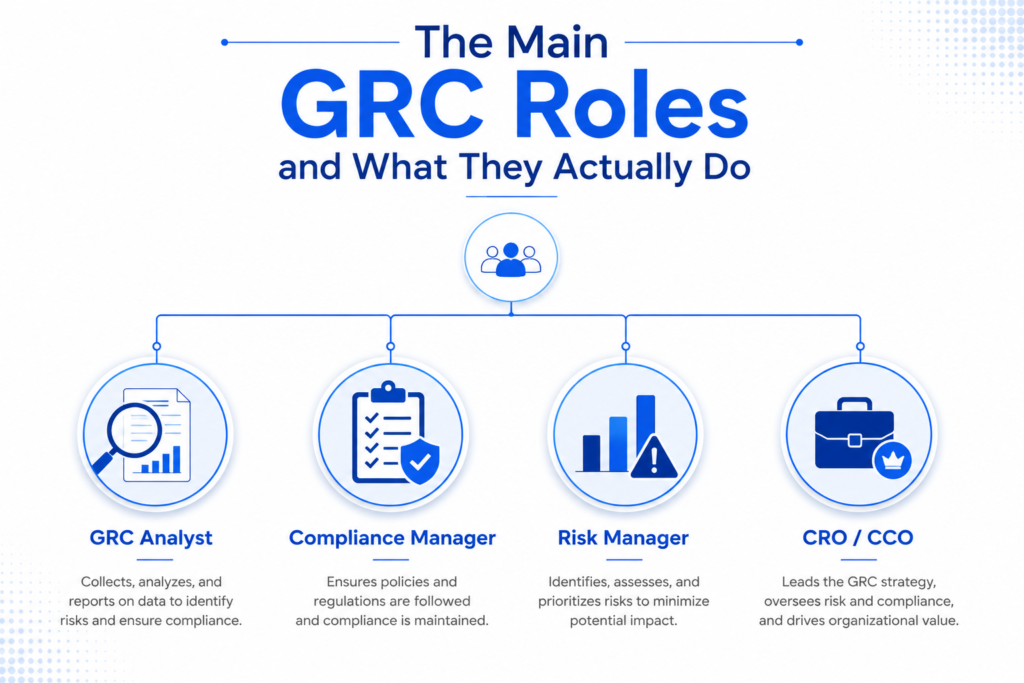
GRC Analyst
A GRC Analyst handles the hands-on work of the function. This includes running risk assessments, reviewing vendor security practices, tracking regulatory changes, and preparing documentation for audits. Most people enter the GRC field through this role.
Compliance Manager
A Compliance Manager owns the relationship between the organization and external regulations. They interpret laws and standards, translate them into internal policy, and confirm the company actually follows through on compliance on paper and in practice.
Risk Manager
A Risk Manager identifies, evaluates, and prioritizes threats across the business, not just cyber threats, but financial, operational, and strategic risks too. They build the risk register that guides where the company invests its protection resources.
Chief Risk Officer (CRO) and Chief Compliance Officer (CCO)
At the executive level, the CRO owns the organization’s entire risk strategy and reports directly to the board on exposure and mitigation plans. The CCO holds similar authority over compliance, ensuring the company’s practices satisfy regulators, auditors, and major clients simultaneously.
GRC Roles by Experience Level
Entry-Level GRC Roles
Entry-level GRC roles focus on data gathering, documentation, and basic control checks. You might update policy documents, help prepare audit evidence, or run introductory risk assessments under supervision. This is where most GRC Analyst positions sit.
Mid-Level GRC Roles
Mid-level GRC professionals run full risk assessments independently, manage vendor security reviews, and often guide junior team members. Titles like Senior GRC Analyst or Compliance Manager typically fall here.
Senior and Leadership GRC Roles
Senior GRC roles build the organization’s overall risk and compliance strategy, lead teams, and report directly to executives or the board. This is where CRO and CCO positions live, along with senior compliance or risk leadership titles.
Which GRC Role Fits Your Background?
Coming From Legal, Audit, or Finance
If you have a legal, audit, or finance background, a Compliance Manager or Risk Manager role often fits naturally. You already understand how to interpret regulations, document findings, and communicate risk to non-technical stakeholders, skills that transfer directly into GRC work.
Coming From IT or Cybersecurity
If you have an IT or cybersecurity background, a Cybersecurity GRC Analyst role or a path toward CISO makes sense. You bring technical credibility that helps translate security findings into governance language executives understand.
Starting With No Prior Experience
If you’re starting with no experience in either direction, an entry-level GRC Analyst position is your realistic starting point. This role rewards strong writing, attention to detail, and willingness to learn frameworks on the job more than any prior technical skill.
A Day in the Life of a GRC Analyst
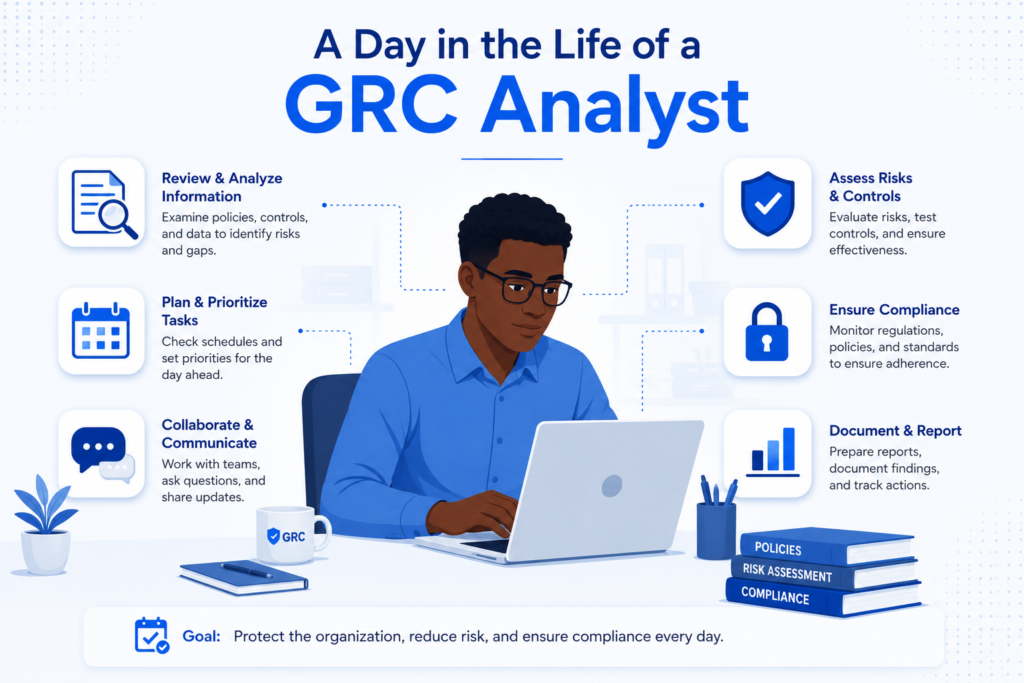
Picture a GRC Analyst starting their morning by reviewing a new vendor contract flagged by procurement. They check the vendor’s security certifications against company policy, note a gap in the vendor’s data encryption practices, and flag it for a vendor risk review with the compliance team.
By afternoon, they’re pulling evidence for an upcoming ISO 27001 audit, organizing screenshots and policy documents into the auditor’s requested format. Before the day ends, they update the risk register after a new regulatory bulletin changes a reporting requirement.
None of this involves writing code. All of it involves careful thinking, clear documentation, and steady communication across departments.
Certifications That Match Each GRC Role
Entry-level GRC Analysts benefit most from foundational certifications like CompTIA Security+ or the Google Cybersecurity Certificate, both of which build core security literacy without requiring a technical degree.
Compliance Managers and Risk Managers often pursue the ISC2 CGRC (Certified in Governance, Risk and Compliance), which validates advanced GRC-specific knowledge and carries strong recognition among employers.
Professionals aiming toward CRO or CCO positions typically combine CGRC with broader risk certifications like CRISC (Certified in Risk and Information Systems Control) as they move into leadership.
GRC Roles and Salary Expectations in Nigeria
GRC salaries in Nigeria vary widely depending on company size, sector, and whether the role serves an international client base. Entry-level GRC Analyst positions at Nigerian fintech or consulting firms typically start modestly but grow quickly with certification and experience.
Mid-level and senior GRC professionals, particularly those with CGRC certification and remote international clients, often earn significantly more than local-only positions. Banking, fintech, and multinational corporations operating in Nigeria tend to pay the most competitively for GRC talent, since they face the heaviest regulatory scrutiny.
How to Land Your First GRC Role
Start by building foundational security knowledge through a certification like Security+ or the Google Cybersecurity Certificate. Follow that by practicing real skills, even volunteering to run a basic risk assessment for a small business or nonprofit builds tangible experience you can discuss in an interview.
Apply specifically for GRC Analyst or Junior Compliance Analyst titles rather than generic “cybersecurity” postings, since GRC hiring managers look for role-specific keywords. Highlight any writing, documentation, or audit-adjacent experience from previous jobs, even outside tech, since these skills matter enormously in GRC work.
If you want structured guidance through this exact path, ExcelMindCyber offers training programs built specifically around GRC career preparation, from foundational concepts through role-specific readiness.
Final Thoughts: Building a Career Around a GRC Role
A GRC role offers one of the most realistic entry points into cybersecurity for people without a technical background, and one of the clearest career ladders once you’re inside the field. Whether you’re coming from legal, audit, finance, or starting completely fresh, there’s a specific GRC role built for your background.
The path forward starts with one certification, one practice risk assessment, and one application to a GRC Analyst position, not a leap into an unclear title you’re not sure you qualify for.
What is the difference between a GRC role and a cybersecurity role?
A cybersecurity role focuses on building and defending technical systems directly. A GRC role focuses on policy, risk documentation, and proving the organization meets its regulatory obligations. Both work toward the same goal from different angles.
Do I need a technical background for a GRC role?
No. Many GRC roles, especially Compliance Manager and Risk Manager positions, value legal, audit, or finance backgrounds as much as technical ones. Strong writing and analytical thinking matter more than coding ability.
Which GRC role should I target first?
If you’re new to the field, target a GRC Analyst or Junior Compliance Analyst position. These roles offer the clearest entry point and provide the real-world experience needed to advance toward Risk Manager or Compliance Manager titles.
How long does it take to move from entry-level to senior GRC roles?
Most professionals spend two to four years at entry and mid-level roles before qualifying for senior positions, though certification and vendor risk experience can accelerate that timeline.