
 English
 Arabic
 English
 French
 German
GRC Cybersecurity: Unlock Real Career Opportunity

Picture a Nigerian fintech company that lands a partnership deal with a major bank, only to lose it at the last stage because they cannot produce a single compliance document. That story repeats itself every month across Lagos, Abuja, and Port Harcourt. GRC cybersecurity is the difference between winning that contract and watching a competitor take it instead.
This guide breaks down everything GRC cybersecurity actually means, why it matters for your business or your career, and exactly how to start building real expertise in it, whether you run a company or want to work in one.
What Is GRC in Cybersecurity?
GRC cybersecurity stands for Governance, Risk, and Compliance. It is the structured approach organizations use to align their security practices with business goals while meeting legal and regulatory obligations. Instead of treating governance, risk, and compliance as separate problems handled by different departments, GRC cybersecurity brings them under one coordinated strategy.
Think of it as the operating system that runs underneath your entire security posture. Without it, individual security tools and policies exist in isolation and often contradict each other.
Breaking Down the Three Pillars
Governance sets the rules. It defines who makes security decisions, what policies your team follows, and how accountability flows through the organization. A company with strong governance does not let its IT team improvise security decisions without oversight.
Risk management finds the danger before it finds you. This pillar involves identifying potential threats, ranks them by how likely they are and how much damage they could cause, then guides where you spend your limited security budget. A small business owner using risk management might realize their biggest exposure isn’t a sophisticated hacker, but an employee who reuses the same password across every account.
Compliance keeps you on the right side of the law. This means following regulations like the NDPR in Nigeria or international standards your industry requires. Compliance isn’t just paperwork, it’s proof to regulators, partners, and customers that your security claims are real.
Why GRC Matters More Than Ever in 2026
Cyberattacks against African businesses have grown sharply as more companies move operations online. At the same time, regulators across Nigeria and the broader continent have become far less forgiving of data breaches and non-compliance. GRC cybersecurity gives you a repeatable system to handle both problems at once instead of reacting to each crisis separately.
The Core GRC Cybersecurity Frameworks You Should Know
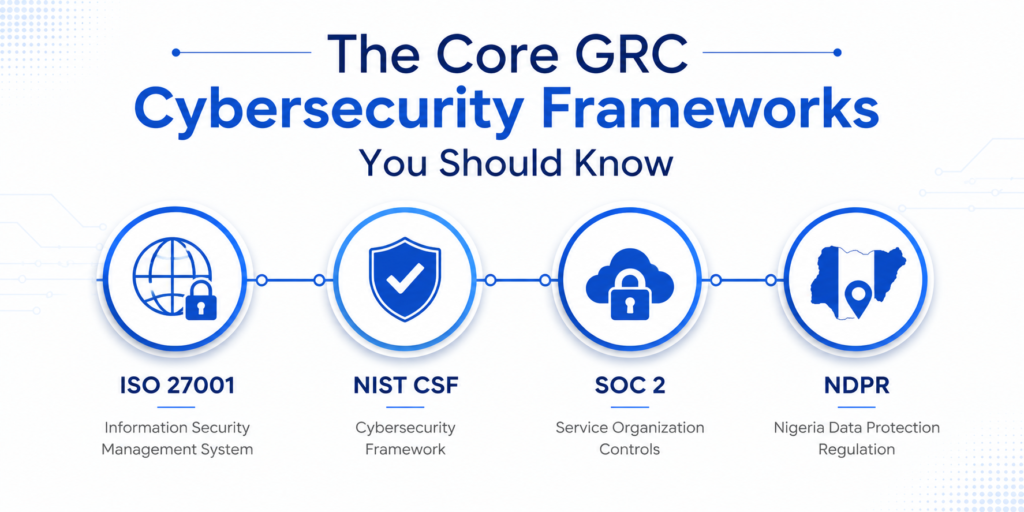
Frameworks give GRC cybersecurity its structure. Instead of building your security approach from scratch, you adopt a proven model and adapt it to your organization.
ISO/IEC 27001
ISO/IEC 27001 is the world’s most recognized standard for information security management systems. It sets out requirements for establishing, maintaining, and continually improving how an organization protects its information. Companies that earn ISO 27001 certification signal serious credibility to partners and clients, particularly in finance and government contracts.
NIST Cybersecurity Framework (CSF)
The NIST Cybersecurity Framework organizes cybersecurity risk management around six functions: Govern, Identify, Protect, Detect, Respond, and Recover. It’s voluntary and flexible, which makes it a popular starting point for organizations of any size that want a clear structure without a rigid certification process.
SOC 2
SOC 2 focuses on how a service organization manages customer data based on five trust principles: security, availability, processing integrity, confidentiality, and privacy. It has become almost mandatory for tech companies and SaaS providers trying to win enterprise clients who demand proof of data protection.
NDPR and Nigeria-Specific Compliance
The Nigeria Data Protection Regulation (NDPR) governs how Nigerian businesses collect, process, and store personal data. Any company handling customer data in Nigeria, regardless of size, falls under its scope. Non-compliance can mean serious fines from the Nigeria Data Protection Commission, on top of the reputational damage that follows a public data breach.
Why Nigerian Businesses Cannot Ignore GRC Cybersecurity
The Real Cost of Non-Compliance
Fines are only part of the cost. A single data breach can trigger legal fees, emergency IT repairs, and a public relations crisis that outlasts the technical fix by months. Businesses that treat GRC cybersecurity as optional often discover too late that prevention costs far less than recovery.
Losing Contracts Without Proper Documentation
Banks, multinational partners, and government agencies increasingly demand proof of security certifications before signing contracts. A logistics company bidding for a government tender, for example, may lose the bid entirely if they cannot produce a basic risk assessment report or a data protection policy. Documentation isn’t bureaucracy, it’s the price of entry into serious business relationships.
Where Most Breaches Actually Start
Most security incidents don’t begin with a brilliant hacker breaking through a firewall. They begin with an employee clicking a phishing link or reusing a weak password. Governance addresses this directly by setting training standards and access rules that reduce human error, which remains the leading cause of breaches worldwide.
What Does a GRC Cybersecurity Analyst Actually Do?
Daily Responsibilities
A GRC cybersecurity analyst spends their day translating security policy into practice. This includes conducting risk assessments, reviewing vendor contracts for security gaps, preparing audit documentation, tracking regulatory changes, and working with IT teams to close identified vulnerabilities. Much of the role involves writing clear reports that non-technical executives can actually understand and act on.
Skills That Matter More Than Coding
GRC cybersecurity rewards communication, analytical thinking, and attention to detail more than programming ability. Professionals coming from legal, audit, finance, or business backgrounds often transition into GRC roles successfully because they already understand how to read policy, assess risk, and document findings clearly. This makes GRC one of the most accessible entry points into cybersecurity for people without a technical background.
GRC Cybersecurity Certifications: Where to Start
Beginner-Friendly Certifications
CompTIA Security+ gives you the foundational security knowledge that underpins every GRC role. It’s vendor-neutral and widely recognized, making it a smart first stop for anyone with no cybersecurity background.
The Google Cybersecurity Certificate offers a flexible, low-cost, self-paced alternative. It requires no prior experience and prepares learners for entry-level roles while covering security frameworks and risk fundamentals relevant to GRC.
Advanced Certifications for Career Growth
Once you have foundational experience, the ISC2 CGRC (Certified in Governance, Risk and Compliance) becomes the natural next step. It’s built specifically for GRC professionals and validates your ability to manage risk frameworks and authorize information systems at an advanced level. ISC2 reports that CGRC holders earn an average global salary of $114,150 according to the Certification Magazine Salary Survey, which reflects how valuable this specialization has become.
GRC Cybersecurity Jobs and Salary Expectations
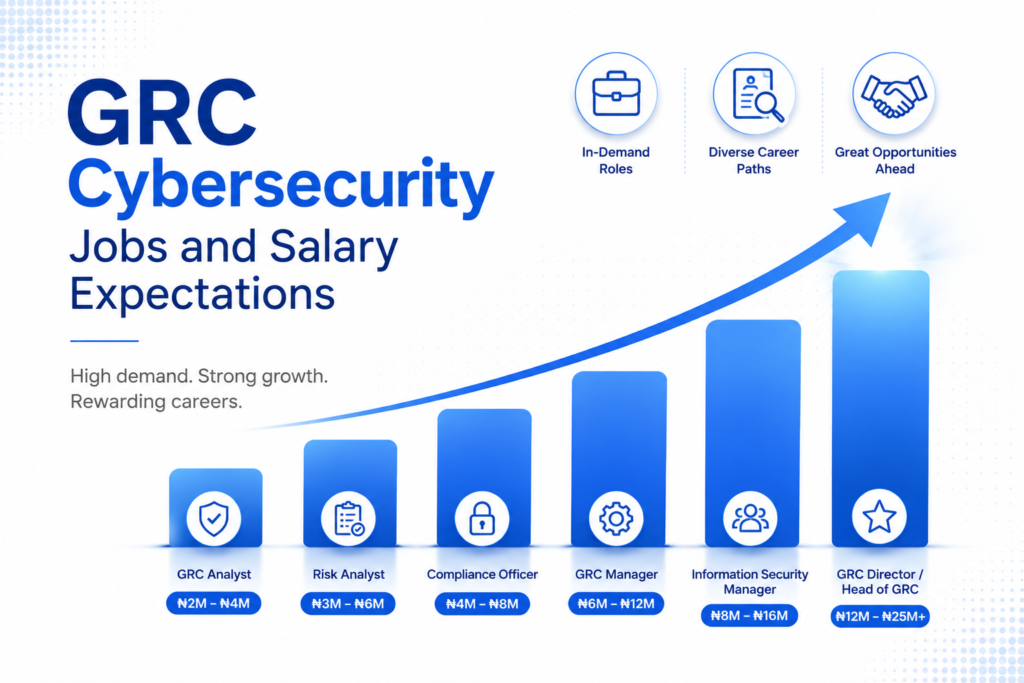
Common Job Titles
GRC professionals typically hold titles like GRC Analyst, IT Auditor, Compliance Officer, Vendor Risk Analyst, or Information Security Risk Analyst. Larger organizations may also have dedicated Governance Managers or Chief Compliance Officers who oversee entire GRC programs.
Career Growth Path
Most professionals start in an analyst role handling documentation and basic risk assessments, then move into specialized areas like third-party risk management or regulatory compliance. With a certification like CGRC and a few years of experience, many progress into senior GRC roles or compliance leadership positions. Salaries scale meaningfully with certification and experience, and international remote GRC roles have become increasingly accessible to skilled Nigerian professionals.
How to Start Building a GRC Cybersecurity Practice Today
For Business Owners
Start by auditing exactly what customer and financial data you store and where it lives. Write down simple, clear security rules your team can actually follow, covering passwords, data access, and device use. Add two-factor authentication to every business account you can. None of this requires a large budget, just consistent follow-through.
For Career Switchers
Begin with a foundational certification like Security+ or the Google Cybersecurity Certificate to build core knowledge. Follow that with hands-on practice, even volunteering to help a small business with a basic risk assessment builds real experience. Once you have a foundation, pursue CGRC to formalize your expertise and open doors to more advanced roles.
If you want structured guidance through this exact path, ExcelMindCyber builds training programs designed around this progression, from foundational security concepts through GRC-specific career preparation.
Final Thoughts: Is GRC Cybersecurity Worth Pursuing?
GRC cybersecurity sits at a rare intersection where career accessibility meets genuine business necessity. For professionals, it offers one of the most realistic entry paths into cybersecurity without needing a coding background. For businesses, it offers protection against fines, breaches, and lost contracts that far outweighs the cost of building the practice.
Whether you’re protecting a growing business or building a new career, the path forward starts with understanding these fundamentals and taking the first concrete step, one policy, one certification, one risk assessment at a time.
Ready to take that first step with real guidance instead of guesswork? ExcelMindCyber offers structured training programs built specifically for people starting their GRC cybersecurity journey, whether you’re switching careers or building compliance practices for your own business. Explore our programs and find the path that fits where you are right now.
What is the difference between GRC and general cybersecurity?
General cybersecurity focuses on technical defense, firewalls, encryption, and threat detection. GRC cybersecurity focuses on the policies, risk decisions, and regulatory obligations that guide how those technical defenses get implemented and governed.
Do I need a technical background to work in GRC?
No. GRC roles value analytical thinking, communication, and process management more than deep technical skill. Many successful GRC professionals come from legal, audit, or business backgrounds.
Which certification should I get first?
CompTIA Security+ or the Google Cybersecurity Certificate both work well as starting points. Once you have foundational knowledge, CGRC becomes the strongest advanced credential specifically for GRC careers.
Is GRC cybersecurity relevant to small businesses?
? Yes. Even small businesses handling customer data fall under regulations like the NDPR. A basic GRC practice, clear policies, regular risk checks, and documented compliance, protects small businesses just as much as large enterprises.