
 English
 Arabic
 English
 French
 German
Security Analyst Interview Questions That Win Offers

Most security analyst interview questions look simple on paper. What’s a firewall. What’s the CIA triad. Walk me through a suspicious alert. The questions themselves rarely trip candidates up. What trips them up is not understanding what the interviewer is actually listening for underneath the question.
This guide breaks down the most common security analyst interview questions and answers, the reasoning behind each one, and exactly how to prepare, even if you’re walking in with no formal job experience yet.
What Interviewers Are Really Listening For
Every question in a security analyst interview has a surface answer and a real answer. The surface answer is the definition. The real answer is what your response reveals about how you think under pressure, how you prioritize, and whether you’d be safe to trust with real systems on day one.
It’s Not Just the Right Answer, It’s How You Think
An interviewer asking “what’s a firewall” isn’t testing whether you know the definition. They’re testing whether you can explain a technical concept clearly, which matters because you’ll need to do that with non-technical colleagues constantly. Keep this in mind through every question below: the content of your answer matters, but so does the structure and confidence behind it.
Fundamental Questions You Should Know Cold
CIA Triad, Risk vs. Threat vs. Vulnerability
The CIA triad, confidentiality, integrity, and availability, comes up in nearly every security interview. Know it well enough to connect each piece to a real example: confidentiality relates to data breaches, integrity relates to tampering or ransomware, and availability relates to outages or denial-of-service attacks.
The difference between risk, threat, and vulnerability is another near-guaranteed question. A vulnerability is a weakness in a system. A threat is anything that could exploit that weakness. Risk is what happens when you combine the two and weigh the potential damage. These are among the most common security analyst interview questions, so have a clean, one-breath answer ready for each.
Firewalls, Encryption, and Core Network Concepts
You should be comfortable explaining what a firewall does, the difference between symmetric and asymmetric encryption, and basic concepts like VPNs and two-factor authentication. You don’t need deep technical mastery for an entry-level role, but you do need to explain each concept clearly enough that a non-technical person could follow along.
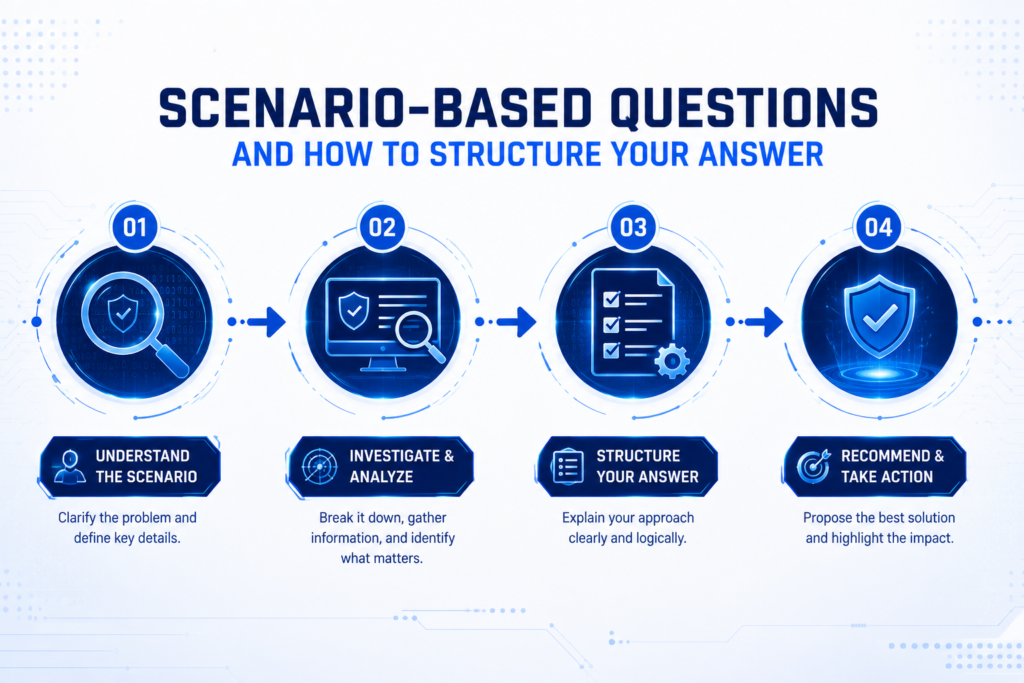
Scenario-Based Questions and How to Structure Your Answer
A Simple Framework for Any Scenario Question
When an interviewer describes a situation and asks what you’d do, resist the urge to jump straight to actions. Use this simple order instead: verify first, investigate second, act third. Most candidates lose points by reaching for a dramatic response (isolate the system, alert everyone) before confirming there’s actually a real problem.
Worked Example: “Walk Me Through a Suspicious Alert”
If asked how you’d handle an unusual alert, structure your answer like this. First, confirm it isn’t a false positive by checking the details behind it. Second, gather more context, what else is happening on that system or account around the same time. Third, decide on next steps based on what you actually found, whether that’s escalating, monitoring, or closing it out. This calm, methodical approach is exactly what separates strong candidates from ones who panic straight to worst-case actions.
Behavioral Questions and What They’re Really Testing
Security analyst behavioral interview questions exist to test communication and judgment, not just technical knowledge. These matter more than most candidates expect, since the job involves constant collaboration with people who don’t share your technical background.
Talking About Teamwork and Communication
When asked about disagreements with a colleague or a time you showed leadership, pick a real, specific example rather than a vague generality. Structure it simply: what was the situation, what did you do, and what happened as a result. Specific stories with real detail always beat polished-sounding generalities.
Explaining a Technical Finding to a Non-Technical Person
This question comes up constantly because the skill it tests is genuinely rare. Practice explaining one technical concept, like phishing or a data breach, in plain language you’d use with a family member who has never worked in tech. If you can do that comfortably, you’ll handle this question well no matter how it’s phrased.
“I Have No Experience,” How to Answer Honestly and Confidently

This is the question every career changer secretly dreads, and it’s rarely asked directly. It shows up disguised as “tell me about a time you found a vulnerability” or “walk me through a project you’ve worked on.” Nobody covers this well, and it’s the single biggest source of anxiety for anyone approaching entry level security analyst interview questions.
Using Certifications and Practice Projects as Proof
A certification like CompTIA Security+ proves you’ve built real foundational knowledge, even without job history. Say so directly and confidently rather than apologizing for a lack of experience. Certifications exist precisely to give employers a signal when formal work history isn’t there yet.
Turning a Mock Risk Assessment Into Your “Real Incident” Story
If you’ve completed a practice risk assessment for a small business, a nonprofit, or even a personal project, that becomes your answer to “tell me about a time.” Walk through it the same way you would a real job story: what you found, how you prioritized it, and what you recommended. Interviewers care more about how you think through a problem than whether it happened at a Fortune 500 company.
Common Mistakes That Cost Candidates the Offer
Jumping straight to dramatic actions before verifying a problem is real. Reciting textbook definitions without connecting them to why they matter. Answering the question you memorized rather than the one actually asked. Apologizing for lack of experience instead of confidently presenting certifications and practice work as proof of capability. Avoid these and you’re already ahead of most candidates.
How to Actually Prepare in the Week Before Your Interview
Knowing how to prepare for a security analyst interview comes down to a short, focused routine rather than last-minute cramming. Review the fundamentals until you can explain each one in one clear sentence. Practice your two or three strongest stories out loud, not just in your head. Research the specific company and think about what risks matter most in their industry. Prepare two or three thoughtful questions to ask the interviewer, since this signals genuine interest more than almost anything else.
Final Thoughts: Walking In Ready
Knowing what security analyst interviewers look for changes how you prepare entirely. It’s not about memorizing 50 definitions, it’s about understanding the handful of concepts and stories that come up again and again, and being ready to explain your thinking clearly under pressure.
If you’re still building the foundational knowledge and practice projects that make these answers feel natural rather than rehearsed, EMC Institute’s cybersecurity training programs are built to get you there, with structured learning, hands-on practice, and real interview-ready confidence. Visit ExcelMindCyber.com to see which program fits where you are right now.
What are the 7 most common interview questions?
Tell me about yourself.
Why do you want to work in cybersecurity?
What’s the CIA triad?
What’s the difference between a threat, a vulnerability, and a risk?
Walk me through how you’d handle a suspicious alert.
Tell me about a time you solved a difficult problem.
Where do you see yourself in five years?
How do I prepare for security analyst interview questions?
Review core fundamentals until you can explain them in one clear sentence, practice your key stories out loud, and research the company beforehand. Preparation a week ahead beats last-minute cramming every time.
What’s the best way to answer scenario-based questions?
Verify the situation first, investigate the details second, and only then decide on action. This calm, methodical order matters more than rushing to a dramatic response.
Do security analyst interview questions get harder for senior roles?
Yes. Entry-level questions focus mostly on fundamentals and basic scenarios. Senior-level questions shift toward incident leadership, tooling depth, and judgment calls under ambiguity, expect fewer definition questions and more “what would you do if” scenarios with no clean answer.