
 English
 Arabic
 English
 French
 German
Is NIST Cybersecurity Framework Mandatory?
Is NIST Cybersecurity Framework Mandatory?
Cybersecurity has become a critical concern for organizations across all industries. As digital operations expand, so does the risk of cyber attacks, data breaches, and operational disruptions.
In response, organizations are seeking structured approaches to safeguard their systems, protect sensitive information, and align with regulatory requirements. One widely recognized framework designed to address these challenges is the National Institute of Standards and Technology Cybersecurity Framework (NIST CSF).
The question often arises: Is NIST Cybersecurity Framework mandatory? While compliance is required for certain federal agencies and government contractors, private sector organizations are encouraged, but not legally obligated, to adopt it.
Despite its voluntary nature, NIST CSF has become a benchmark for best practices, guiding organizations in identifying risks, implementing protective measures, detecting incidents, and recovering from cyber events.
This article provides a comprehensive overview of the NIST Cybersecurity Framework, explores its core components, and examines how organizations can leverage it to strengthen cybersecurity, manage risk, and ensure resilience in an increasingly complex digital environment.

Start a Life-Changing Career in Cybersecurity Today
What is the NIST Cybersecurity Framework (NIST CSF)?
The National Institute of Standards and Technology (NIST) Cybersecurity Framework, commonly referred to as NIST CSF, is a set of voluntary guidelines designed to help organizations manage and mitigate cybersecurity risks.
Introduced in 2014, the framework was developed through a collaborative effort involving government agencies, industry experts, and private-sector organizations. Its purpose is to provide a structured approach for organizations to identify vulnerabilities, implement protective measures, detect threats, respond effectively, and recover from cybersecurity incidents.
The framework is intentionally flexible, allowing organizations of varying sizes and sectors to tailor its recommendations to their unique operational and risk environments. It does not prescribe rigid controls but instead offers a common language and methodology for risk management.
By adopting NIST CSF, organizations can improve resilience, demonstrate a commitment to cybersecurity best practices, and align their security efforts with business objectives.
At its core, the framework comprises three main components: the Framework Core, which outlines essential cybersecurity functions; Implementation Tiers, which measure risk management maturity; and Profiles, which help align current practices with organizational goals and priorities.
Core Components of NIST CSF
The NIST Cybersecurity Framework is structured around three key components that provide organizations with a roadmap for managing cybersecurity risks: the Framework Core, Implementation Tiers, and Profiles. Understanding these elements is essential for effective adoption and alignment with business objectives.
Framework Core
The Framework Core defines a set of cybersecurity activities and desired outcomes organized into five high-level functions: Identify, Protect, Detect, Respond, and Recover. Each function guides organizations in implementing practical measures to reduce risk and improve resilience.
- Identify: Focuses on understanding organizational assets, systems, data, and potential threats. Activities include asset management, governance, and risk assessment, providing a foundation for informed decision-making.
- Protect: Establishes safeguards to ensure the delivery of critical services. Key practices include access control, identity management, data security, and staff training aligned with NIST best practices for passwords and authentication.
- Detect: Enables timely discovery of cybersecurity events through monitoring, anomaly detection, and continuous assessment. Early detection allows for rapid response before incidents escalate.
- Respond: Outlines measures to contain and mitigate the impact of detected incidents, including communication plans, incident analysis, and corrective actions.
- Recover: Focuses on restoring capabilities and services affected by cybersecurity events. Recovery plans, lessons learned, and process improvements ensure organizational resilience.
Implementation Tiers
Implementation Tiers provide a mechanism to assess the rigor and sophistication of an organization’s cybersecurity risk management practices. Ranging from Tier 1 (Partial) to Tier 4 (Adaptive), the tiers allow organizations to gauge progress and identify areas for improvement.
Profiles
Profiles represent the alignment of an organization’s current cybersecurity practices with its desired outcomes. By comparing current and target profiles, organizations can prioritize risk management efforts and develop actionable roadmaps for enhancing their cybersecurity posture.
Collectively, these core components enable organizations to adopt a flexible, risk-informed approach to cybersecurity that can be adapted to varying operational contexts and industries.
RELATED: NIST Cybersecurity Framework Vs 800-53: A Comprehensive Comparison
Is NIST Cybersecurity Framework Mandatory?
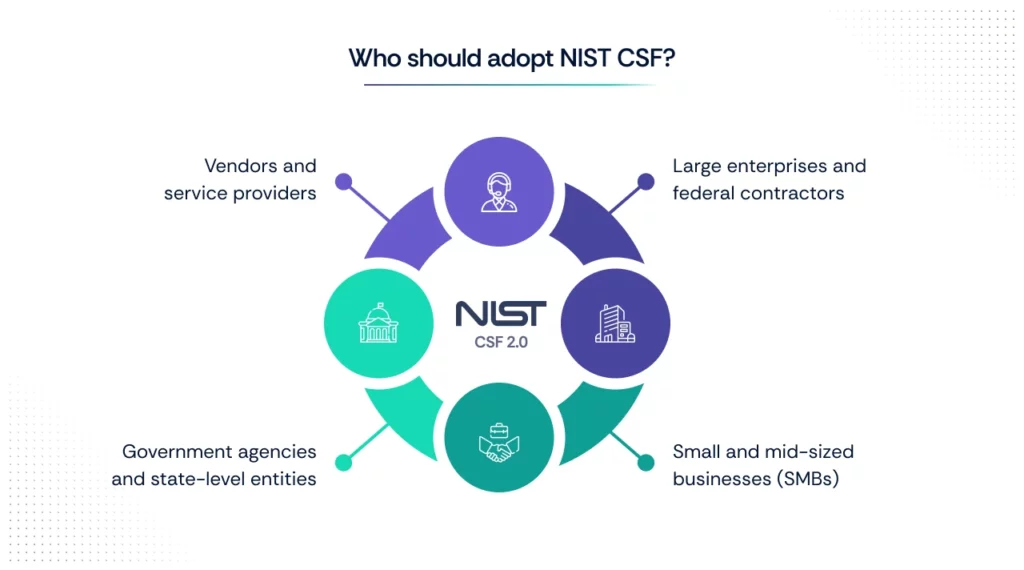
The NIST Cybersecurity Framework (NIST CSF) occupies a unique position in cybersecurity governance. While it is widely recognized as a standard for managing cybersecurity risks, its adoption is not universally mandatory. The requirement to comply with the framework depends largely on the type of organization and its regulatory environment.
Federal Agencies and Contractors
For federal agencies, compliance with NIST CSF is effectively mandatory. Executive Order 13636, issued in 2014, directed federal entities to adopt the framework as part of their cybersecurity risk management programs.
Government contractors handling sensitive information are also required to demonstrate adherence to NIST CSF as part of contractual obligations. In these contexts, the framework provides a standardized approach to safeguard critical systems and ensure continuity of operations.
Private Sector Organizations
In contrast, private sector organizations are not legally required to implement NIST CSF. Adoption remains voluntary, though it is strongly encouraged. Companies in finance, healthcare, manufacturing, and critical infrastructure increasingly use the framework to benchmark cybersecurity practices, reduce risk, and enhance operational resilience.
Voluntary adoption allows these organizations to implement NIST’s best practices, including recommended approaches for password management and risk assessment, without undergoing formal certification.
Strategic Benefits
Even where not mandatory, NIST CSF adoption demonstrates a commitment to robust cybersecurity governance. It provides a common language for technical and business teams, facilitates alignment with other standards such as ISO 27001 or NIST 800-53, and supports proactive risk management.
By integrating the framework, organizations can improve incident response capabilities, protect critical assets, and strengthen stakeholder confidence.
NIST Special Publications and Complementary Frameworks
While the NIST Cybersecurity Framework provides a high-level roadmap for managing cyber risks, several NIST Special Publications and complementary frameworks offer more detailed guidance for organizations seeking robust implementation. These resources are particularly valuable for Governance, Risk, and Compliance (GRC) analysts tasked with operationalizing cybersecurity strategies.
NIST 800-53: Security and Privacy Controls
NIST Special Publication 800-53, titled Security and Privacy Controls for Federal Information Systems and Organizations, provides a comprehensive catalog of controls organized into 20 families. These include Access Control, Audit and Accountability, Risk Assessment, and Incident Response.
Organizations can select and implement controls based on their risk environment, operational needs, and regulatory requirements. NIST 800-53 serves as a practical reference for both federal agencies and private entities seeking to strengthen cybersecurity measures.
NIST Risk Management Framework (RMF)
The NIST RMF, also known as Which NIST framework, focuses on the Risk Management Framework (RMF) for information systems, outlines a six-step process for integrating security, privacy, and risk management into the system development lifecycle. The steps include:
- Prepare – Define scope and context for risk management.
- Categorize – Classify information systems based on potential impact.
- Select – Choose appropriate security and privacy controls.
- Implement – Apply the selected controls effectively.
- Assess – Evaluate control effectiveness.
- Authorize and Monitor – Grant approval for system operation and continuously track security posture.
NIST 800-39 and Privacy Framework
NIST 800-39 focuses on enterprise risk management, providing guidance for managing risk across organizational levels. The framework emphasizes the identification, assessment, and response to risks in a coordinated manner. Complementing this, the NIST Privacy Framework guides organizations in managing privacy risks through structured functions such as Identify-P, Govern-P, Control-P, Communicate-P, and Protect-P.
Complementary Frameworks
Organizations often integrate NIST CSF with other industry standards for comprehensive coverage:
- ISO 27001 – International standard for information security management systems.
- CIS Controls – Prioritized actions to protect systems and data.
- COBIT – High-level framework for IT governance.
- SOC 2 – Audits assessing security, availability, processing integrity, confidentiality, and privacy.
By leveraging these frameworks alongside NIST CSF, organizations can establish layered security measures, address compliance requirements, and enhance risk management capabilities.
READ MORE: The Three Main Pillars of Information Security: Complete 2026 Guide
Implementing NIST CSF in Your Organization
Adopting the NIST Cybersecurity Framework involves more than understanding its components; organizations must integrate its practices into daily operations. Effective implementation ensures that cybersecurity measures are not only compliant but also resilient, scalable, and aligned with business objectives.
Initial Assessment and Gap Analysis
The first step is conducting a comprehensive assessment of the organization’s current cybersecurity posture. This involves inventorying assets, reviewing existing controls, and identifying vulnerabilities. GRC analysts compare current practices against the NIST CSF Core functions, Identify, Protect, Detect, Respond, and Recover, to pinpoint gaps and prioritize remediation efforts.
Policy Development and Technology Selection
Once gaps are identified, organizations should develop policies and procedures that align with NIST best practices. For example, recommended password policies, access management protocols, and incident response plans help establish a secure environment. Selecting appropriate technology is equally important: intrusion detection systems, security monitoring tools, and automated alerts enhance protection and enable rapid response. Tools should be chosen based on organizational size, complexity, and risk profile.
Continuous Monitoring and Improvement
Implementation does not end with policy deployment. Continuous monitoring ensures that controls are effective and threats are detected in real time. Regular audits, employee training, and periodic reviews help maintain compliance and adapt to evolving cyber threats. For instance, healthcare, financial, and manufacturing sectors often conduct scenario-based testing to validate controls and refine incident response strategies.
By following these steps, organizations can create a sustainable, proactive cybersecurity program that leverages NIST CSF while addressing industry-specific risks and operational requirements.
Benefits and Costs of Adopting NIST CSF

Implementing the NIST Cybersecurity Framework provides organizations with a structured approach to managing cyber risks while delivering measurable operational advantages. Understanding both the benefits and associated costs helps decision-makers evaluate its value.
Organizational Advantages
Adopting NIST CSF enhances an organization’s ability to prevent, detect, and respond to cybersecurity threats. By following the framework’s structured approach, organizations can:
- Reduce Risk: Identify vulnerabilities proactively and prioritize mitigation strategies, protecting critical assets and sensitive data.
- Align IT and Business Goals: Create a common language between technical and executive teams, improving strategic decision-making.
- Strengthen Stakeholder Confidence: Demonstrate a commitment to robust cybersecurity practices to customers, partners, and regulators.
- Enhance Supply Chain Security: Encourage vendors and partners to adopt similar cybersecurity standards, creating a more secure ecosystem.
- Promote Resilience: Develop the capability to recover quickly from incidents, ensuring operational continuity.
Cost Considerations
Unlike frameworks that require formal audits, such as SOC 2 or ISO 27001, NIST CSF adoption is flexible and cost-effective. Organizations can invest in implementing controls, monitoring tools, and training programs based on their risk profile and available resources. The framework helps prioritize spending by identifying the most critical vulnerabilities, maximizing the impact of investments.
Even when voluntary, NIST CSF adoption provides long-term value, reducing the likelihood of costly breaches, fines, or reputational damage. For many organizations, the investment in alignment with NIST CSF is outweighed by the benefits of improved cybersecurity and operational resilience.
ALSO: IoT vs Cybersecurity: 2026 Careers, Challenges, and Certifications
Key Takeaways for Organizations
The NIST Cybersecurity Framework (NIST CSF) serves as a comprehensive, flexible roadmap for managing cybersecurity risks across industries. While compliance is mandatory for federal agencies and certain contractors, private sector organizations can adopt the framework voluntarily to strengthen their security posture, improve risk management, and align IT initiatives with business objectives.
Key points include:
- Strategic Value: NIST CSF provides a common language between technical and executive teams, bridging the gap between cybersecurity and business operations.
- Flexibility and Scalability: Organizations can tailor controls and policies to their size, sector, and risk profile, making the framework applicable to a wide range of environments.
- Integration with Other Standards: NIST CSF complements frameworks such as NIST 800-53, NIST RMF, ISO 27001, and CIS Controls, creating layered, robust protection.
- Cost-Effective Implementation: Because certification is optional, organizations can implement controls incrementally, prioritizing high-risk areas without incurring the expense of formal audits.
- Continuous Improvement: Regular assessments, monitoring, and updates ensure the organization adapts to evolving threats, maintaining resilience over time.
Conclusion
Although the NIST Cybersecurity Framework is not universally mandatory, its adoption provides clear benefits for organizations seeking to improve cybersecurity governance and risk management. By implementing its core functions, leveraging complementary frameworks, and following best practices, organizations can reduce vulnerabilities, safeguard critical assets, and build resilience against cyber threats.
Adopting NIST CSF demonstrates proactive leadership in cybersecurity and positions organizations to respond effectively to incidents while supporting regulatory alignment and stakeholder confidence. For organizations ready to enhance their cybersecurity posture, NIST CSF offers a structured, adaptable, and widely respected roadmap.
FAQ
Is NIST 800-53 mandatory?
NIST 800-53, which outlines security and privacy controls for federal information systems, is mandatory for federal agencies and contractors handling government data. Private sector organizations, however, are not legally required to implement these controls. Many private companies adopt NIST 800-53 voluntarily to strengthen their cybersecurity posture, improve risk management, and align with industry best practices.
Who is required to be NIST compliant?
Compliance with NIST standards is required primarily for federal agencies, government contractors, and members of the federal supply chain. These entities must meet NIST requirements to protect sensitive information and critical infrastructure. For private sector organizations, adoption is voluntary but recommended as a benchmark for best practices in cybersecurity governance and risk management.
How much does it cost to get NIST certified?
NIST CSF itself is a voluntary framework and does not have a formal certification process, making it cost-effective to adopt. Organizations can implement the framework internally without paying for audits. Costs are generally associated with implementing controls, monitoring tools, training, and consulting if desired. In contrast, formal certifications like SOC 2 or ISO 27001 can cost tens of thousands of dollars, depending on scope and organization size.
What is the difference between ISO 27001 and NIST Cybersecurity Framework?
ISO 27001 is an international standard for information security management systems (ISMS) that requires formal certification and external audits. NIST CSF, on the other hand, is a voluntary, flexible framework designed primarily for organizations in the U.S. to manage and reduce cybersecurity risks. While ISO 27001 emphasizes compliance and auditable management systems, NIST CSF focuses on guiding organizations through risk-based cybersecurity practices and can be adapted without mandatory certification. Many organizations use the two frameworks together for comprehensive coverage.