
 English
 Arabic
 English
 French
 German
Risk Management Frameworks: A Cybersecurity Professional’s Guide (2026)
Cybersecurity teams and financial institutions face a constant stream of risks that can disrupt operations, compromise sensitive data, or damage reputations. Implementing risk management frameworks gives organizations a structured way to identify, assess, mitigate, and monitor these threats. By following a clear RMF process, teams can act proactively instead of reacting to incidents after they happen.
In simple terms, what is RMF? Risk management frameworks (RMF) are a set of best practices and standards that guide companies in making informed decisions about operational, financial, and IT risks. Effective frameworks help organizations reduce exposure, meet regulatory requirements, and strengthen their cyber risk management strategy.
In this guide, we’ll explore top risk management frameworks, provide risk management framework examples, and break down the RMF steps cybersecurity professionals use to protect systems and data. You’ll also see how frameworks like ISO 31000, NIST CSF, and emerging NIST AI risk management frameworks fit into a modern, proactive approach to risk.
RELATED: Vendor Risk Management (VRM) in 2025
What Are Risk Management Frameworks?
Risk management frameworks provide organizations with a structured way to handle uncertainties that can affect operations, finances, and IT systems. A business risk management framework or enterprise risk framework standardizes how teams identify potential threats, measure their impact, and take action to reduce harm.
The RMF process follows a clear cycle: identify risks, assess their probability and severity, implement mitigation strategies, and monitor results continuously. Companies use this approach to ensure they protect critical assets, comply with regulations, and maintain operational resilience.
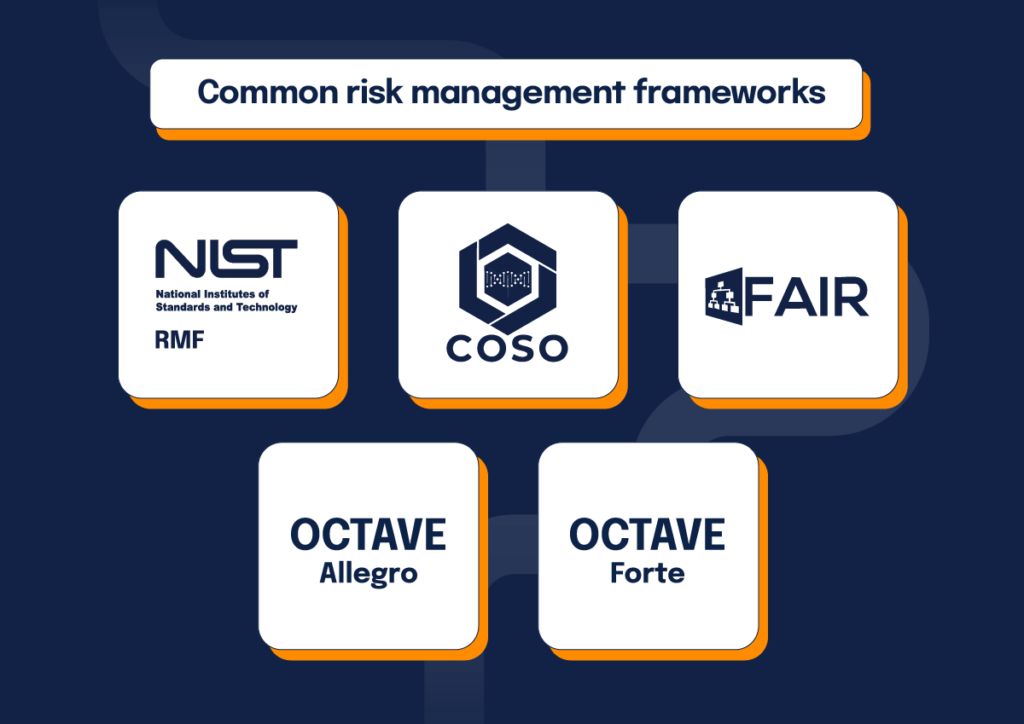
Examples of risk management framework examples include ISO 31000, NIST CSF, COSO ERM, and the FAIR framework. Each framework serves a specific purpose: some focus on IT and cybersecurity, others on enterprise-wide operational or financial risk. Choosing the right framework depends on your industry, regulatory environment, and organizational goals.
Core RMF Components: 4 Components of Risk Management
Every risk management framework relies on a clear structure to protect organizations from threats. Cybersecurity teams and financial institutions can follow the 4 components of risk management to ensure they manage risk effectively.
- Risk Identification
Teams actively catalog all potential risks, including operational, financial, IT, and regulatory threats. A strong enterprise risk assessment framework ensures no risk goes unnoticed. Cyber teams should classify risks by likelihood and impact to prioritize action.
- Risk Assessment
Once identified, risks require precise measurement. Analysts estimate the probability of occurrence and potential consequences. Tools such as scenario analysis, stress testing, and quantitative modeling help translate risks into actionable insights. This step directly informs a cyber risk management strategy.
- Risk Mitigation
Teams choose how to respond: reduce, transfer, accept, or avoid risk. For IT risks, this might mean patching vulnerabilities, implementing firewalls, or applying access controls. In financial institutions, mitigation could include hedging, insurance, or policy changes. Mitigation keeps threats under control and aligns with RMF framework steps.
- Risk Monitoring
Continuous tracking and auditing ensure mitigation strategies remain effective. Dashboards, reporting tools, and regular reviews allow teams to adjust quickly as threats evolve. Monitoring completes the rmf process, keeping the organization resilient and compliant.
Applying the 4 components of risk management creates a repeatable cycle that strengthens both IT and operational defenses, making your risk management program proactive rather than reactive.
READ MORE: What is the Certification Authority? 2026 Update
Top Risk Management Frameworks for Cybersecurity
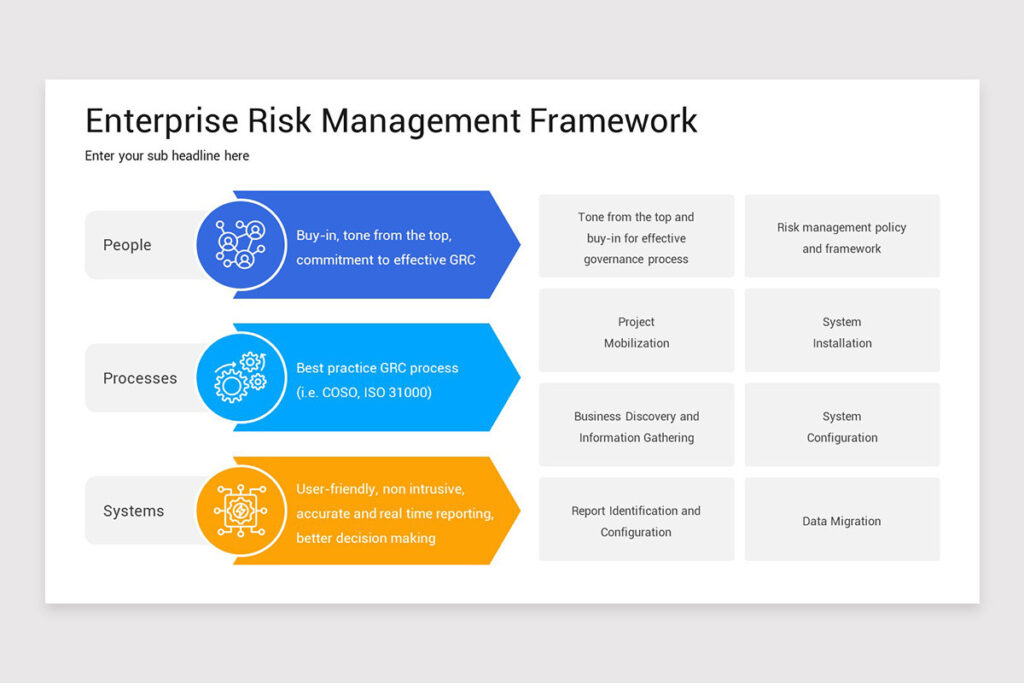
Choosing the right risk management frameworks ensures your organization addresses threats effectively and builds long-term resilience. Below, we highlight the top risk management frameworks every cybersecurity professional should know.
1. ISO 31000 – Enterprise-Wide Risk Management
ISO 31000 provides broad guidance for implementing an enterprise risk framework across all organizational levels. It integrates risk management into strategy, governance, and operations. Cyber teams and financial institutions adopt ISO 31000 to standardize procedures for risk identification, assessment, mitigation, and monitoring.
Tip: Use ISO 31000 to align IT risk, operational risk, and business objectives.
2. NIST Risk Management Frameworks (Including AI Updates)
NIST CSF and the NIST AI Risk Management Framework guide organizations on managing cybersecurity and AI-related risks. NIST frameworks focus on:
- Protecting IT assets
- Aligning cyber risk with business goals
- Adapting to emerging threats, including generative AI
Recent updates, including NIST AI Risk Management Framework update November 2025 and December 2025, provide guidance for AI risk evaluation, trustworthiness, and mitigation. Cybersecurity teams can integrate these frameworks into their cyber risk management strategy to handle evolving digital threats.
3. COSO ERM – Linking Risk to Strategy
COSO Enterprise Risk Management focuses on strategy and performance. Its core components include:
- Governance and culture
- Strategy and objective setting
- Performance
- Review and revision
- Information, communication, and reporting
COSO ERM works well for financial institutions that need a structured risk management program tied to strategic goals. Teams apply COSO principles to coordinate across departments, monitor operational risks, and support compliance.
4. FAIR Framework – Quantifying Risk
The Factor Analysis of Information Risk (FAIR) framework allows organizations to measure operational and cybersecurity risks in financial terms. Unlike qualitative approaches, FAIR translates exposure into potential loss amounts, helping teams prioritize mitigation efforts effectively.
Example: A bank may use FAIR to calculate the financial impact of a ransomware attack before deciding on insurance coverage or security controls.
5. ISO/IEC 42001 – AI Risk Management
For organizations adopting AI, ISO/IEC 42001 sets requirements for an AI Management System (AIMS). It helps teams:
- Assess AI-related risks
- Implement mitigation measures
- Monitor AI system outcomes and compliance
This framework complements cyber risk management strategies by addressing the unique operational and ethical risks of AI systems.
Framework Comparison Table (Optional for Visual Learners)
| Framework | Focus | Best For | Key Benefit |
| ISO 31000 | Enterprise-wide risk | All sectors | Integrates risk into governance & strategy |
| NIST CSF & AI RMF | Cybersecurity & AI | IT & AI systems | Aligns cyber risk with business objectives |
| COSO ERM | Strategic & operational risk | Financial institutions | Links risk to performance & compliance |
| FAIR | Quantitative financial risk | Enterprise & finance | Measures risk in monetary terms |
| ISO/IEC 42001 | AI risk & governance | AI product teams | Standardizes AI risk management processes |
SEE MORE: User Datagram Protocol: 2026 Complete Guide
RMF in Practice: Cybersecurity Coaching Perspective
Implementing risk management frameworks in real-world cybersecurity programs transforms theory into action. Cybersecurity teams, IT departments, and financial institutions can follow proven strategies to manage threats and protect critical assets.
1. Financial Institutions
Banks and investment firms rely on a risk management framework for financial institutions to safeguard capital and comply with regulations. Teams actively use frameworks like ISO 31000, COSO ERM, and FAIR to:
- Identify operational, IT, and regulatory risks
- Quantify potential financial losses
- Prioritize mitigation based on business impact
Example: A bank can use the FAIR framework to calculate potential losses from a data breach, then decide whether to buy cyber insurance or strengthen controls.
2. IT Risk Management
IT teams implement IT risk management frameworks to protect infrastructure and digital assets. Frameworks like NIST CSF guide teams to identify vulnerabilities, enforce access controls, and monitor system performance. Regular RMF process reviews ensure updates keep pace with emerging threats, including AI-powered attacks.
3. Operational Risk Management
Organizations integrate operational risk management frameworks to handle everyday business risks. Teams track supply chain, vendor, and process risks while aligning mitigation strategies with strategic goals. Continuous monitoring strengthens the risk management program and supports compliance reporting.
4. Coaching Teams to Implement RMFs
Cybersecurity coaches help teams apply RMF framework steps systematically:
- Assign ownership for each risk category
- Use measurable criteria for assessment
- Apply mitigation actions proactively
- Track and report results continuously
Active participation ensures the enterprise risk framework remains dynamic and adaptable. Coaching teams also teach cyber risk management strategy, so risk becomes part of decision-making rather than an afterthought.
Implementing Your RMF: Step-by-Step
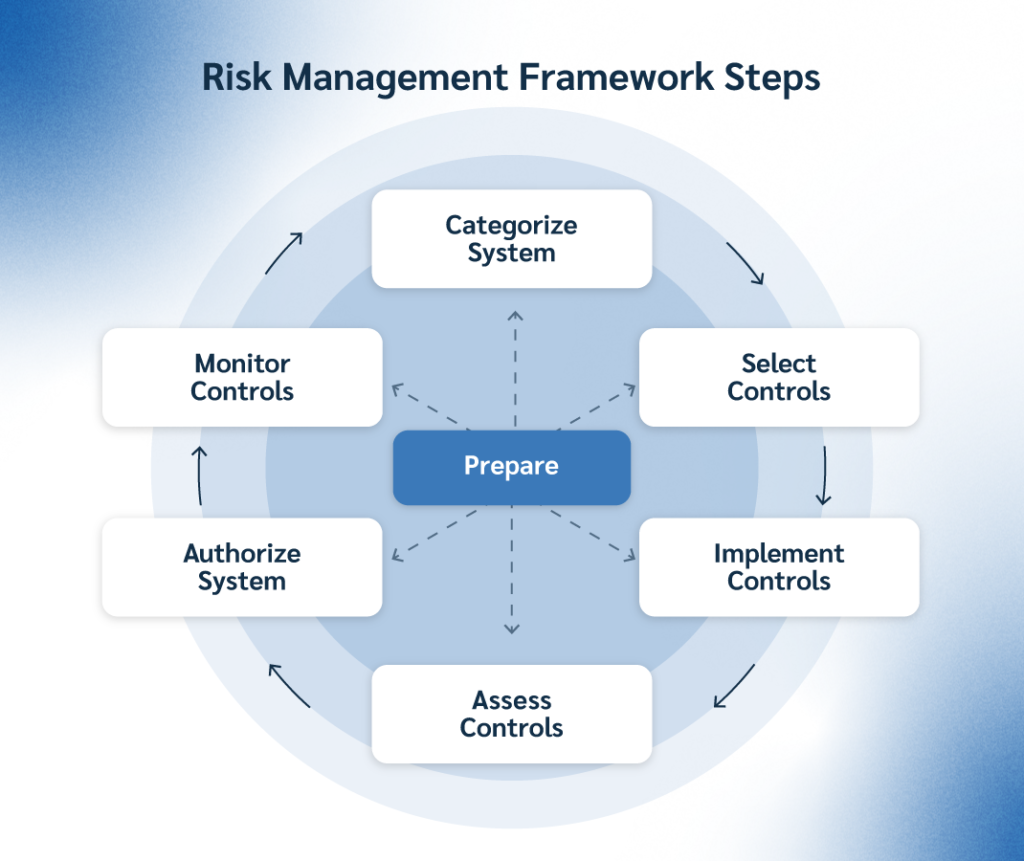
Implementing a risk management framework turns strategy into action. Cybersecurity teams, IT departments, and financial institutions follow these RMF framework steps to protect assets and ensure compliance.
- Identify Risks
Catalog operational, IT, financial, and regulatory risks. Use enterprise risk assessment frameworks to capture every potential threat.
- Assess Impact and Probability
Measure each risk’s likelihood and potential damage. Apply scenario analysis or stress testing to inform your cyber risk management strategy.
- Select Mitigation Measures
Decide whether to reduce, transfer, accept, or avoid each risk. IT teams may patch vulnerabilities; financial teams may hedge or purchase insurance.
- Implement Controls
Apply policies, procedures, and tools that actively reduce exposure. Ensure alignment with IT risk management frameworks and operational priorities.
- Monitor and Review
Continuously track risks, audit control effectiveness, and update the risk management program as the threat landscape evolves. Repeat the rmf process regularly to stay proactive.
Tip: Active monitoring and regular reviews ensure your enterprise risk framework adapts to new threats and emerging technologies, including AI systems.
MORE: Secure Shell Protocol: Everything You Need to Know in 2026
Key Takeaways for Cybersecurity Professionals
Implementing risk management frameworks strengthens your organization, reduces exposure, and supports strategic decisions. Cybersecurity teams and financial institutions that follow structured RMF steps gain clarity on threats and act proactively.
- Integrate RMFs into daily operations – Make risk assessment and mitigation part of routine processes.
- Prioritize emerging threats – Include AI-related risks using the NIST AI Risk Management Framework and updates from November and December 2025.
- Measure and monitor – Continuously track IT, operational, and financial risks to maintain an effective risk management program.
- Choose the right framework – Align ISO 31000, NIST CSF, COSO ERM, or FAIR to your organization’s goals and sector needs.
- Apply coaching principles – Train teams to follow the RMF process, reinforce accountability, and make risk-informed decisions daily.
A well-implemented enterprise risk framework not only protects assets but also empowers teams to act confidently, integrate risk into strategy, and build resilient systems.
Level up your cybersecurity career in 90 days. Join ExcelMindCyber’s immersive program to master GRC, work on real-world cybersecurity projects, and land high-paying remote roles, even if you’re starting from scratch.
Start building your future today.
FAQ
What is ISO 27001 vs NIST vs SOC 2?
ISO 27001 is an international standard for information security management systems (ISMS) that helps organizations systematically protect sensitive data. NIST frameworks provide detailed guidelines for managing cybersecurity risk in IT systems, including the NIST CSF and AI-focused RMF updates.
SOC 2 is an auditing standard that assesses an organization’s controls for security, availability, processing integrity, confidentiality, and privacy. Together, they address compliance, risk management, and security assurance from complementary perspectives.
Is ITIL a risk management framework?
No, ITIL is not a risk management framework. ITIL (Information Technology Infrastructure Library) is a set of best practices for IT service management, focusing on delivering IT services efficiently. While ITIL includes guidance on managing incidents and service risks, it does not provide a structured risk management framework like ISO 31000 or NIST RMF.
What are the 4 pillars of risk management?
The 4 pillars of risk management provide a foundation for any enterprise risk framework:
Risk Identification – Recognize potential threats.
Risk Assessment – Measure likelihood and impact.
Risk Mitigation – Apply strategies to reduce or control risk.
Risk Monitoring and Reporting – Track risk continuously and update controls as needed.
What is L1, L2, and L3 in risk management?
L1, L2, and L3 refer to risk ownership levels in a layered governance model:
L1 (First Line of Defense) – Operational teams actively manage and mitigate risk during daily processes.
L2 (Second Line of Defense) – Risk management and compliance functions provide oversight, guidance, and policy enforcement.
L3 (Third Line of Defense) – Internal audit evaluates the effectiveness of risk management and governance independently.